At the dawn of the Fourth Industrial Revolution, the term "automaker" has become far too narrow to describe the Japanese giant Toyota. Under the visionary leadership of Akio Toyoda and the strategic execution of its subsidiary, Woven by Toyota, the company has embarked on its most ambitious project yet: the creation of Woven City. This 175-acre "living laboratory" at the base of Mount Fuji is a place where Artificial Intelligence (AI) is not just a tool, but the connective tissue of every human activity.
The City as an Operating System
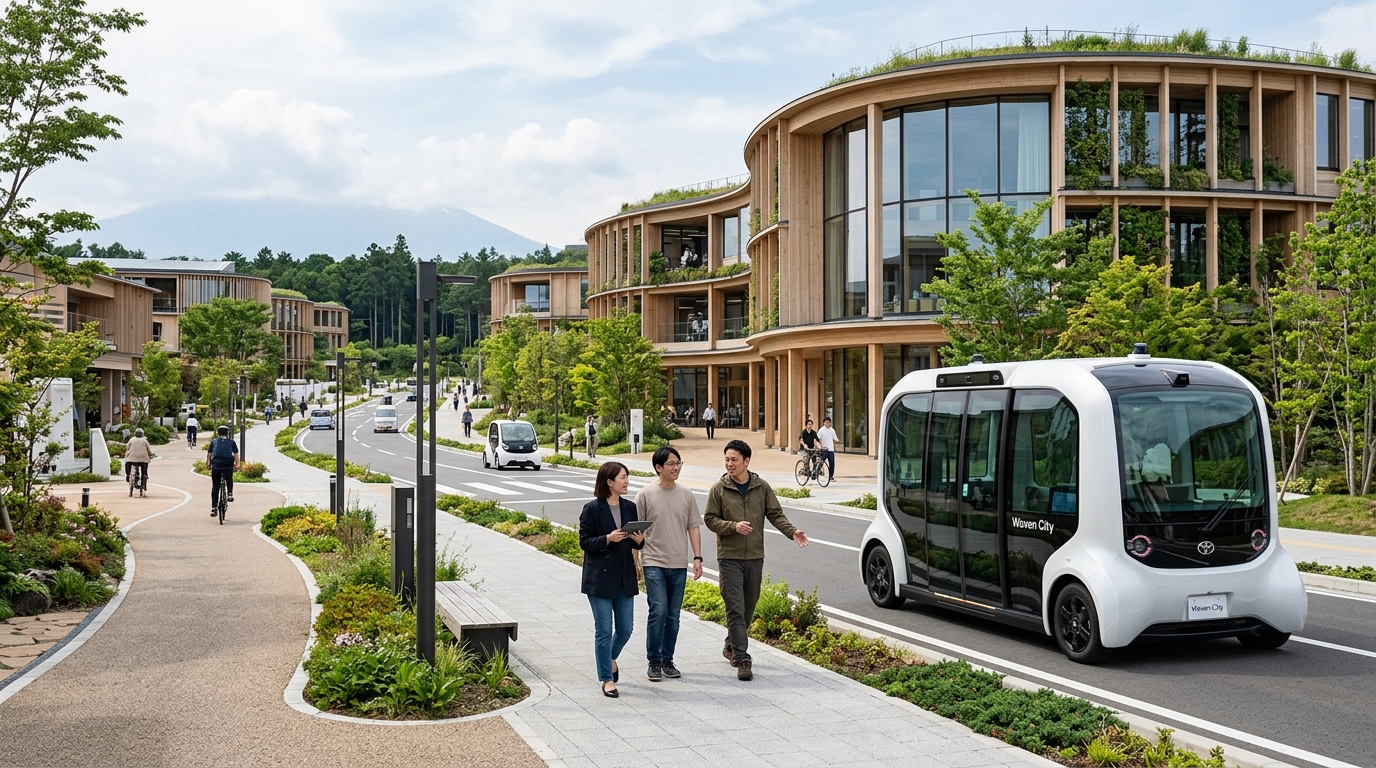
Woven City was not designed to be a traditional "smart city" with a few sensors scattered on the streets. Instead, it functions as a fully integrated ecosystem. The urban plan features three types of streets woven together (hence the name): one for fast autonomous vehicles, one for micro-mobility (bikes, scooters) and pedestrians, and one dedicated solely to pedestrians in a park-like environment. AI manages traffic flow in real-time, virtually eliminating accidents and congestion.
Beneath the surface, a network of autonomous delivery vehicles distributes goods directly to homes, while the city's energy is powered entirely by hydrogen fuel cells. AI acts here as an invisible energy manager, forecasting demand and optimizing hydrogen production, making the city a global benchmark for sustainability.
From Design Studio to Production: AI at Toyota's Core
However, AI's influence extends far beyond the borders of Woven City. Toyota is utilizing Generative AI to revolutionize how vehicles are designed. Through advanced algorithms, engineers can input parameters such as aerodynamic drag and weight, and the AI generates thousands of optimized designs in seconds. This process dramatically reduces the development time for new models and allows for the creation of shapes that human intuition might never have conceived.
- Digital Twins: Toyota creates digital replicas of entire factories, allowing AI to simulate production scenarios and identify bottlenecks or malfunctions before they occur in the physical world.
- Autonomous Driving (Teammate): Toyota's "Teammate" system does not aim to replace the driver but to partner with them, using AI to predict hazards that a human might miss.
- Assistive Robotics: With Japan facing an aging population crisis, Toyota is developing AI-driven robots for home care, integrating technology directly into social welfare.
The Philosophy of "Human-Centric" AI
Unlike Silicon Valley, which often promotes technology as a means of disruption, Toyota follows the Japanese approach of "Monozukuri" (the art of making things) combined with the national vision of "Society 5.0." AI is not treated as a cold algorithm but as a means to achieve "Happiness for All." In Woven City, residents—including Toyota employees, retirees, and researchers—actively participate in shaping the algorithms, ensuring that technology serves human needs rather than the other way around.
"Building a complete city from the ground up, even on a small scale like this, is a unique opportunity to develop future technologies, including a digital operating system for the city's infrastructure," Akio Toyoda famously stated.
The challenge remains immense. Managing personal data in a city where every movement is tracked by AI sensors requires a new ethical framework. Toyota promises total transparency, but the balance between security, convenience, and privacy will be the ultimate test of whether Woven City becomes the blueprint for future urban living or a high-tech gilded cage.