When the first Toy Story debuted in 1995, the technological 'threat' to Woody, the traditional cowboy, was Buzz Lightyear—a space ranger with lasers and pop-out wings that represented the pinnacle of plastic toy engineering. Today, thirty years later, Toy Story 5 is preparing to face a far more formidable adversary: the screen. Pixar, with its uncanny ability to capture the cultural zeitgeist, is turning its lens toward the existential crisis of physical objects in a world dominated by software.
The Screen as the Ultimate Antagonist
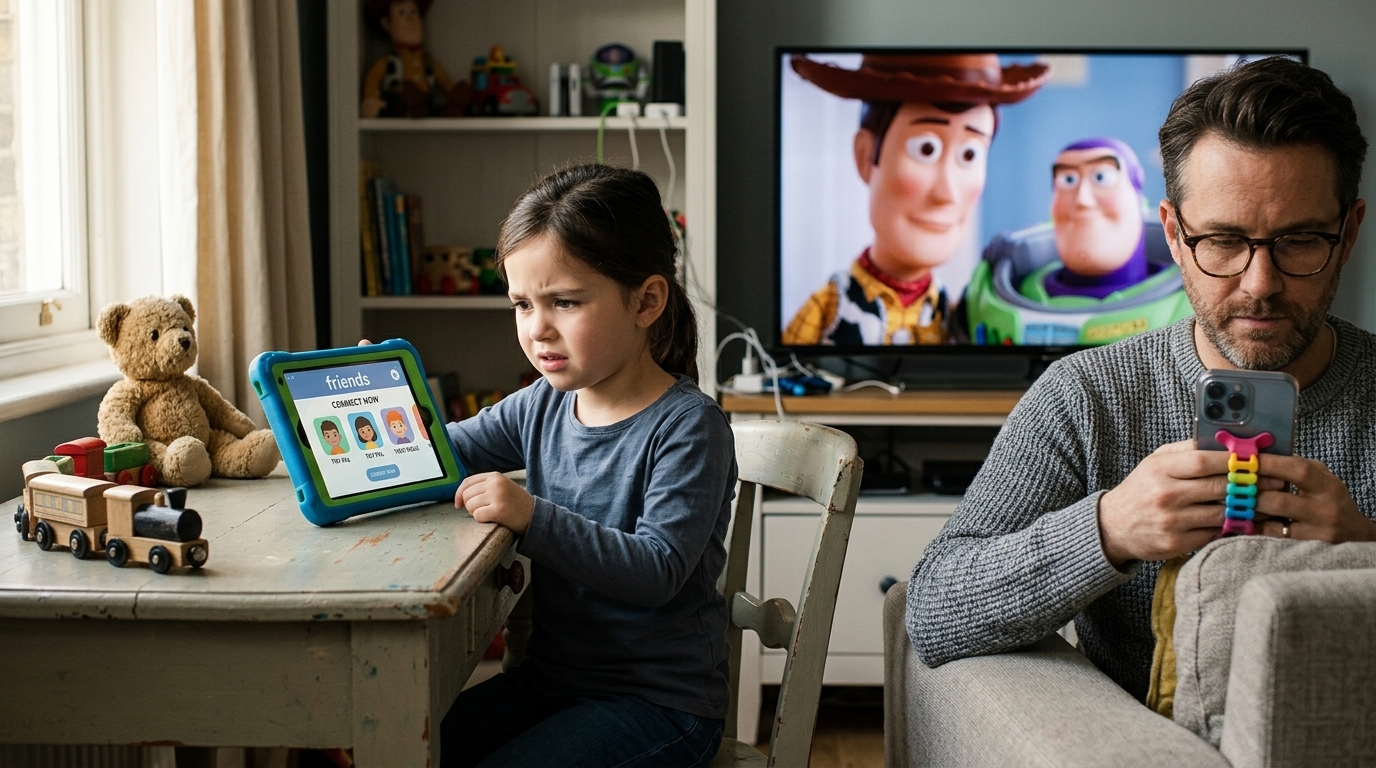
At Disney's recent D23 presentation, it was revealed that the central conflict of Toy Story 5 will involve toys trying to win back children's attention from electronic devices. This is no longer a competition between two playthings, but a war between physical reality and digital distraction. Concept art shows Bonnie, the child who inherited Andy's toys, huddled under a blanket, illuminated by the cold blue glow of a tablet, while Woody and the gang look on, sidelined and somber.
This image isn't just a narrative choice; it's a profound social observation. Technology has fundamentally altered how children—and adults—interact with the physical world. The 'magic' of a toy that requires imagination to come alive pales in comparison to the instant gratification offered by a YouTube Kids algorithm or an iPad game. Pixar is asking a crucial question: what happens to childhood when 'play' ceases to be an active process of creation and becomes a passive process of consumption?
From Hardware to Software: The Obsolescence of the Material
The Toy Story franchise has always been a saga about obsolescence. In the first film, it was the obsolescence of the old by the new. In the second, it was obsolescence through collectability versus utility. In the third, the inevitable obsolescence brought by growing up. Now, the threat is different: it is the obsolescence of the material object itself. In a world where software can simulate anything, why does anyone need a piece of plastic?
This shift reflects our broader technological trajectory. We have moved from an era of specs and gadgets we could touch, to an era of specs hidden behind a glass surface. Toy Story 5 seems to argue that something precious is lost in this transition. The tactility, the wear and tear, and the physical presence of a toy create a bond that digital experiences, no matter how immersive, struggle to replicate. Pixar reminds us that technology, in its purest form, should be a tool for the imagination, not a replacement for it.
The Cultural Significance of 'Resistance'
Pixar's choice to tackle this subject is bold, considering that Disney itself relies heavily on digital platforms to distribute its content. There is a certain irony in watching a film about the dangers of the screen... on a screen. However, this critique is necessary. Technology is no longer an accessory to our lives; it is the environment in which we live.
Toy Story 5 is expected to explore how toys can survive in this new ecosystem. Perhaps the solution is not the complete rejection of technology, but the finding of a balance. As noted in the Verge's 'Installer' column, technology must return to the service of human connection. If Woody and Buzz manage to defeat the tablet, it won't be because they are more technologically advanced, but because they offer something an algorithm cannot: the sense of being the hero of your own unique story, without the need for likes or views.
Conclusion
Pixar has the 'right take' because it doesn't demonize technology; rather, it highlights the cost of the convenience it provides. Toy Story 5 promises to be a mirror of our own dependency, reminding us that despite the digital revolution, our need for tangible, physical connection remains more relevant than ever. At the end of the day, perhaps the greatest innovation is not the next version of Android or the next VR headset, but the ability to put down the device and simply play.