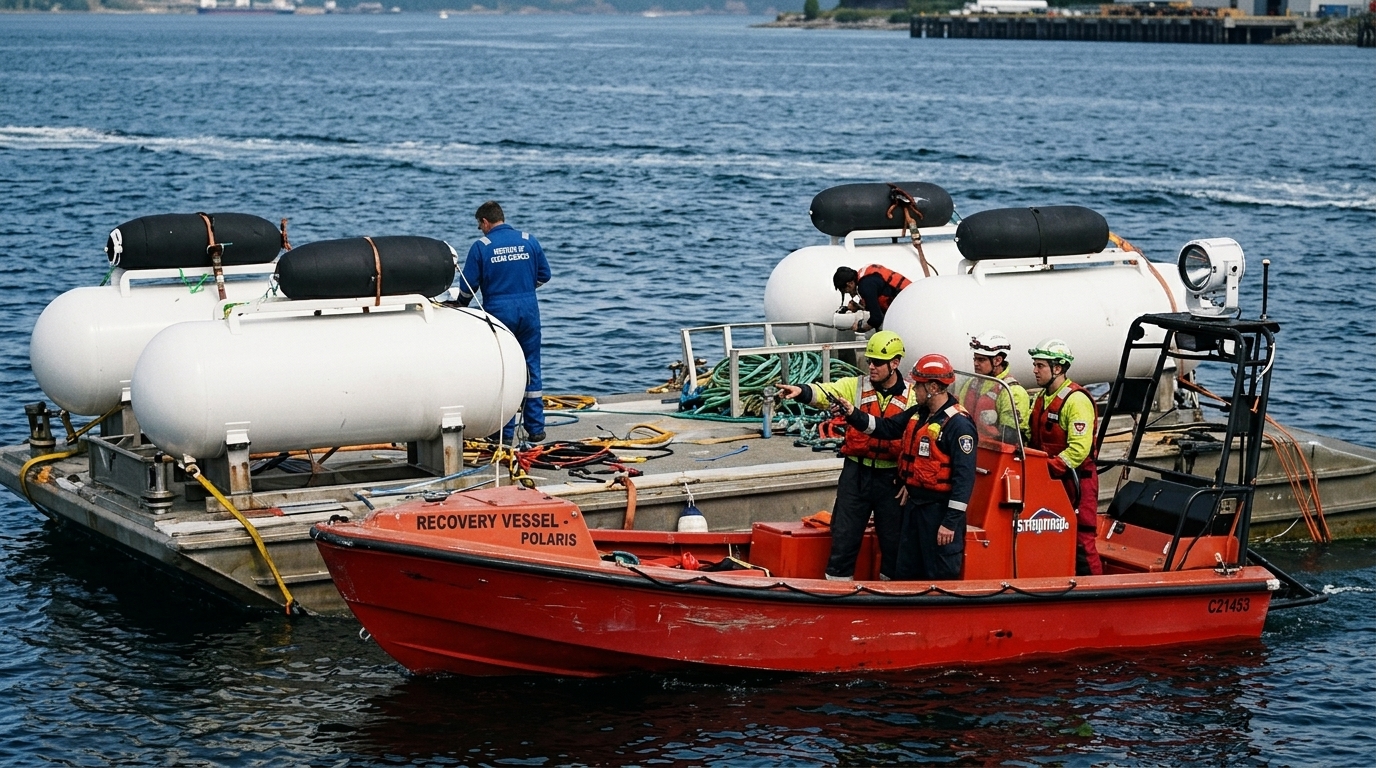
Three years after the catastrophic implosion of the Titan submersible in the North Atlantic, the dust of legal battles and technical post-mortems is beginning to settle, revealing a grim reality: the disaster was not merely a failure of engineering, but a systemic failure of regulatory oversight. A recent, comprehensive report, extensively analyzed by Wired, sheds new light on Canada’s “missed opportunities” to inspect OceanGate’s vessel before its fatal June 2023 dive.
The Titan case remains one of the most instructive examples of the collision between “disruptive innovation” and public safety. While Stockton Rush, the founder of OceanGate, framed his venture as an attempt to democratize ocean exploration, the reality behind the closed doors of Canadian maritime authorities was a story of bureaucratic confusion, lack of communication, and legal loopholes that allowed an uncertified vessel to carry passengers to depths that defy reason.
The Regulatory Void and OceanGate’s Strategy
OceanGate did not choose its base of operations by accident. By using the port of St. John’s in Newfoundland, Canada, the company managed to navigate a “gray zone” of international maritime law. The Titan was not registered with any nation (a flag of convenience strategy) and the dives took place in international waters, above the wreck of the Titanic. This meant that, technically, it did not fall directly under the jurisdiction of the US or Canada for the dives themselves.
However, the new report reveals that Canada had multiple opportunities to intervene. The support ship, Polar Prince, which carried the Titan to the dive site, was Canadian-flagged. This gave Transport Canada (the Canadian Ministry of Transport) both the right and the obligation to ensure that the ship’s cargo—in this case, the submersible—did not pose a risk to the crew or the environment. Inspectors had visited the ship several times, but their checks were limited to the support vessel’s paperwork, conspicuously ignoring the experimental craft strapped to its deck.
Failure of Inter-Agency Communication
One of the most shocking elements of the report is the lack of coordination between Transport Canada and the Transportation Safety Board (TSB). While internal reports existed expressing concerns about the structural integrity of the Titan’s carbon-fiber hull, this information was never “translated” into a formal detention or inspection order. Authorities appeared to be trapped in a formalistic interpretation of regulations, believing that since the Titan was not a “commercial vessel” in the traditional sense, they lacked the authority to inspect it.
This passivity stands in stark contrast to the warnings sent by the subsea technology community as early as 2018. The famous letter from the Marine Technology Society to Stockton Rush warned that OceanGate’s “experimental” approach could lead to catastrophic outcomes. Canada, as the host nation for these expeditions, had the moral—and as the report argues, the legal—leverage to demand third-party certification (classing), something Rush stubbornly refused, claiming that certification “stifles innovation.”
Technical Hubris and Its Consequences
The report also delves into the technical side of the failure. The use of carbon fiber for a vessel intended for repeated dives to 4,000 meters was a choice most engineers considered suicidal. Carbon fiber is excellent in tensile strength but unpredictable under extreme compression, especially after multiple stress cycles. The absence of non-destructive testing (NDT) by Canadian authorities, which could have been mandated before the vessel sailed from St. John’s, deprived the crew of a final line of defense.
Today, in 2026, the extreme tourism industry stands at a crossroads. The report’s recommendations include mandatory certification for all submersibles carrying passengers, regardless of whether they are deemed “experimental,” and a tightening of inspections at ports of departure. Canada has already begun revising its legislative framework, but for the five individuals who lost their lives, this awakening came three years too late.
Conclusion: The Need for a New Ethic of Exploration
The Titan tragedy was not an “accident” in the sense of being unforeseeable. It was a failure of the system to protect citizens from their own ignorance—or the hubris of the organizers. The Canadian case highlights that technological progress cannot operate in a legal vacuum. Exploring the far reaches of our planet is a noble pursuit, but when it is turned into a commercial product without safeguards, the price is paid in human lives. This report serves as a painful memorial and a stern warning for the future: science demands respect, and regulations exist because the laws of physics are non-negotiable.