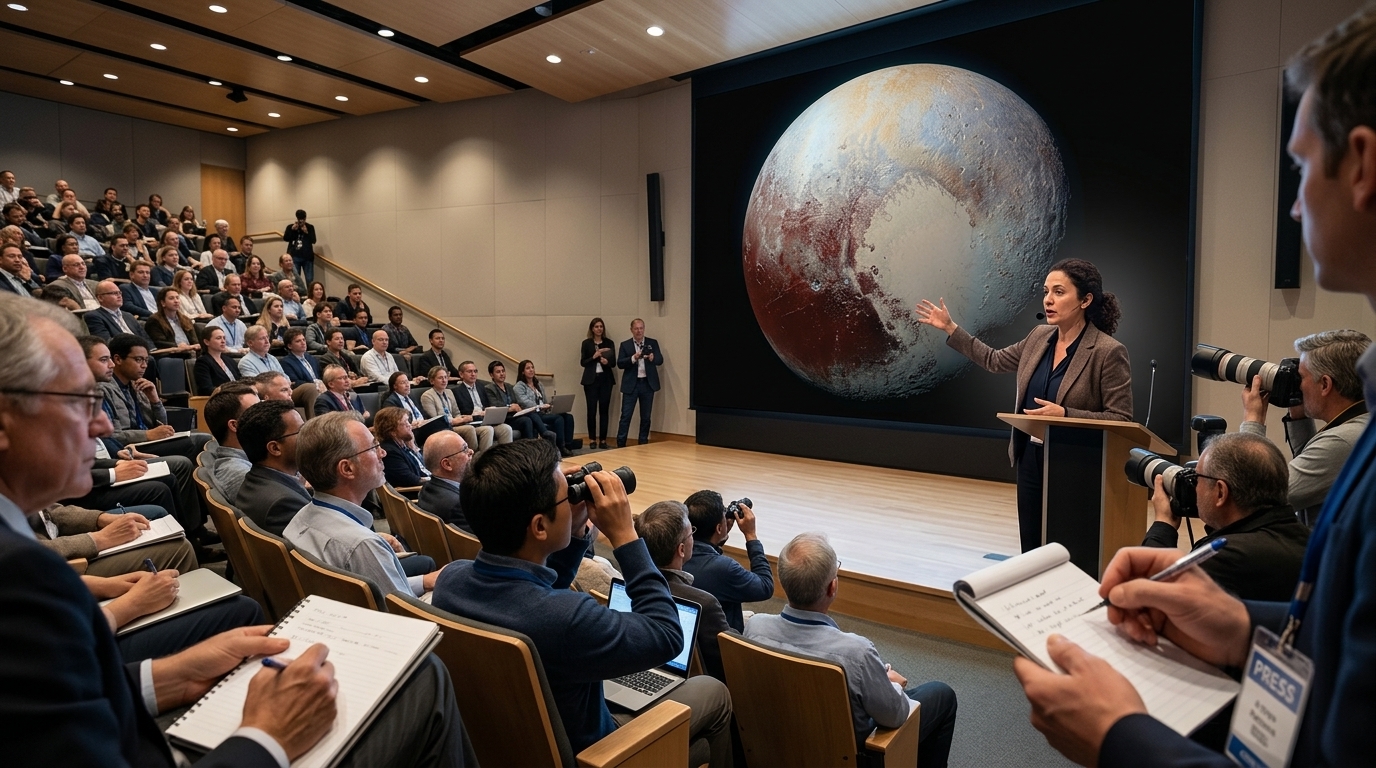
It was August 2006 when the International Astronomical Union (IAU), meeting in Prague, made a decision that would forever change school textbooks and our perception of the solar system. In a vote that sparked a firestorm of controversy, Pluto, the mysterious world on the fringes of our system, lost its title as the ninth planet and was demoted to the category of "dwarf planet." Today, in 2026, this debate returns to the forefront with renewed intensity, fueled by new scientific data and the intervention of figures like Jared Isaacman, the billionaire commander of the Polaris program who works closely with NASA and SpaceX.
The Chronicle of an "Execution"
The 2006 decision was not based on a lack of interest in Pluto, but on the need for a rigorous scientific definition of what constitutes a planet. The IAU set three criteria: the body must orbit the Sun, have sufficient mass to assume a nearly round shape (hydrostatic equilibrium), and have "cleared the neighborhood" around its orbit. Pluto failed the third criterion, as it shares its orbit with a multitude of other icy bodies in the Kuiper Belt.
However, many planetary scientists, led by Alan Stern, the principal investigator of NASA's New Horizons mission, argue that this definition is fundamentally flawed. "If we applied the 'clearing the neighborhood' criterion to Earth, Mars, or Jupiter, none of them would be planets, as they all have asteroids in their orbits," critics argue. The dispute is not merely semantic; it concerns how we categorize our knowledge of the universe.
The New Horizons Revolution
Our image of Pluto changed radically in 2015 when the New Horizons spacecraft passed within a whisker of the icy world. Instead of a dead, frozen ball, scientists beheld a planet of stunning geological complexity: mountains of water ice thousands of meters high, vast plains of nitrogen ice (such as the famous Sputnik Planitia), a blue atmosphere, and evidence of a subsurface ocean of liquid water.
These findings strengthened the argument for the "Geophysical Planet Definition." According to this view, a planet should be considered any celestial body that is large enough to be spherical but not so large as to trigger nuclear fusion (a star), regardless of its orbit. In this light, Pluto is undeniably a planet—just as the Moon or Titan would be. The complexity of its surface processes rival those of Earth and Mars, making the "dwarf" label feel like a dismissal of its scientific importance.
The Political and Cultural Dimension
Jared Isaacman's recent stance in favor of restoring Pluto's status is no coincidence. It reflects a growing frustration within the NASA community regarding how astronomical bureaucracy imposed a definition that often confuses the public and downplays the significance of exploring the outer reaches of our solar system. "Pluto is a planet in the hearts of the people, but also in its physical reality," proponents of the movement state.
This effort also has an educational dimension. The removal of Pluto from the list of planets led to a decrease in public interest in bodies beyond Neptune, despite the fact that this region holds the "key" to understanding the formation of the solar system. Restoring Pluto could serve as the catalyst for new, ambitious missions to the Kuiper Belt, funded by both government agencies and the burgeoning private space industry. Isaacman's involvement signals a shift where private mission commanders are now influencing scientific taxonomies once reserved for academic elites.
Conclusion
The battle for Pluto is, in reality, a battle for the nature of science itself. Is science a static set of rules established in boardrooms, or a living process that adapts to new discoveries? As 2026 progresses, pressure on the IAU to reconsider the 2006 definition is mounting. Whether officially named a planet or remaining a "dwarf," Pluto has already proven that the value of a world is not judged by its label, but by the secrets it is ready to reveal to us. The ninth planet may have been gone from the maps, but it never left the scientific consciousness.