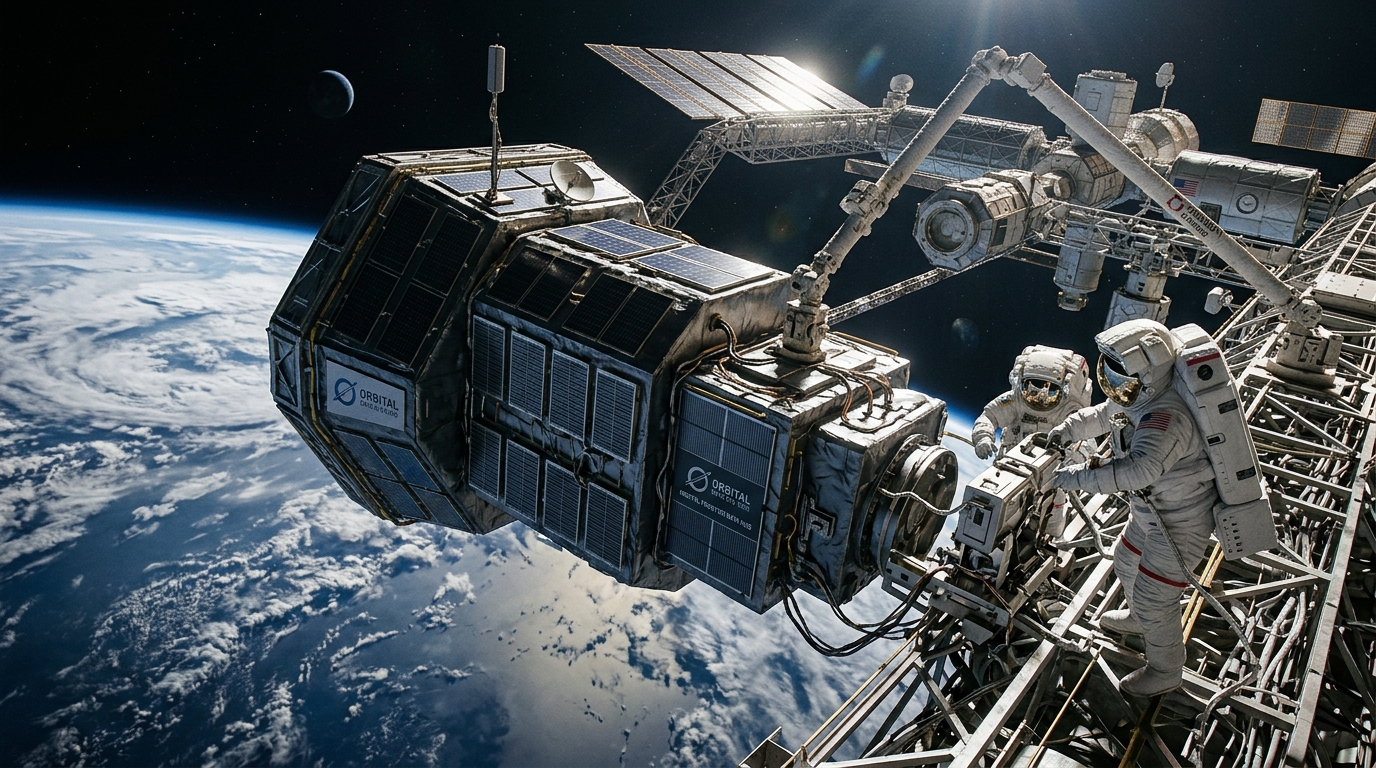
Humanity stands on the precipice of a new industrial revolution, one that is not taking place on terra firma, but hundreds of kilometers above our heads. The recent SpaceX Initial Public Offering (IPO), poised to reshape the global economy, has catapulted a once-fanciful concept into the mainstream: space-based data centers. As demand for Artificial Intelligence (AI) power surges and Earth struggles to meet the energy and cooling requirements of terrestrial infrastructure, the vacuum of space is emerging as a compelling alternative.
The Physics of Orbital Computing
Why launch servers into orbit? The rationale rests on three pillars: energy, cooling, and real estate. On Earth, data centers consume vast amounts of electricity, much of it dedicated to cooling the high-performance chips that drive modern AI. In space, solar energy is abundant, intense, and uninterrupted by atmospheric interference or weather cycles. While the vacuum of space acts as a perfect insulator—making heat dissipation a complex engineering challenge—advancements in massive radiator technology and liquid-to-gas cooling loops are proving more efficient than the water-hungry systems used in terrestrial facilities.
Furthermore, the rise of "Space Edge Computing" has become a necessity. With thousands of satellites orbiting the planet collecting high-resolution imagery and climate data, the latency involved in beaming raw data back to Earth for processing is a significant bottleneck. Orbital data centers will allow for real-time processing in situ, transmitting only the actionable insights back to the ground, thereby optimizing bandwidth and response times for critical applications like wildfire monitoring or military intelligence.
The SpaceX Catalyst and the Starship Effect
The primary driver of this shift is the plummeting cost of access to space. SpaceX’s Starship, now in regular operation, has reduced the price per kilogram to a point where launching heavy server racks is no longer cost-prohibitive. The market no longer views space as an expensive laboratory but as a logical extension of the terrestrial supply chain. Following the company's landmark IPO, a surge of capital is flowing into startups like Lonestar and LEOcloud, which are partnering with established cloud giants like Microsoft Azure and AWS to establish the first data nodes on the Moon and in Low Earth Orbit (LEO).
Legal Gray Zones and Data Sovereignty
One of the most intriguing—and controversial—aspects of this orbital migration is geopolitical. Where does data reside when it is not on any nation's soil? As terrestrial governments tighten regulations on data privacy, encryption, and state access, space could become the ultimate "data haven." Without comprehensive international treaties governing extra-planetary digital sovereignty, corporations may seek the regulatory freedom of orbit to bypass national jurisdictions. However, this raises profound cybersecurity concerns; a server in space is physically inaccessible for repair and uniquely vulnerable to both state-sponsored electronic warfare and the relentless bombardment of cosmic rays.
Challenges: Radiation and the Debris Crisis
Despite the prevailing optimism, the hurdles are formidable. Cosmic radiation can cause "bit flips"—random changes in data bits—that can corrupt memory and crash systems. Hardening electronics against this environment requires heavy shielding, which adds to launch costs. Moreover, the growing threat of space debris, often referred to as the Kessler Syndrome, poses an existential risk to orbital infrastructure. A single collision with a stray fragment could destroy billions of dollars in hardware and trigger a chain reaction that could render certain orbits unusable for decades. The long-term viability of space-based computing depends entirely on our ability to manage orbital traffic responsibly.
Conclusion
The year 2026 may be remembered as the moment cloud computing literally reached the clouds and beyond. Moving data centers into space is not merely a technical pivot; it is a profound statement about the future of our civilization. By offloading the energy burden of our digital existence from Earth’s biosphere, we are taking the first tentative steps toward becoming a truly multi-planetary digital species. The stakes are high, but the potential rewards—both for the economy and the environment—are truly astronomical.