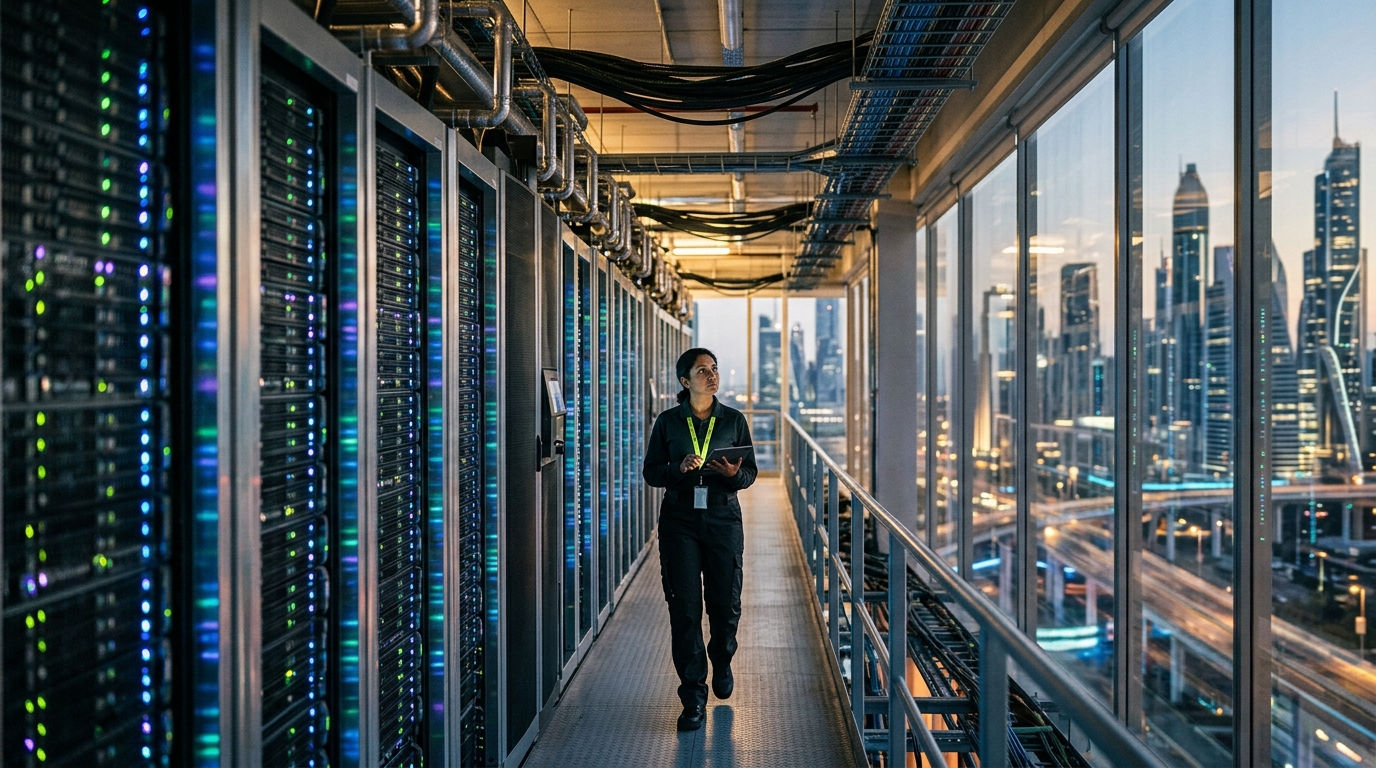
At the dawn of 2026, the global economy is no longer fueled solely by oil or gas, but by data and, more importantly, the processing power that transforms it into intelligence. AI data centres have ceased to be mere server warehouses. As Nvidia's Jensen Huang often points out, they have evolved into "AI factories," where the raw material is data and the final product is knowledge and automation.
The Architecture of Power: GPUs and Liquid Cooling
The fundamental difference between a traditional cloud data centre and an AI data centre lies in the density and type of hardware. While traditional cloud computing relies on Central Processing Units (CPUs) for general-purpose tasks, AI requires the parallel processing of billions of parameters—a task performed by Graphics Processing Units (GPUs) and specialized AI accelerators.
These systems generate immense amounts of heat. In the modern data centres being deployed today, traditional air cooling is no longer sufficient. The shift to liquid cooling is now universal. Racks that once consumed 10-15 kW are now reaching 100 kW or more, requiring complex coolant circulation systems that touch the processors directly. This change in infrastructure is not just technical but structural, affecting how buildings are designed from the foundation up.
The Energy Bottleneck and the Nuclear Solution
AI's thirst for energy has pushed power grids worldwide to their limits. It is estimated that by the end of the decade, data centres could consume up to 10% of global electricity. This reality has led tech giants into unexpected alliances. Microsoft, Amazon, and Google are now investing directly in energy production, with a particular focus on nuclear power.
- SMRs (Small Modular Reactors): Small, modular reactors that can be placed near data centres.
- Reviving Old Plants: The deal to restart the Three Mile Island plant in the US is the most prominent example of this trend.
- Renewables: The need for 24/7 operation makes solar and wind insufficient without massive storage infrastructure, reinforcing nuclear energy's role as "baseload" power.
Geopolitics and Sovereign AI
Beyond technology, data centres have become tools of geopolitical power. The concept of Sovereign AI refers to a nation's ability to produce its own artificial intelligence using its own infrastructure, data, and workforce. Countries like Saudi Arabia, the UAE, and EU member states are investing billions to build domestic AI data centres to avoid total dependence on American hyperscalers.
"Whoever controls the AI infrastructure controls the rules of the future economy," industry analysts state.
Greece, with its strategic location and investments from companies like Microsoft and Digital Realty, is attempting to position itself as a data hub in Southeast Europe. However, the challenge remains energy availability and the speed of grid permitting in a world moving at silicon speeds.
The Future: From Hyperscale to Edge
As we head toward 2027, the trend shows a bifurcation. On one hand, we have "monstrous" 5GW data centres training the next large language models. On the other, we see the rise of Edge AI—smaller data centres located closer to the end-user to reduce latency for applications like autonomous vehicles and robotic surgery.
In conclusion, AI data centres are no longer supporting infrastructures. They are the heart of the fourth industrial revolution. Their success will be judged not only by the power of the chips but by our ability to solve the energy problem and ensure that access to intelligence is equitable and sustainable.