Today, May 20, 2026, marks a watershed moment for the global financial markets and the future of space exploration. SpaceX, the aerospace giant founded by Elon Musk, has officially filed its S-1 registration statement with the SEC, signaling the start of the most anticipated Initial Public Offering (IPO) in history. The filing reveals a vision that transcends mere corporate growth, targeting a staggering Total Addressable Market (TAM) of $28.5 trillion.
The $28.5 Trillion Frontier
The S-1 filing is not just a financial document; it is a blueprint for the next century of human civilization. SpaceX is no longer positioning itself as a launch provider but as the infrastructure layer for a new, space-based economy. The $28.5 trillion TAM includes global high-speed connectivity, orbital manufacturing, lunar logistics, and the nascent but high-potential field of asteroid mining.
Starlink, the company’s satellite internet constellation, is the primary driver of this valuation. With over 15,000 satellites in orbit as of May 2026, Starlink has achieved significant profitability, providing the necessary cash flow to fund the ambitious Starship program. The filing emphasizes that Starlink’s goal is to capture a massive share of the global telecommunications market, which is currently valued at over $5 trillion. By providing low-latency internet to underserved regions and moving into the enterprise and government sectors, SpaceX is building a recurring revenue model that traditional aerospace companies can only envy.
Starship: The Multiplanetary Mandate
Central to the SpaceX narrative is Starship, the fully reusable launch system designed to carry humans and cargo to the Moon, Mars, and beyond. The S-1 explicitly states that the company’s mission is to “make life multiplanetary.” This is framed as a hedge against existential risks to Earth, such as asteroid impacts or climate collapse. The document outlines a roadmap for the first human landing on Mars by 2029 and the establishment of a permanent settlement shortly thereafter.
Furthermore, the filing touches upon a deeper philosophical objective: to “understand the true nature of the universe.” SpaceX argues that by becoming a spacefaring species, humanity can deploy scientific instruments at a scale previously unimaginable. This includes massive orbital telescopes that could peer back to the dawn of time or detect signs of life on exoplanets. This blend of hard-nosed business strategy and grand philosophical ambition is what defines the Musk era of SpaceX.
Geopolitics and the Privatization of Space
The decision to go public brings SpaceX’s immense power into sharp focus. As the company that now controls more than 80% of the world’s orbital launch mass, SpaceX is effectively a geopolitical actor. The S-1 filing acknowledges the complexities of operating in a world where space is increasingly contested. Relationships with NASA and the Department of Defense remain critical, but the company’s global reach through Starlink has already sparked debates about digital sovereignty and the weaponization of space assets.
Investors are being asked to buy into a company that operates with the scale of a nation-state. The risks listed in the S-1 are as vast as the opportunities: regulatory hurdles, the technical challenges of deep-space travel, and the immense capital requirements of the Mars mission. However, with the cost of launch continuing to plummet due to Starship’s reusability, SpaceX has created a moat that is virtually unassailable by competitors like Blue Origin or national space agencies.
- The SpaceX IPO is expected to debut with a valuation exceeding $500 billion, making it one of the most valuable companies on Earth.
- Starlink's revenue is projected to exceed $30 billion annually by the end of 2027.
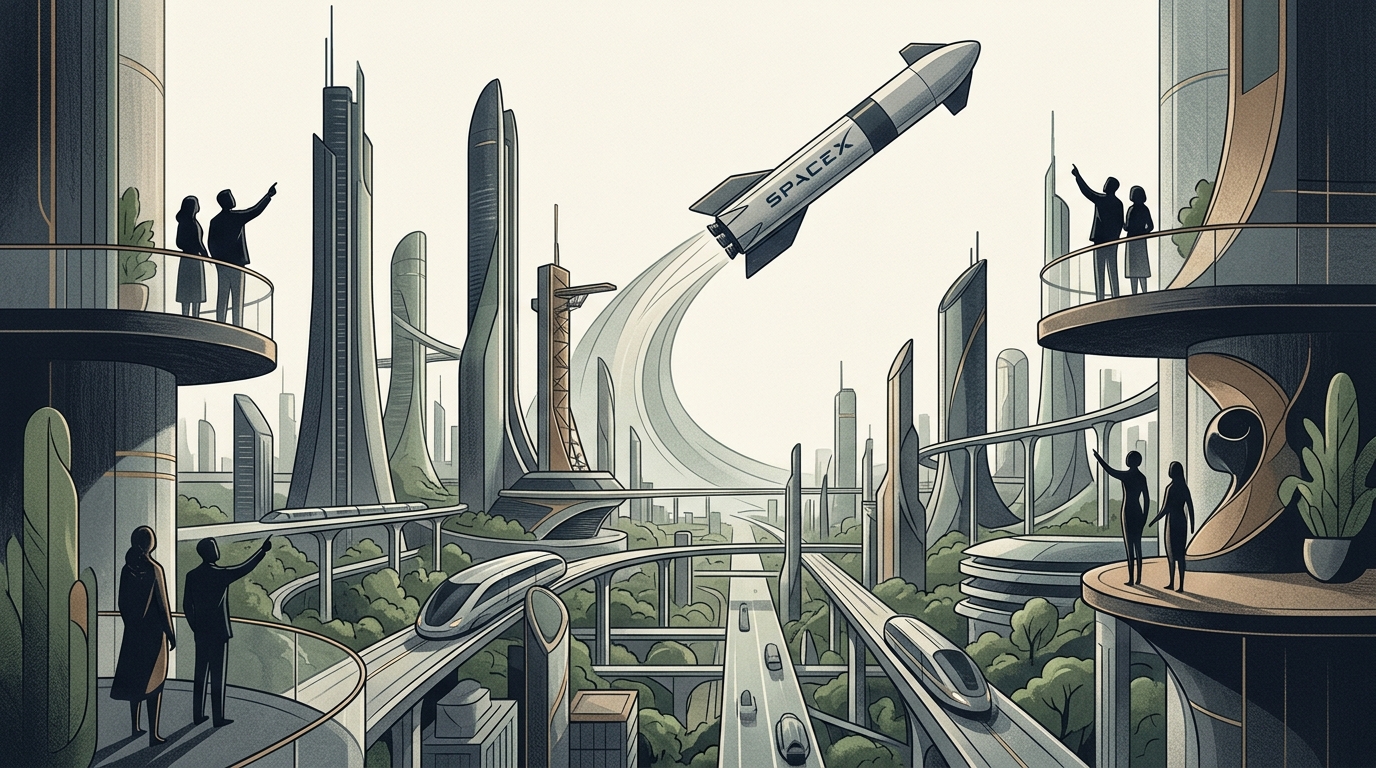
- The S-1 outlines plans for 'Earth-to-Earth' transport, promising to move passengers between any two cities in under 45 minutes.
- SpaceX’s dominance has forced a consolidation in the traditional aerospace sector, with legacy players struggling to keep pace.
As we move toward the IPO date, the world is watching. This is more than just a stock market event; it is the moment when the privatization of the heavens becomes a financial reality. Whether SpaceX can deliver on its promise to make us a multiplanetary species remains to be seen, but the S-1 filing proves that they have the capital, the technology, and the audacity to try.