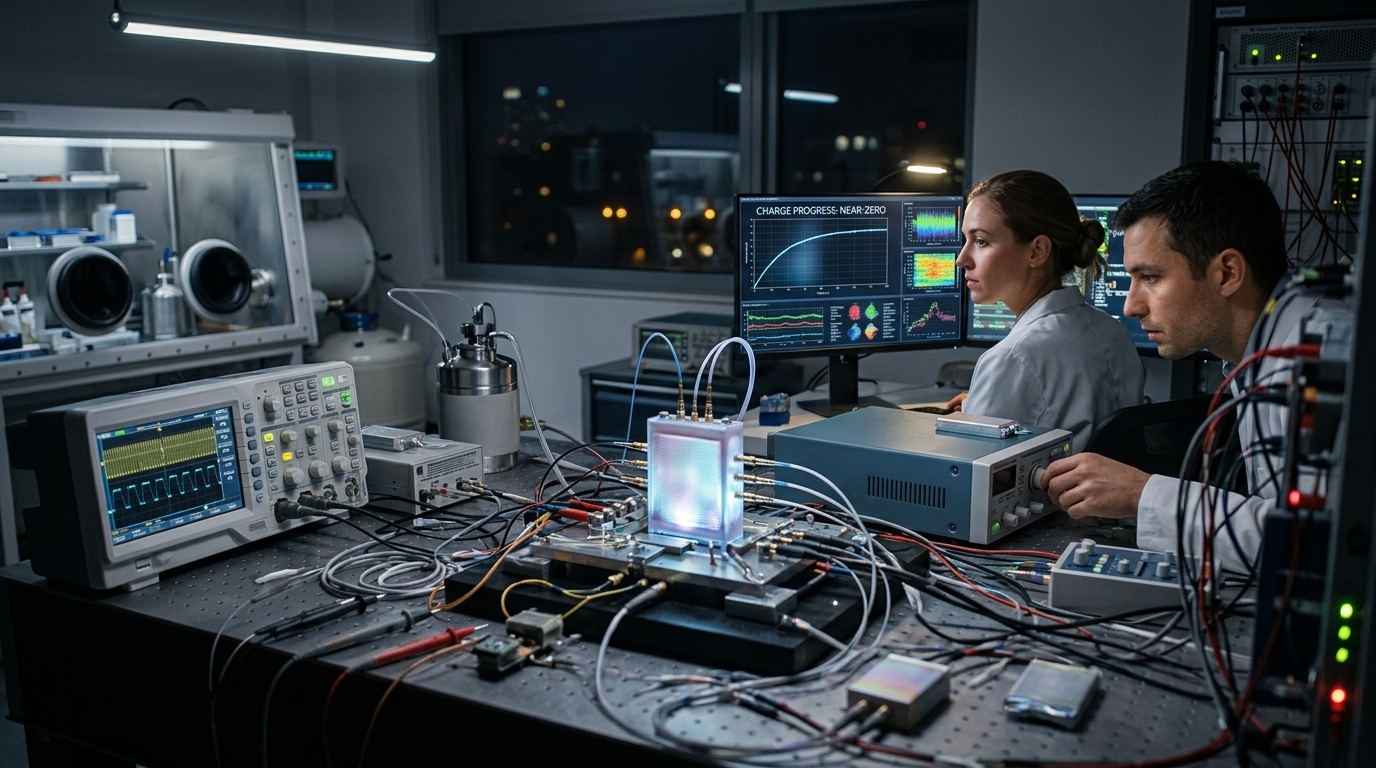
The frustration of waiting by a wall socket to charge a smartphone or enduring long stops at electric vehicle charging stations may soon become a relic of a slow, analog past. A team of researchers from Australia, in collaboration with international institutes, has achieved a milestone that until recently belonged to the realm of theoretical physics: the creation of a quantum battery capable of absorbing energy almost instantaneously.
This achievement is not merely an incremental improvement of existing lithium-ion technology but a radical paradigm shift. In classical batteries, charging is a linear process: the larger the battery, the more time it takes to fill. In the quantum world, the rules are inverted through a phenomenon known as "superabsorption." This means that as more quantum cells are added to the system, the battery charges faster, reducing charging time to the absolute minimum.
The Physics of Superabsorption
At the heart of this innovation lies quantum entanglement and coherent superposition. In a traditional battery, each chemical element functions independently. In the quantum battery developed at the University of Adelaide, the energy-storing molecules work collectively. When these molecules enter a state of quantum coherence, they begin to act as a single entity.
The research team utilized a microcavity filled with photoactive molecules, which were exposed to laser light. Due to superabsorption, the system's ability to absorb energy increases exponentially with the number of molecules. This creates a paradox by classical standards: a car-sized battery could theoretically be charged faster than a watch battery, provided its quantum state is maintained.
"This is the first proof that quantum mechanics can be used to accelerate energy storage at a macroscopic level," the researchers stated.
From Lab to Living Room: The Challenges
Despite the excitement, the transition to commercial production will not happen overnight. The main obstacle remains "decoherence" – the tendency of quantum systems to lose their unique properties when interacting with the environment. For a quantum battery to function in a smartphone, it must remain isolated from thermal interference and noise, requiring extremely advanced materials and shielding.
Furthermore, there is the issue of discharge. While charging is instantaneous, the steady and controlled release of energy to power a device requires different control mechanisms. Scientists are now working on "switches" that will allow the battery to transition from the quantum state (for charging) to the classical state (for usage).
Geopolitical and Environmental Implications
In a world struggling to decouple from fossil fuels, the quantum battery offers a way out of the "range anxiety" that hampers the adoption of electric vehicles. If charging a car takes as little time as filling a gas tank – or even less – the need for massive slow-charging infrastructure disappears.
At the same time, this technology could reduce our reliance on lithium and cobalt, metals whose extraction carries a heavy environmental and humanitarian cost. Although the first quantum batteries are based on organic molecules and semiconductors, the principle of their operation allows for the use of more abundant and environmentally friendly materials.
The Future of Energy in 2026 and Beyond
As we move through 2026, the convergence of quantum computing and materials science is creating a new landscape. The quantum battery is not just a gadget; it is the key to decentralized energy. Imagine buildings that charge their reserves in fractions of a second during peak solar production, or power grids that balance instantaneously without the risk of blackouts. The moment when energy is not only clean but also instantaneously available seems to be approaching faster than we dared to predict.