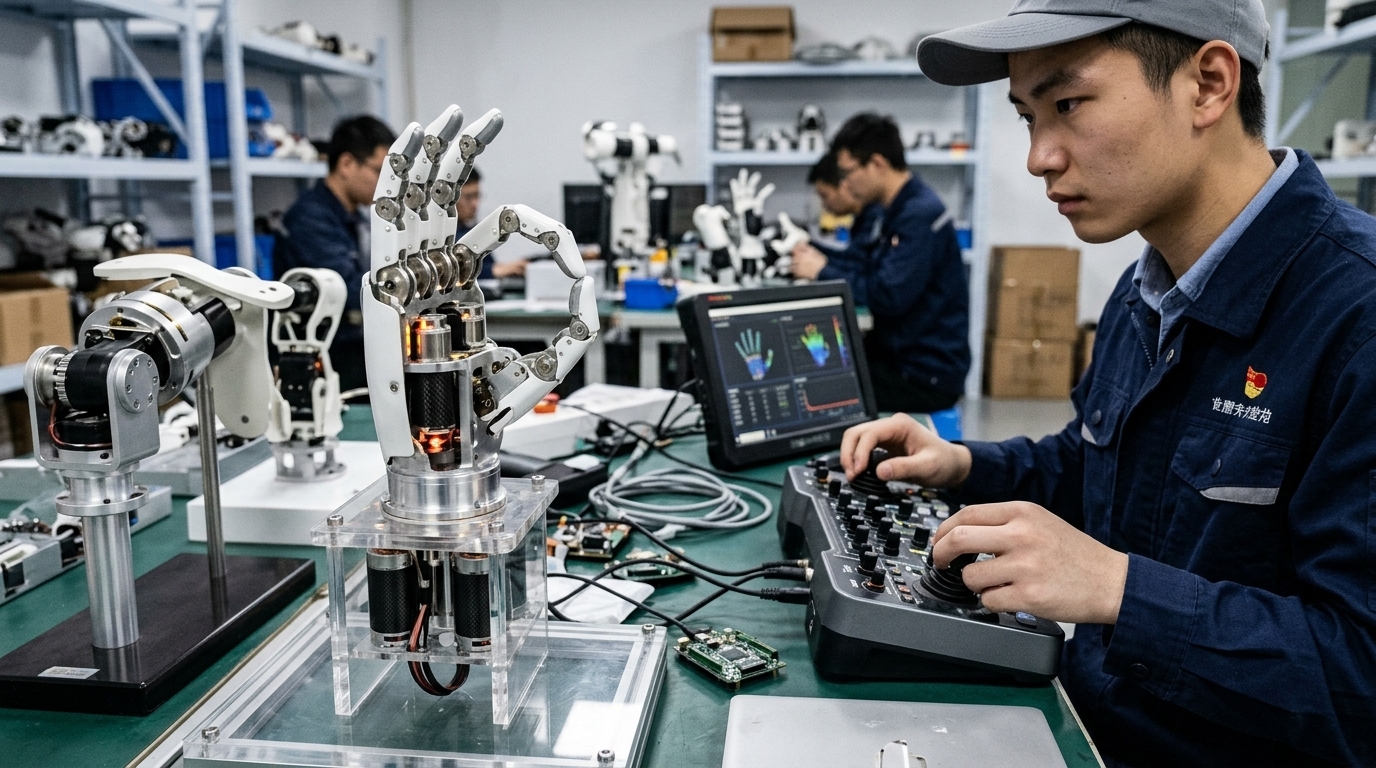
In the heart of Shenzhen, the city often dubbed the "Silicon Valley of Hardware," a new generation of workers is no longer just assembling components. Instead, they are "inhabiting" metallic bodies. Inside the offices of IO-AI Tech, young men and women don virtual reality (VR) headsets and motion-capture suits, performing meticulous movements that are mirrored with precision by humanoid robots just a few meters away. This scene, looking like a page out of the dystopian vision of "Ready Player One," represents the new frontier in the global race for AI supremacy.
The Art of Teleoperation and Machine Training
This process is called teleoperation, and it is the critical link in the chain of "imitation learning." For a robot to perform complex tasks—such as grasping a fragile object or climbing stairs—coding alone is insufficient. It needs data—vast amounts of data derived from human experience. The robot "pilots" in Shenzhen provide exactly that: the biological subtlety and instinctive understanding of the physical world that artificial intelligence struggles to master.
Every flick of the wrist, every hesitation before a move, and every balance correction is recorded and fed into neural networks. Over time, the robot learns to predict the next move, transforming human guidance into autonomous skill. At IO-AI Tech, the demand for these operators has skyrocketed as the company seeks to accelerate model development ahead of Western rivals like Tesla and Figure AI.
Shenzhen as the Global Lab for Embodied AI
Why is this happening with such intensity in Shenzhen? The answer lies in the city's unique ecosystem. Here, the distance between designing a component and producing it is measured in hours, not weeks. When an operator notices a robot struggling to turn a bolt due to finger shape, the engineering team can 3D-print a new limb and test it that same afternoon.
- Prototyping Speed: Proximity to factories allows for immediate hardware upgrades.
- Labor Costs: While "pilot" work requires skill, costs remain competitive compared to the US.
- State Support: The Chinese government has made mass production of humanoids a national priority by 2027.
This synergy of hardware and software creates a "data engine" that is difficult to replicate elsewhere. While American firms often rely on computer simulations, Chinese companies prefer "real-world contact," believing that the laws of physics cannot be fully replicated in a digital vacuum.
The Social Dimension: From Worker to Trainer
There is an irony at the heart of this new profession. The people training these robots are essentially working toward the obsolescence of their own future jobs—or at least those of their manufacturing peers. However, for many young people in Shenzhen, this work is considered "high-tech" and preferable to the traditional assembly line. They wear white coats, work in air-conditioned labs, and feel part of the technological vanguard.
"I don't feel like I'm controlling a machine. I feel like I'm lending my senses to the future," says one operator at IO-AI Tech.
Yet, physical and psychological fatigue are real. Prolonged VR use causes motion sickness, while the need for absolute concentration during data recording exhausts the nervous system. Furthermore, the ethical issue of "motion ownership" arises. If a robot learns to move with a specific person's unique style, who owns the intellectual property of that kinesiology?
Geopolitics and the Future of Autonomy
The humanoid race is not just about technology; it’s about geopolitical power. China faces a demographic crisis with a rapidly aging population. Humanoid robots are seen as the solution to maintaining industrial output without the need for cheap human labor. If Shenzhen succeeds in standardizing robot training via teleoperation, it could export not just the robots, but the "intelligence" that moves them.
In conclusion, the work in Shenzhen today is a harbinger of what is to come globally. The distinction between physical and digital labor is blurring. As 2026 draws to a close, the question is not whether robots will replace humans, but how quickly humans can transmit the essence of their movement to machines before the need for teleoperation becomes obsolete.