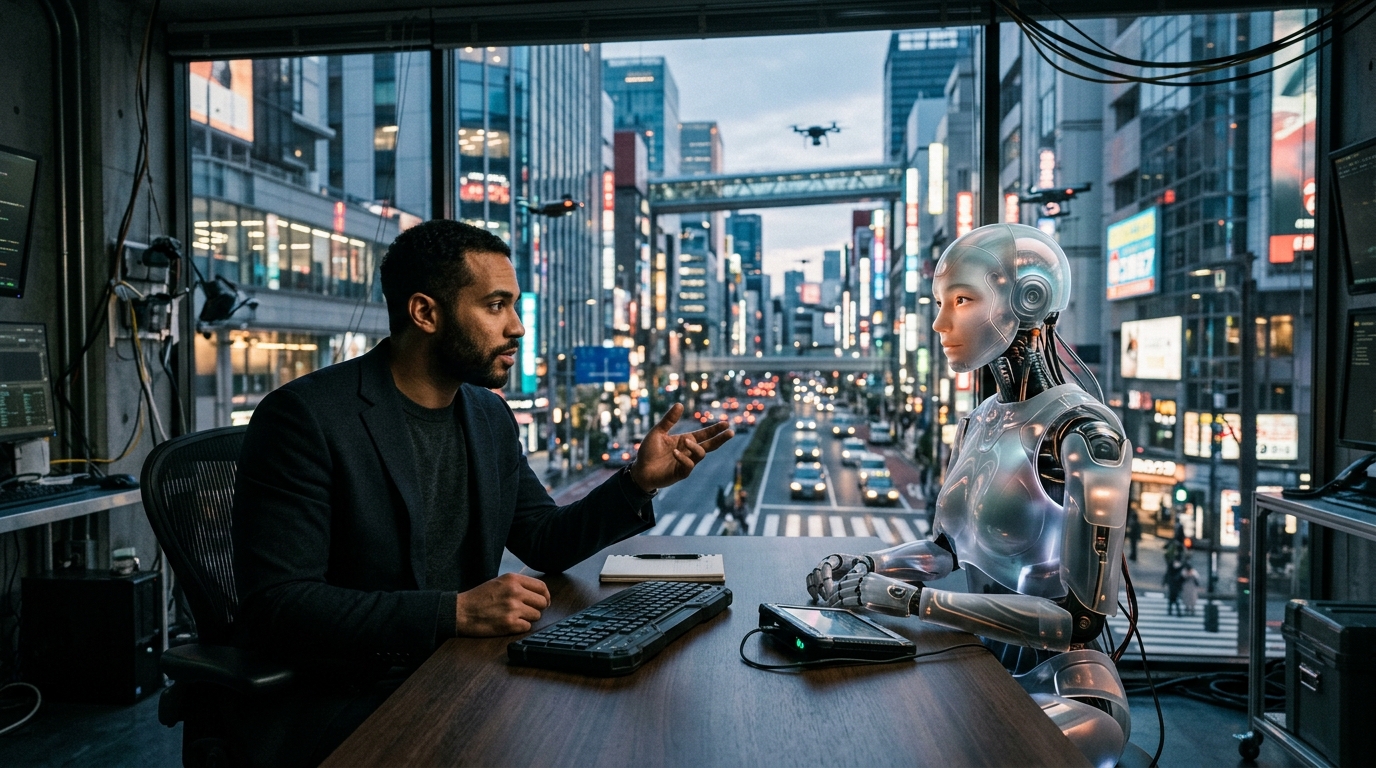
In the long history of computer science, communication between humans and machines has always been an exercise in translation. Humans had to adapt to the language of code, commands, and strict syntax. Today, as we move through the mid-2020s, this dynamic is reversing in a spectacular fashion. The next generation of artificial intelligence is no longer limited to providing correct answers; it seeks to master the art of conversation, with all the complexity, emotional richness, and subtle nuances that characterize human interaction.
The transition from Large Language Models (LLMs) to Multimodal Models marks the end of the era of "dry" information. Technology giants, from OpenAI and Google to Anthropic, are investing billions in developing systems that don't just read words, but "hear" the tone of voice, "feel" the pauses, and perceive the sarcasm or fatigue of the interlocutor. This development is not merely a technical improvement but a fundamental shift in how we perceive the very nature of intelligence.
Prosody and the Psychology of Voice
For decades, digital assistants sounded robotic, with a characteristic monotony that betrayed their artificial nature. The new generation of AI uses advanced neural networks to control prosody—the rhythm, volume, and intonation of speech. When a machine can whisper to avoid disturbing others or speed up its speech when it senses urgency, the "Uncanny Valley" begins to be bridged. The ability of AI to interrupt and be interrupted naturally, without the awkward pauses of previous years, creates a sense of flow that was previously considered an exclusively human privilege.
Researchers are now focusing on what they call "Affective Computing." This is the system's ability to analyze acoustic signals in real-time and adjust its own "personality" accordingly. If the user sounds frustrated, the AI can adopt a more reassuring tone. If the user is excited, the AI can mirror that energy. This mirroring behavior is the basis of human empathy, and its digital reproduction opens new horizons in mental health, education, and customer service.
The Technological Revolution of Low Latency
The biggest obstacle to natural conversation has always been latency. The need to send voice to the cloud, convert it to text, process the response, and convert it back to sound created gaps of seconds that destroyed any sense of authenticity. With the advent of on-device processing and the spread of 6G networks, latency has been reduced to levels below 200 milliseconds, faster than human reaction time in many cases.
This speed allows AI to function as a true real-time partner. Imagine a surgeon talking to a digital assistant during an operation, or an engineer receiving voice instructions while working on a complex system. The ability of AI to "think out loud" and correct itself during speech adds a layer of reliability and humanity that is a game-changer for professional use.
Ethical Risks and the Illusion of Companionship
However, this new ability of AI to converse "like us" brings with it serious ethical questions. The creation of strong emotional bonds with a machine is no longer a science fiction scenario. As people begin to trust their secrets, hopes, and fears to digital entities that sound perfectly understanding, the risk of psychological dependency and social isolation increases.
Furthermore, there is the issue of manipulation. An AI that can speak in a persuasive, attractive, and emotionally charged way can be used to influence political views, consumer habits, or even defraud the elderly through "deepfake" voice calls. Legislation, such as the European Union's AI Act, attempts to anticipate these developments by mandating disclosure that the interlocutor is a machine, but the line between tool and entity is becoming increasingly blurred.
In conclusion, the next generation of artificial intelligence aims not only to solve problems but to master human connection. As machines learn to speak the language of the heart and not just of logic, we are called to redefine what it means to be human in a world where the voice of the machine is no longer distinguishable from our own.