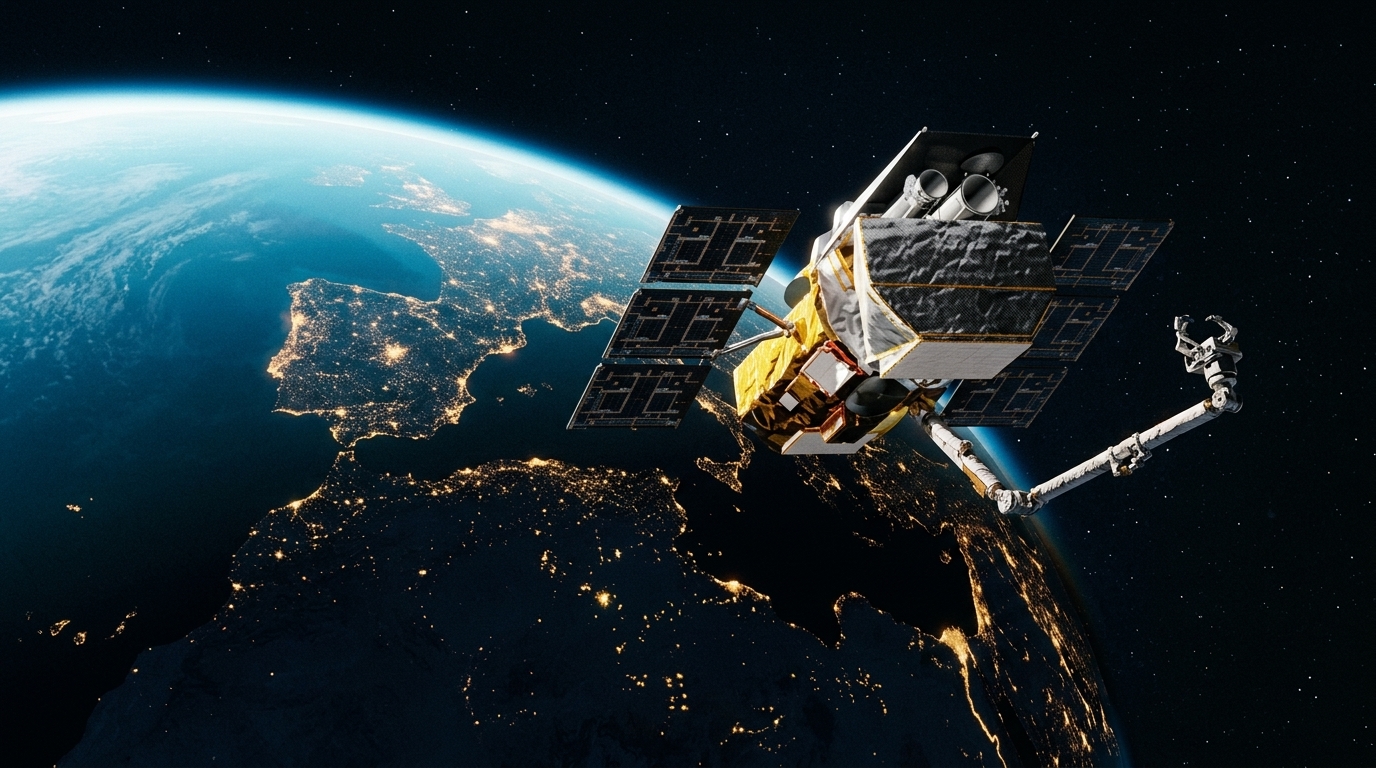
For over two decades, NASA’s Swift Observatory (officially the Neil Gehrels Swift Observatory) has served as our primary sentinel against the most violent and energetic phenomena in the universe: Gamma-Ray Bursts (GRBs). However, time and gravity have begun to claim their due. Due to atmospheric drag, Swift’s orbit is gradually decaying, bringing it closer to a fiery reentry into Earth’s atmosphere. The news that NASA is exploring the dispatch of a space "tugboat" to boost the telescope into a higher orbit is not merely an effort to save a scientific instrument; it is the opening chapter of a new era in space infrastructure.
The Scientific Legacy of Swift
Launched in 2004, Swift was a mission many expected to be short-lived. Its unique ability to pivot rapidly—hence its name—toward the direction of a gamma-ray burst within seconds of detection allowed scientists to observe the "afterglow" of these explosions across multiple wavelengths. These bursts, triggered by the collapse of massive stars into black holes or the collision of neutron stars, unlock secrets regarding the early universe and the fundamental nature of spacetime.
Despite its age, Swift remains one of NASA’s most productive assets. Its loss would leave a massive void in multi-messenger astronomy, especially now when the synergy between ground-based gravitational wave detectors and space-based telescopes is more critical than ever. NASA’s decision to investigate a rescue mission reflects a growing realization: building a replacement would take years and hundreds of millions of dollars, whereas extending the life of existing hardware is a far more rational and cost-effective approach.
The Rise of ISAM (In-Space Servicing, Assembly, and Manufacturing)
The Swift rescue mission fits into a broader strategic framework known as ISAM. Until recently, satellites and telescopes were treated as disposable assets. Once they ran out of fuel or their orbits decayed, their fate was sealed. The success of the Hubble Space Telescope servicing missions by the Space Shuttle was the exception, not the rule, primarily due to the immense cost and risk associated with crewed missions.
Today, robotic technology has matured to the point where autonomous or semi-autonomous craft can take over this role. NASA and private entities like Northrop Grumman (with their Mission Extension Vehicle - MEV) have already demonstrated that docking with satellites not originally designed for servicing is possible. The proposed "tug" for Swift would utilize similar technology: approaching the observatory, docking with its aft interface, and using its own propulsion system to raise the telescope's altitude, potentially granting it another decade of operational life.
Geopolitical and Environmental Implications
Beyond pure science, the ability to maneuver objects in space has profound geopolitical implications. The technology capable of saving a telescope can also be deployed to remove space debris—a pressing issue as Low Earth Orbit (LEO) becomes increasingly congested. However, the dual-use nature of these "tugs" is not lost on global military leadership. A craft capable of "grabbing" a friendly satellite could theoretically do the same to an adversary’s asset, leading to new tensions in the realm of space security.
The Swift mission will serve as a critical test case for how government agencies can collaborate with the private sector to preserve space heritage. If successful, it will set the standard for future endeavors, such as the highly anticipated (and debated) proposal to boost the Hubble Space Telescope's orbit, a project proposed by billionaire Jared Isaacman in collaboration with SpaceX. It signifies a transition from a "frontier" mentality of abandonment to a "settlement" mentality of maintenance.
Conclusions for the Future
The potential rescue of Swift marks the end of the "throwaway culture" in space exploration. As humanity expands its footprint beyond the atmosphere, sustainability and repairability are becoming central pillars of our extraterrestrial strategy. Swift, an instrument designed to peer into the most distant and violent corners of our cosmic past, is now becoming a symbol of a more responsible and technologically sophisticated future in our local orbits. We are no longer just explorers; we are becoming the mechanics of the heavens.