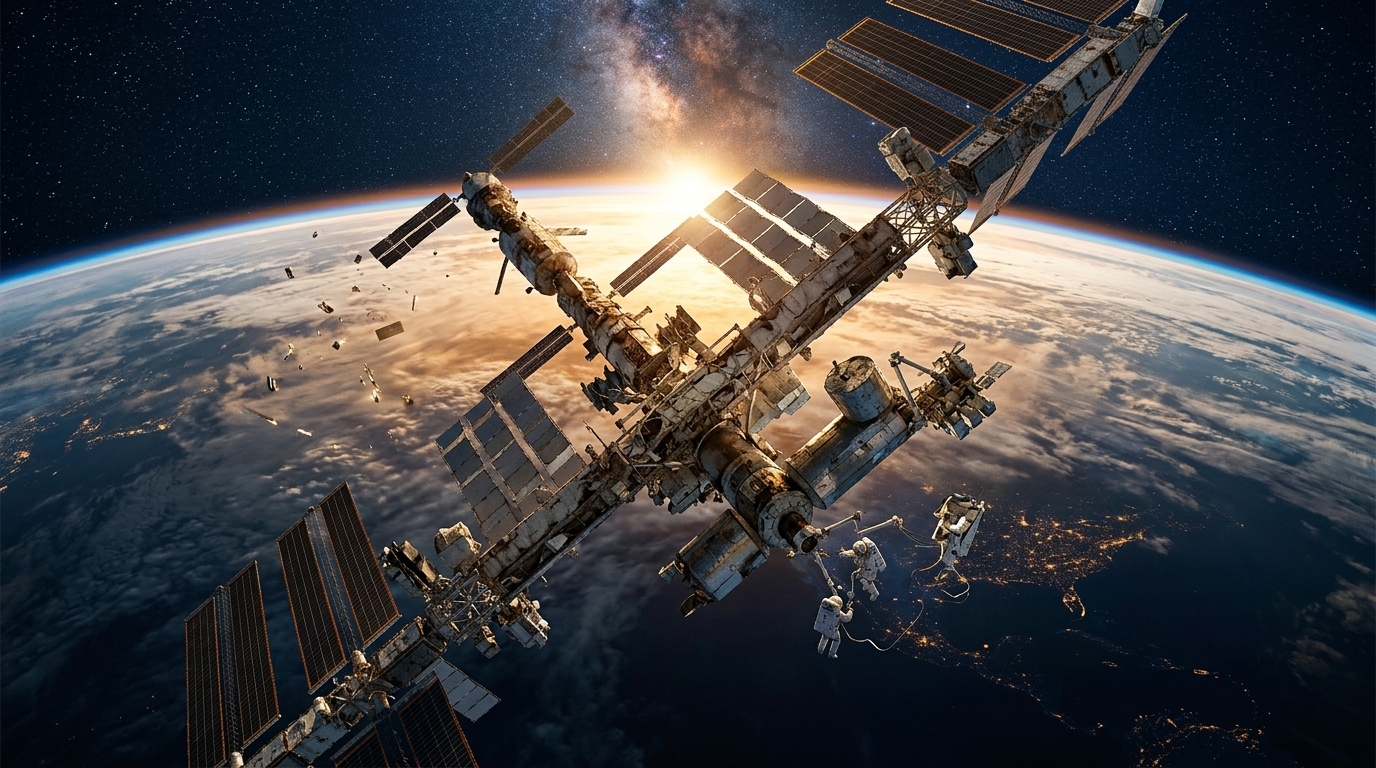
For over a quarter of a century, the International Space Station (ISS) has stood as the ultimate testament to human ingenuity and post-Cold War diplomacy. Floating 400 kilometers above our heads, it has been a beacon of cooperation in an increasingly fractured world. However, the laws of physics and the relentless wear of the space environment are final. NASA has officially detailed its roadmap for the station’s decommissioning, a process that will see the massive structure perform a controlled re-entry and a final dive into the most remote waters on Earth.
The Engineering of a Controlled Demise
Deorbiting a 450-ton structure the size of a football field is a feat of engineering as complex as its initial assembly. To ensure a safe and precise disposal, NASA has awarded SpaceX an $843 million contract to develop the U.S. Deorbit Vehicle (USDV). This specialized spacecraft will act as a powerful orbital tug, docking with the ISS and providing the necessary thrust to lower its altitude until it hits the dense layers of the atmosphere.
The target for this final descent is Point Nemo, the 'Oceanic Pole of Inaccessibility.' Located in the South Pacific, it is the spot on Earth furthest from any human habitation. While much of the station will vaporize into plasma during re-entry, substantial fragments will inevitably survive. By targeting Point Nemo, NASA ensures that these remnants—some potentially the size of small cars—sink to the bottom of the ocean without posing a risk to populated areas or maritime routes.
Geopolitical Shifts and the Lunar Pivot
The decision to retire the ISS by 2030 is not merely a matter of structural fatigue; it is a reflection of a changing geopolitical landscape. The station was a product of a unique era of Russo-American partnership. Today, that partnership is under extreme duress due to the conflict in Ukraine and broader systemic rivalries. While Russia has committed to the station through 2028, its future lies in its own planned orbital infrastructure, or perhaps a closer alignment with China’s space program.
Meanwhile, China’s Tiangong space station is already operational, representing a significant shift in orbital power dynamics. As the ISS nears its end, the United States is pivoting its focus. Rather than building a direct successor, NASA is concentrating its budget on the Artemis program, aiming to establish a permanent presence on the Moon and eventually send humans to Mars. The low-Earth orbit (LEO) is no longer the frontier; it is becoming the backyard, and NASA is ready to hand the keys over to the private sector.
The Privatization of the Heavens
The retirement of the ISS marks the beginning of the 'Commercial LEO' era. NASA’s strategy involves transitioning from being the owner and operator of an orbital lab to being one of many customers. Companies like Axiom Space, Blue Origin, and Voyager Space are racing to launch private habitats. These stations will serve a dual purpose: providing a platform for government research while simultaneously catering to space tourism, pharmaceutical manufacturing in microgravity, and even entertainment production.
This transition is economically motivated. Maintaining the ISS costs NASA approximately $3 billion annually. By outsourcing orbital operations to private entities, the agency can redirect those funds toward deep-space exploration. However, critics worry that this shift could lead to a 'pay-to-play' model for science, potentially excluding developing nations from the benefits of space research and turning the orbital environment into a corporate monopoly.
A Legacy Written in the Stars
When the ISS finally sinks into the depths of the Pacific, it will leave behind a legacy that transformed our understanding of life. From breakthroughs in Alzheimer’s research to the development of water purification systems now used in remote villages on Earth, the station’s scientific output has been monumental. But perhaps its greatest achievement was the 24/7 human presence in space for over two decades—a feat that proved we could sustain life beyond our planetary cradle. The ISS will die as it lived: as a bridge between the Earth and the infinite, reminding us that while our machines are temporary, our curiosity is boundless.