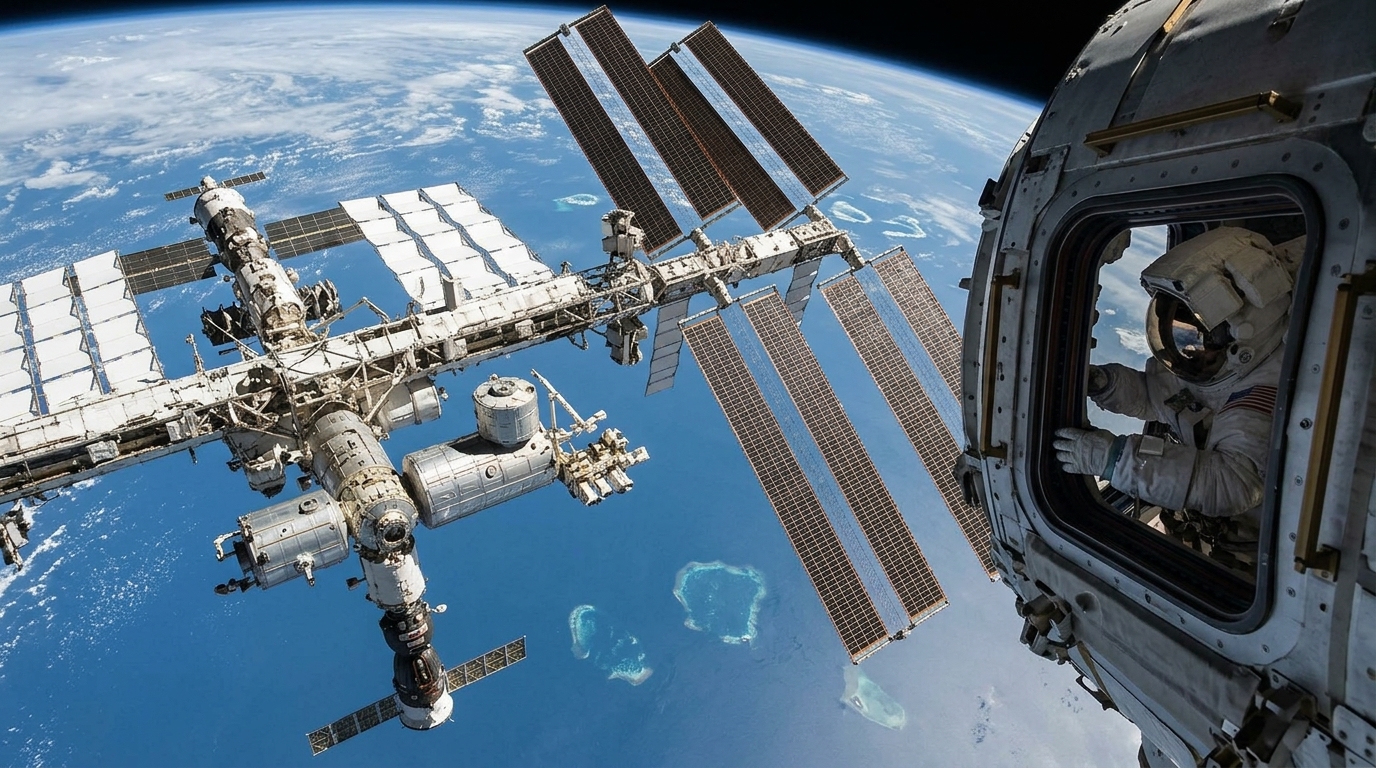
For over twenty-five years, the International Space Station (ISS) has served as humanity's only permanent outpost among the stars—a symbol of post-Cold War cooperation that transcended geopolitical tensions on Earth. However, the station's aging hull, subject to constant stress from extreme temperature fluctuations and micrometeoroid impacts, is nearing the end of its operational life. NASA recently announced a detailed plan for the "euthanasia" of this colossal structure, a process that will culminate in 2031 with a spectacular, controlled plunge into the Pacific Ocean.
The SpaceX Contract and the Deorbit Vehicle
NASA has awarded Elon Musk’s SpaceX a $843 million contract to develop the US Deorbit Vehicle (USDV). This specially designed spacecraft will be tasked with the Herculean feat of guiding the ISS toward its destruction. This marks a significant shift in the space industry: the very private sector that helped sustain the station is now being called upon to retire it. The USDV will not be a standard Dragon capsule; it will require enhanced thrust and massive fuel reserves to push a 450-ton mass—roughly the weight of a fully loaded Boeing 747—out of its stable orbit.
The process will begin gradually in 2028. The station will be allowed to lose altitude naturally through atmospheric drag. Once it reaches a critical threshold, the SpaceX vehicle will fire its engines for the final deorbit burn. Precision is a matter of life and death. An incorrect entry angle could scatter flaming debris over inhabited areas. Instead, the target is "Point Nemo," the most remote location in the world's oceans, thousands of miles from any coastline.
Point Nemo: The Final Resting Place
Point Nemo, also known as the "Oceanic Pole of Inaccessibility," is located in the South Pacific. It is the spot where astronauts on the ISS are often closer to a human presence (at 400 km altitude) than anyone on dry land. This aquatic desert has been designated as the planet's "space cemetery." It is already the final resting place for the Russian Mir station, hundreds of satellites, and old cargo spacecraft.
The destruction of the ISS will not be instantaneous. As it enters the atmosphere at speeds exceeding 27,000 kilometers per hour, friction will generate temperatures of thousands of degrees Celsius. Solar panels and external trusses will be the first to shear off. Subsequently, the main modules will begin to break apart. It is estimated that 60% to 70% of the station's mass will vaporize. However, the densest components, such as titanium tanks and docking mechanisms, will survive the fall, settling on the ocean floor.
Geopolitical Shifts and the Rise of Private Stations
The retirement of the ISS is not merely a technical necessity; it is a profound political act. Russia, via Roscosmos, has already signaled its intent to withdraw after 2028 to focus on its own station (ROSS), while China already operates the fully functional Tiangong station. The West, meanwhile, appears to be moving away from the model of state-owned stations.
NASA's post-ISS strategy relies on "Commercial Low-Earth Orbit Destinations" (CLDs). Companies like Axiom Space, Blue Origin (with Orbital Reef), and Voyager Space are developing private stations that will lease space back to government agencies and private researchers. This transition aims to free up NASA's budget so it can focus on the Artemis lunar program and, eventually, Mars. However, many analysts worry that losing a unified international station will mark the end of scientific diplomacy, ushering in an era of competition and the commercialization of space.
Environmental and Ethical Challenges
Despite the necessity of de-orbiting, the scientific community has raised concerns. Burning vast amounts of aluminum and other metals in the upper atmosphere releases oxides that could potentially affect the ozone layer or the climate. Furthermore, sinking tons of metal at Point Nemo, while considered environmentally safe due to the lack of marine life in that specific region, remains an act of depositing waste in a pristine ecosystem.
There is also the dimension of cultural heritage. The ISS is the most expensive and complex object ever built by humans. Its total destruction deprives future generations of a monument to our technological evolution. Although plans were proposed to keep parts of it in orbit as a "museum," the maintenance costs and the risks of collisions with space debris made these ideas unfeasible. Thus, the station that taught us how to live together in space will suffer the same fate as its predecessors: a brief flash in the night sky and eternal silence in the depths of the Pacific.