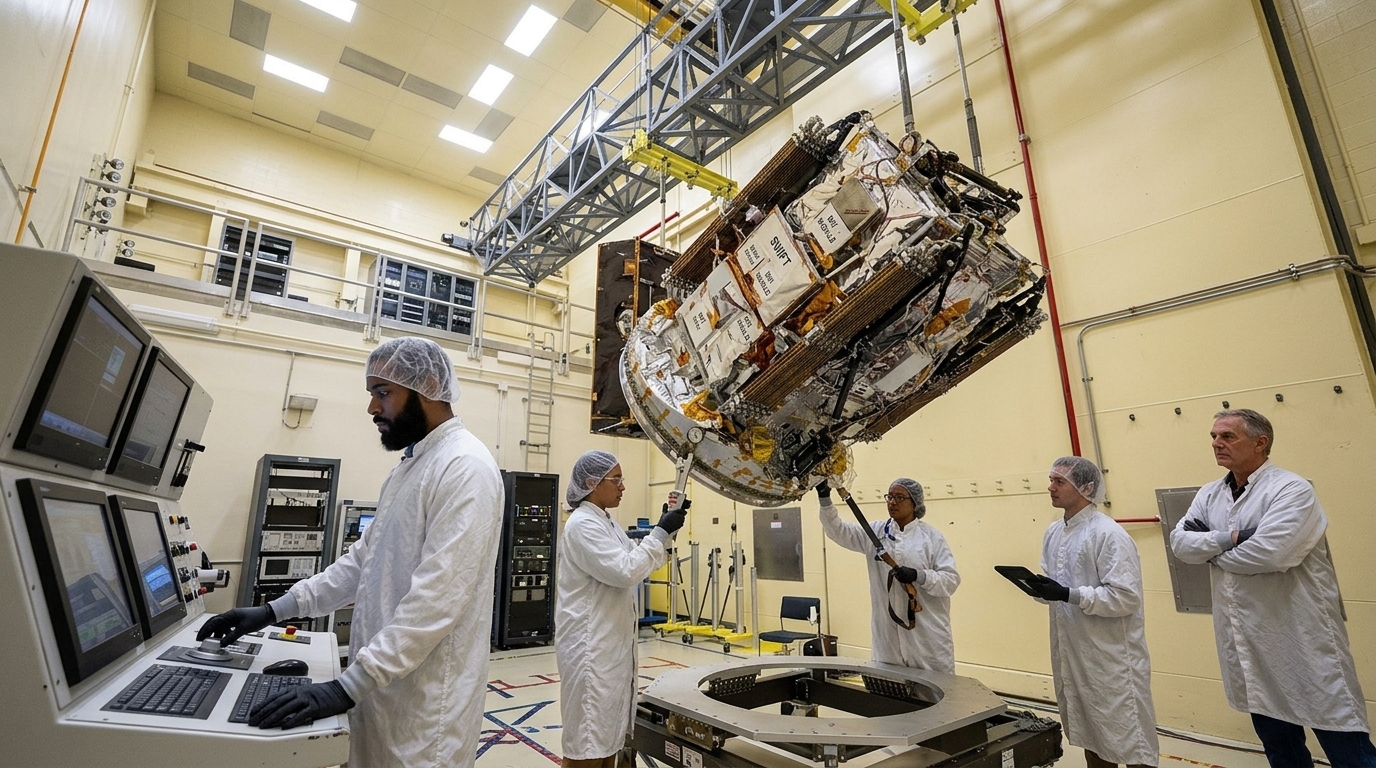
In the vast void above our heads, a dramatic rescue operation is unfolding, signaling a new era in the management of space assets. The Neil Gehrels Swift Observatory, a cornerstone of modern astrophysics since its launch in 2004, faces an existential threat. This isn't due to a mechanical failure or a lack of fuel, but rather the wrath of the Sun itself. Intense solar storms in recent years have caused Earth's atmosphere to expand, increasing drag on Swift's orbit and pushing it dangerously close to an uncontrolled reentry and destruction.
The Threat of the Solar Maximum
Swift was designed to detect gamma-ray bursts (GRBs), the most violent and luminous events in the universe. For over two decades, it has provided invaluable data to scientists worldwide. However, the current phase of the solar cycle, known as the solar maximum, has proven much more intense than predicted. Solar flares and coronal mass ejections heat the upper layers of the atmosphere, making them denser at altitudes where a vacuum usually prevails. This "atmospheric swelling" acts as a brake for satellites in Low Earth Orbit (LEO).
For Swift, this has meant a rapid loss of altitude. NASA's calculations indicated that without intervention, the telescope could re-enter the atmosphere and burn up as early as 2026 or early 2027. The loss of such an instrument would not only be a financial blow of hundreds of millions of dollars but also a massive gap in the global capacity to monitor the "living" universe.
The Alliance with Katalyst Space Technologies
Rather than accepting fate, NASA has taken a groundbreaking step: commissioning an emergency mission from the private firm Katalyst Space Technologies. The mission, named "Link," involves a specialized spacecraft that launched last Friday with the goal of meeting Swift in orbit. Link is not a typical spacecraft; it is a "space tug," designed to dock with satellites that were not originally intended for in-orbit servicing.
Katalyst’s technology employs advanced proximity algorithms and an innovative docking system capable of "embracing" Swift's body without damaging its sensitive instruments. Once the connection is established, Link will use its own thrusters to boost the observatory into a higher, safer orbit, granting it at least another decade of operational life. This approach represents a radical shift from NASA's old dogma, where satellites were considered disposable once their orbital maintenance capabilities were exhausted.
A New Economy in Orbit
The Swift case highlights the growing need for In-Space Servicing, Assembly, and Manufacturing (ISAM) services. As LEO becomes increasingly crowded, the ability to repair, refuel, and relocate existing satellites is becoming a strategic priority. This is not just about science; it's about national security and protecting telecommunications infrastructure.
- Sustainability: Extending the life of satellites reduces the creation of space debris.
- Cost-Efficiency: Sending a tug is a fraction of the cost of building and launching a new telescope.
- Innovation: Partnering with companies like Katalyst accelerates the development of technologies essential for future lunar and Martian bases.
The stakes are high. If the Link mission succeeds, it will pave the way for the rescue of dozens of other historic missions currently in decaying orbits. NASA is demonstrating that the future of space exploration lies not only in going "where no one has gone before" but also in tending to what we have already managed to send to the stars.
Conclusion
The Swift rescue mission is a reminder of the fragility of our technological achievements in the face of natural forces, even in space. At the same time, it serves as a beacon of hope for how human ingenuity and public-private partnerships can solve problems that were considered insurmountable just a few years ago. Swift, our "eye" on the most violent explosions in the cosmos, deserves a second chance to continue staring into the darkness, searching for the light.