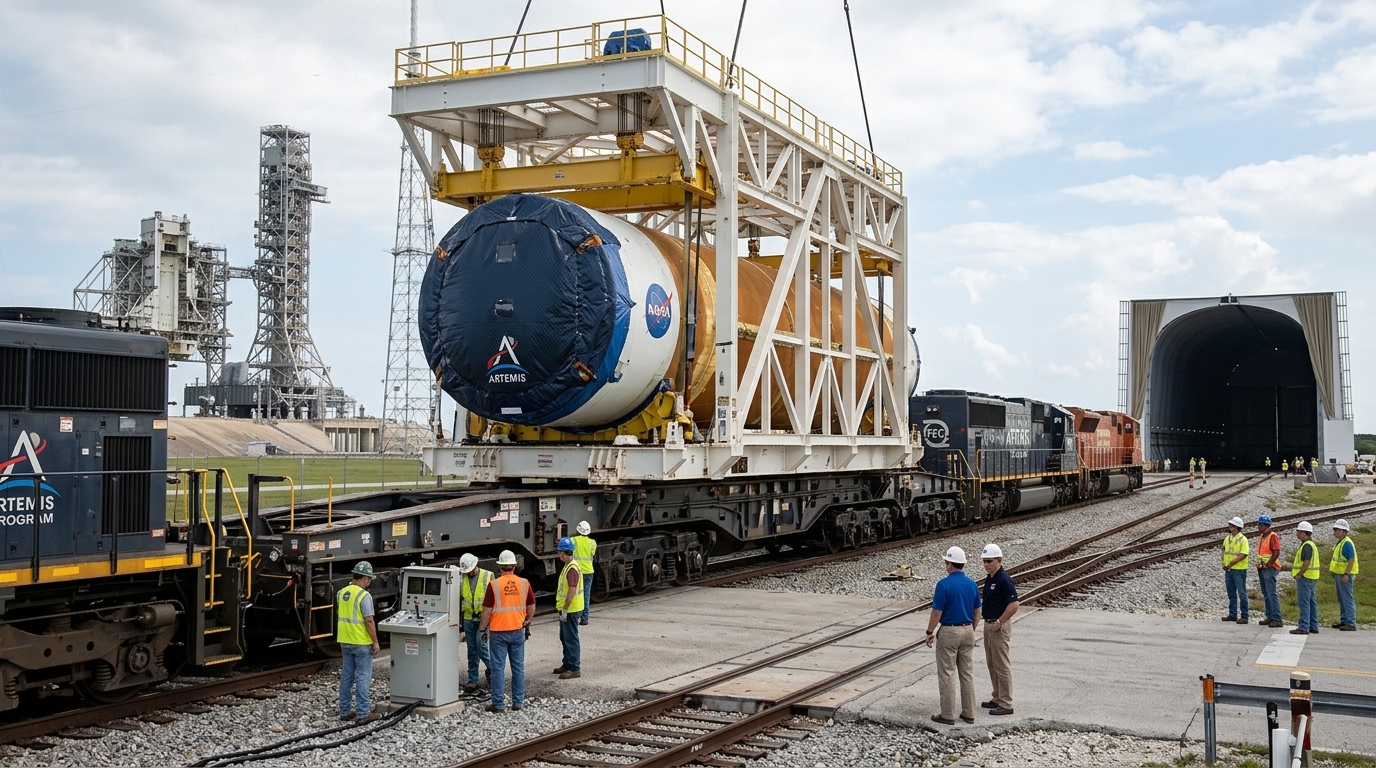
In a scene reminiscent of the Cold War’s greatest technological triumphs, NASA has commenced the transportation of critical components for the Space Launch System (SLS) rocket destined for the Artemis III mission. The 2,500-mile journey from Northrop Grumman’s facilities in Utah to the Kennedy Space Center in Florida is more than just a logistical feat; it is a stark reminder of the political continuity required for space conquest. This rocket carries the 'signature' of the Trump administration, which in 2017 laid the groundwork by accelerating the Artemis program, transforming the Moon from a distant goal into an immediate priority.
A Railway Bridge to the Stars
Transporting ten distinct segments of the Solid Rocket Boosters (SRBs) by rail is a decades-old NASA tradition, dating back to the Space Shuttle era. However, for Artemis III, the stakes are historic. This specific rocket is slated to carry the first woman and the first person of color to the lunar surface in a mission currently scheduled for 2026. Each booster segment weighs hundreds of tons, and their transport requires specialized, heavy-duty railcars, as any mishap along the route could jeopardize NASA’s entire timeline.
The choice of rail is not only practical but symbolic. It connects the industrial heartland of America with its gateway to the cosmos. As the train traverses the United States, it carries the hopes of a nation seeking to reaffirm its dominance in space at a time when competition with China has reached new heights of intensity.
Political Legacy and the Continuity of Artemis
While the Artemis program has enjoyed bipartisan support, the reference to the 'Trump signature' is not accidental. It was Space Policy Directive 1 in 2017 that redirected NASA toward the Moon as a stepping stone to Mars. The Biden administration, recognizing the strategic importance of the program, continued and even increased its funding, proving that space remains one of the few sectors where American policy maintains a steady course despite internal polarization.
"Returning to the Moon is not just a matter of science; it is a matter of national power and technological supremacy," notes an aerospace industry analyst.
However, the SLS is not without its critics. Many argue that the rocket is a "product of another era," expendable and prohibitively expensive compared to reusable solutions like SpaceX’s Starship. Nevertheless, NASA maintains that the SLS is the most reliable vehicle for getting the Orion capsule into lunar orbit for these foundational missions.
The Geopolitical Chessboard of the Moon
The arrival of the boosters in Florida coincides with increasing reports of progress in the Chinese space program. China aims to land its own astronauts on the Moon before 2030, creating a de facto race for control over the resources of the lunar South Pole, where water ice is believed to exist. Artemis III is the West's answer to this challenge.
Technical hurdles remain immense. NASA must successfully complete the Artemis II mission (a crewed flyby of the Moon) before proceeding with the Artemis III landing. Any delay in the delivery of rocket components or in the testing of SpaceX’s Human Landing System (HLS)—which will act as the "elevator" to the surface—could hand the advantage to Beijing. The train carrying Northrop Grumman’s boosters is not just transporting propellant and metal; it is carrying the prestige of a superpower.
Conclusion: A New Chapter
As the SLS segments are offloaded at Kennedy Space Center, NASA engineers begin the meticulous assembly process. The success of Artemis III will be the ultimate validation of a strategy that began nearly a decade ago. In a rapidly changing world, the return to the Moon symbolizes humanity's ability to dream of grand achievements once again, setting aside terrestrial differences for the sake of exploring the unknown.