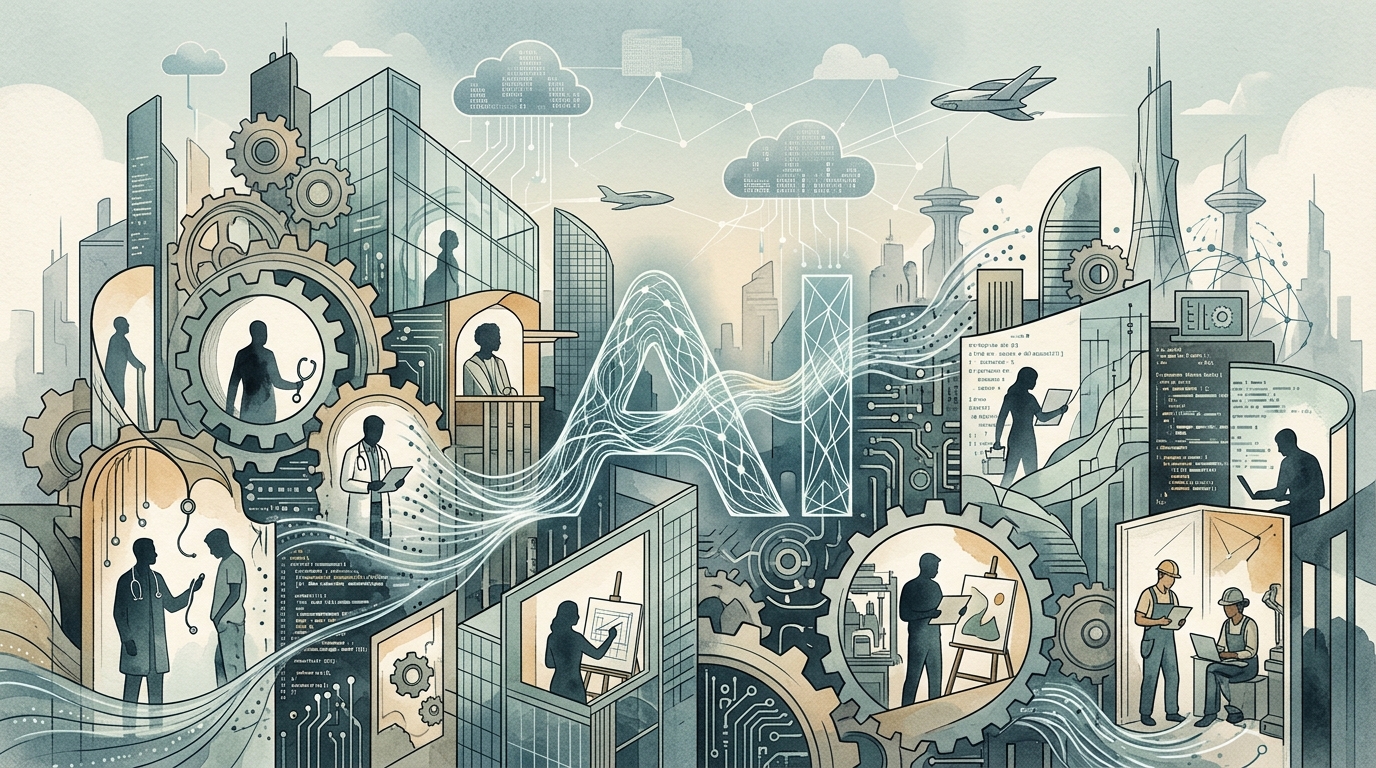
In a rare moment of stark transparency that has resonated through the halls of Wall Street and global policy centers, Satya Nadella, the visionary who propelled Microsoft to the forefront of the Artificial Intelligence revolution, has issued a warning that cannot be ignored. During recent public remarks, Nadella emphasized that the rapid adoption of generative AI could potentially "hollow out" entire sectors of the economy, overturning decades-old business models and fundamentally altering the nature of work as we know it.
The term "hollowing out" was not chosen lightly. In economic parlance, it refers to a process where the middle tier of an industry—whether in terms of skill sets or profit margins—evaporates, leaving behind a polarized structure with a few dominant winners at the top and a mass of low-wage service roles at the bottom. This time, however, the threat isn't aimed at factory floors, but at legal departments, financial institutions, creative agencies, and software development firms.
The Digital Erosion of Professional Domains
Nadella’s analysis focuses on AI’s unprecedented ability to automate cognitive tasks that were previously considered the "fortress" of human intellect. When a machine can draft a legal brief, write sophisticated code, or analyze complex financial datasets in seconds, the value proposition of the average professional is brought into question. What the Microsoft CEO is describing is a world where corporations can achieve the same, or even superior, output with a fraction of the workforce they currently employ.
For global markets, this warning carries immense weight. In economies heavily reliant on services and knowledge work, this "hollowing out" could manifest as a sharp decline in the demand for mid-level expertise. The risk isn't just outright unemployment, but the "commoditization" of labor: when AI performs 80% of a task, the compensation for the remaining 20% that requires human oversight may be drastically compressed. This creates a precarious environment for the global middle class, which has traditionally been the engine of economic stability.
The Productivity Paradox and Corporate Responsibility
There is an inherent irony in the fact that Microsoft, the primary provider of AI tools through its partnership with OpenAI, is leading this narrative of caution. Nadella appears to be adopting a strategy of "responsible leadership," acknowledging the externalities of his products before regulators do. He argues that the solution lies not in halting progress, but in a scale of workforce reskilling that humanity hasn't attempted since the Industrial Revolution.
However, skeptics point out that the hollowing out of traditional industries directly benefits tech giants. As legacy sectors weaken, their dependence on the cloud infrastructure and AI models provided by the likes of Microsoft, Google, and Amazon increases. Economic power is shifting from those who possess industry-specific knowledge to those who own the underlying algorithms and the compute power to run them. The "hollowing out" of others may lead to the "filling up" of Big Tech's coffers.
Toward a New Social Contract?
Nadella’s warning serves as a clarion call for governments to prepare for a structural crisis. If entire industries are drained of human-centric activity, tax systems based on labor income will face obsolescence. Discussions regarding Universal Basic Income (UBI) or "robot taxes," once relegated to the fringes of economic theory, are now becoming urgent priorities on the agendas of Brussels and Washington.
In conclusion, AI is not merely a new productivity suite; it is a catalyst for the reconfiguration of capitalism itself. The hollowing out predicted by Nadella could eventually lead to an era of unprecedented abundance, but the transition costs risk being borne by the middle class. Without a coordinated global effort to safeguard human value in the labor market, the efficiency gains of AI may come at a devastating social price. The question remains: can we build a future where AI augments humanity rather than replacing the very structures that sustain our societies?