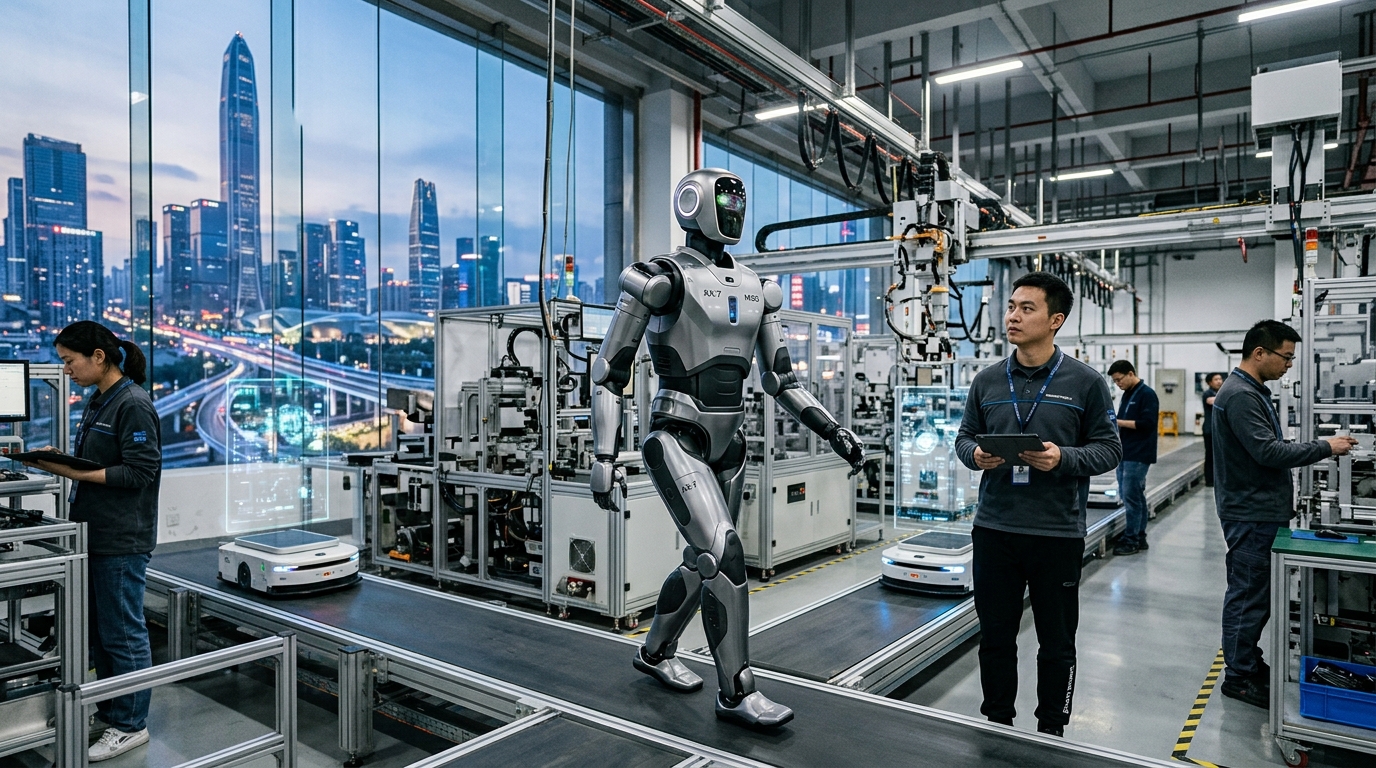
The global industrial landscape is on the cusp of a transformation that once belonged exclusively to the realm of science fiction. According to a recent report by Morgan Stanley, forecasts for humanoid robot shipments in China have doubled, as technological maturity and state support create an explosive mix for growth. This move is not merely a statistical adjustment but a resounding acknowledgement that "Embodied AI" is now ready to move from laboratories to production lines and, eventually, into daily life.
The Strategic Significance of the Chinese Market
China was not chosen as the focus of this report by chance. The country possesses a unique ecosystem that combines a vast manufacturing base with an urgent need for automation due to demographic shrinkage. Morgan Stanley points out that the Chinese government has designated humanoid robots as a priority of national importance, comparable to that of electric vehicles a decade ago. This political will translates into subsidies, tax incentives, and the creation of specialized industrial parks in Beijing and Shanghai.
The bank's analysis highlights that production costs in China are falling at rates that surprise analysts. Thanks to the existing supply chain for precision components—such as harmonic drive reducers and servo motors—Chinese manufacturers can produce humanoids at a fraction of the cost of their Western competitors. This "cost advantage" is the primary reason Morgan Stanley expects shipments to reach hundreds of thousands of units much earlier than 2030.
From Chatbots to Movement: The Role of Large Language Models
The real revolution, however, does not lie solely in hardware. The integration of Large Language Models (LLMs) into robotic systems has solved the industry's biggest problem: adaptability. Until recently, robots required rigorous programming for every single movement. Today, Artificial Intelligence allows humanoids to understand natural language, observe their environment, and learn new tasks through visual demonstration.
"We are not just seeing machines executing commands, but agents that perceive their environment and react to it in a way that simulates human reasoning," the report states.
This development enables robots to work in unstructured environments, such as warehouses with changing inventory or even household chores in the future. Morgan Stanley predicts that industry will be the first sector of full adoption, with humanoids taking over dangerous, repetitive, or unsanitary tasks that humans now avoid.
Challenges and Geopolitical Competition
Despite the optimism, the road is not without obstacles. Morgan Stanley notes that energy autonomy remains a challenge, as current batteries allow for limited operating time for robots that require high power for their movement. Furthermore, the geopolitical competition between the US and China over the control of advanced semiconductors could slow down the development of the "brains" of these machines.
However, China seems to be building a closed ecosystem that reduces its dependence on the West. Companies like Unitree, Fourier Intelligence, and UBTECH are already presenting models that rival Tesla's Optimus in agility and production speed. Morgan Stanley concludes that scaling production will lead to an "iPhone moment" for robotics, where the technology suddenly becomes accessible and ubiquitous, drastically changing the global economic landscape.
Conclusion
Morgan Stanley's doubled forecast is a warning to global markets: automation is no longer a distant promise. For China, it is the solution to its demographic impasse. For the rest of the world, it is a challenge to competitiveness. The era when humanoid robots will walk beside us in workplaces is approaching at rates few had predicted, and China seems determined to hold the reins of this race.