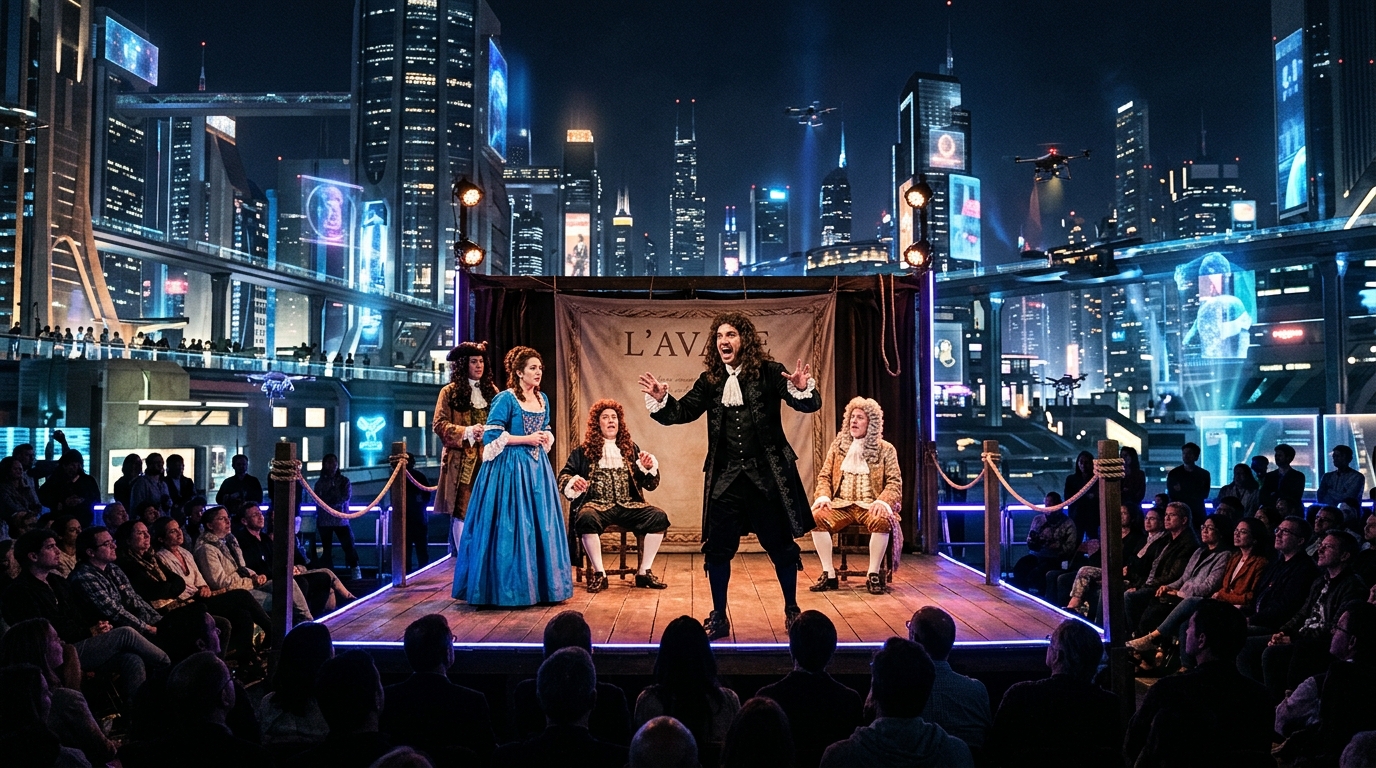
On the stage of contemporary theater, a shadow from the past seems to be taking on a new, digital life. Jean-Baptiste Poquelin, known globally as Molière, died over three centuries ago, but his spirit—or at least a statistical approximation of it—is returning via Artificial Intelligence. Recent news that a theatrical performance written by AI "in the style of Molière" is already being staged is not merely a technological feat; it is a cultural challenge that touches the very core of human expression.
The Digital Anatomy of the Alexandrine Verse
The endeavor to write a "new" play by Molière using a machine is no coincidence. Molière utilized specific structures, such as the alexandrine verse (a 12-syllable line with a specific meter and rhyme scheme), which lends itself perfectly to mathematical modeling. Large Language Models (LLMs) have been trained on his entire corpus, from "Tartuffe" to "The Miser," learning not only the vocabulary of the era but also the way the French playwright constructed conflicts between his characters.
The creators of the production argue that the AI managed to capture the irony and social critique that defined Molière. However, the question remains: can an algorithm understand the "why" behind a joke? Molière’s comedy was based on a profound observation of human vanity and the hypocrisy of the 17th-century bourgeoisie. AI, conversely, operates by predicting the next likely word. What emerges is an impressive mirror, but perhaps one lacking the depth of the original.
Theater as a Living Organism vs. Algorithmic Statis
The reaction from the artistic community is polarized. On one hand, some view AI as a new tool, akin to the introduction of electric lighting or digital projections. "It is a way to explore the possibilities of language," supporters claim. On the other hand, many actors and directors fear that art is being transformed into a "pastiche"—a soulless assembly of stylistic elements devoid of authentic lived experience.
In the production currently running, actors report a strange sense of "uncanniness." The dialogues are technically proficient but sometimes lack the emotional crescendo that only a human author, with their own wounds and experiences, could breathe into the work. Theater, at its heart, is an act of presence and interaction. When the text originates from a machine, the relationship between viewer and creator changes fundamentally. There is no longer a creator's "intent," but rather a model's "output."
Ethical and Legal Dilemmas on Stage
Beyond the aesthetic considerations, serious issues of intellectual property and ethics arise. Although Molière’s works are in the public domain, using them to train models that produce "new" works raises questions about the value of originality. Who is the "author" of this play? The programmer, the model trainer, or the machine itself? In the case of the performance mentioned by Flash.gr, human dramaturgs had to intervene to "polish" the text, proving that AI is still far from being an autonomous artist.
- AI's ability to mimic historical writing styles with high precision.
- The necessity for human editing to make the text theatrically viable.
- The risk of degrading artistic creation into a data recycling process.
- The challenge for actors to interpret texts lacking human intentionality.
In conclusion, Molière's return via algorithms serves as a reminder that technology changes not only how we live but also how we remember and create. Whether this "new" work will stand the test of time like the originals remains to be seen. For now, the curtain rises, and the audience is invited to decide if they can truly laugh at a joke born in a silicon processor.