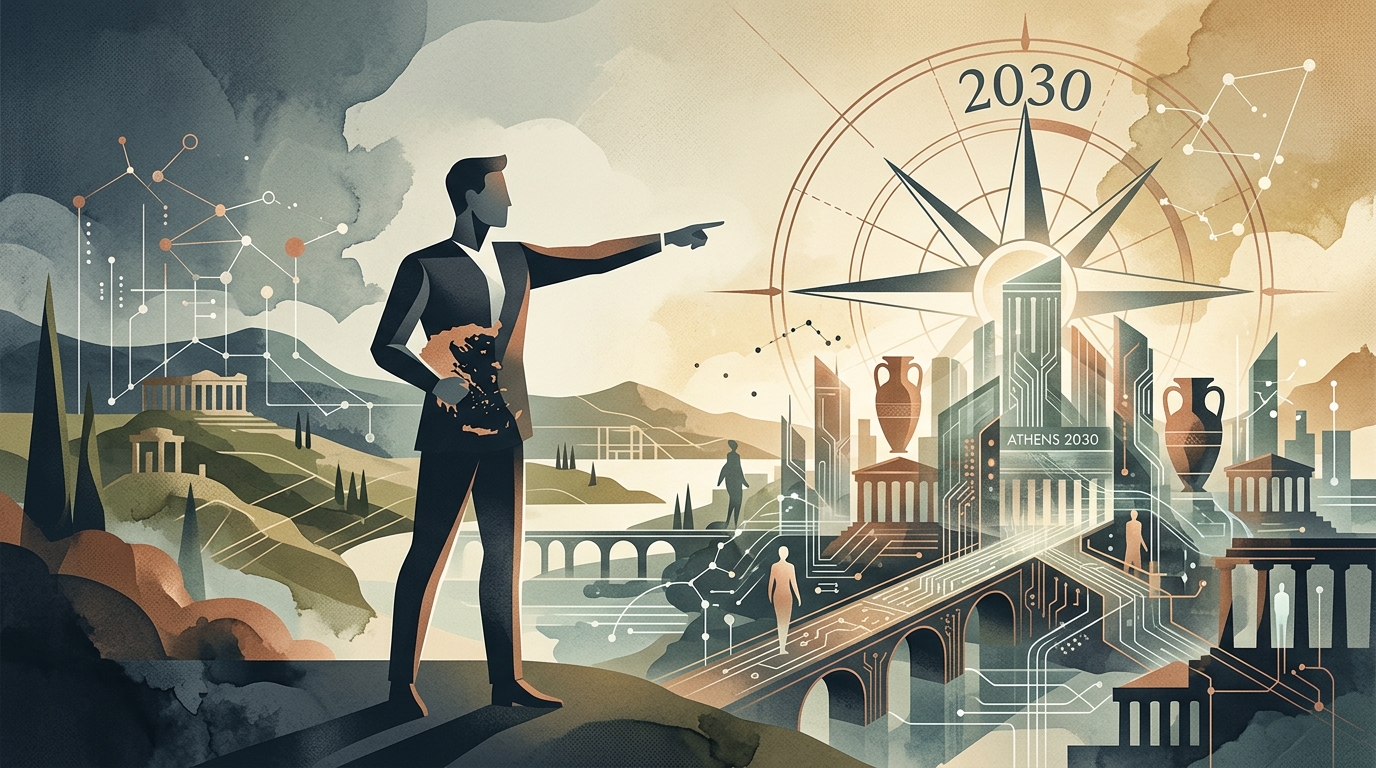
In an era where geopolitical balances are being redefined and technological evolution moves at speeds surpassing traditional political thought, Prime Minister Kyriakos Mitsotakis, through statements to the Macedonian News Agency, has set the 2030 milestone as the final stretch for Greece's full transformation. As we navigate the first half of 2026, the government's rhetoric is shifting from crisis management to building strategic resilience, with Artificial Intelligence and the green transition serving as the central pillars of this effort.
According to the Prime Minister, the next four years are not just a period of economic recovery, but a "world-historical" opportunity. Greece, which for decades sat on the periphery of developments, is now called upon to claim a leading role. This is no longer an abstract political promise but a necessity imposed by global shifts in supply chains, energy production, and digital sovereignty.
The Digital Revolution and the AI-Driven State
One of the central points of Kyriakos Mitsotakis' intervention is the integration of Artificial Intelligence (AI) across the entire spectrum of public administration and the economy. Following the successful digitization of core services via Gov.gr, the next phase involves using predictive models for decision-making. "It is not enough to follow developments; we must co-shape them," the Prime Minister emphasized, referring to the need for a "smart state" that can anticipate citizens' needs before they become urgent.
Investing in data infrastructure (Data Centers) and attracting tech giants to Greece form the foundation of this strategy. However, the challenge remains the education of the workforce. By 2030, the jobs we know today will have undergone radical changes. The government is planning massive reskilling programs with an emphasis on digital skills, seeking to turn the demographic problem into an opportunity through the productivity gains offered by automation.
Energy Hub and Geopolitical Stability
The Greece of 2030 envisions itself as the energy "lung" of Southeast Europe. The Prime Minister highlighted that the green transition is not only an environmental obligation but also a geopolitical tool. With the development of offshore wind farms and electrical interconnections with Egypt and Cyprus, the country aspires to become a net exporter of energy to Central Europe.
This energy autonomy strengthens Greece's position within the European Union, especially at a time when the continent is desperately seeking alternative sources away from authoritarian regimes. The "Greece 2030" strategy inextricably links domestic prosperity with external credibility. Participation in frameworks like the IMEC (India-Middle East-Europe Economic Corridor) places Greece at the center of new global trade routes, making it a port of entry for the technology and goods of the future.
Challenges and the Social Contract
Despite the optimism, the road to 2030 is not without obstacles. The Prime Minister acknowledged that "world-historical changes" bring significant social upheaval. Widening inequalities due to the digital divide and pressure on the cost of living represent the greatest risks to social cohesion. The political bet is whether the growth derived from AI and green investments will be distributed fairly across society.
In this context, the reform of education and healthcare remains the "open wounds" that must be closed by the end of the decade. Kyriakos Mitsotakis stressed that Greece cannot be a protagonist with institutions from the last century. Confronting state pathologies and establishing a culture of meritocracy are the prerequisites for not losing the historical opportunity opening before us.
"2030 is not just a date on the calendar; it is the moment when Greece must decide whether it will be the driver or the passenger of the new era," the Prime Minister concluded.
In conclusion, the vision for 2030 requires transcending traditional party lines and building a national consensus on the goals of technological and energy upgrades. The next four years will determine whether the country manages to capitalize on its current stability into permanent power within a rapidly changing global landscape.