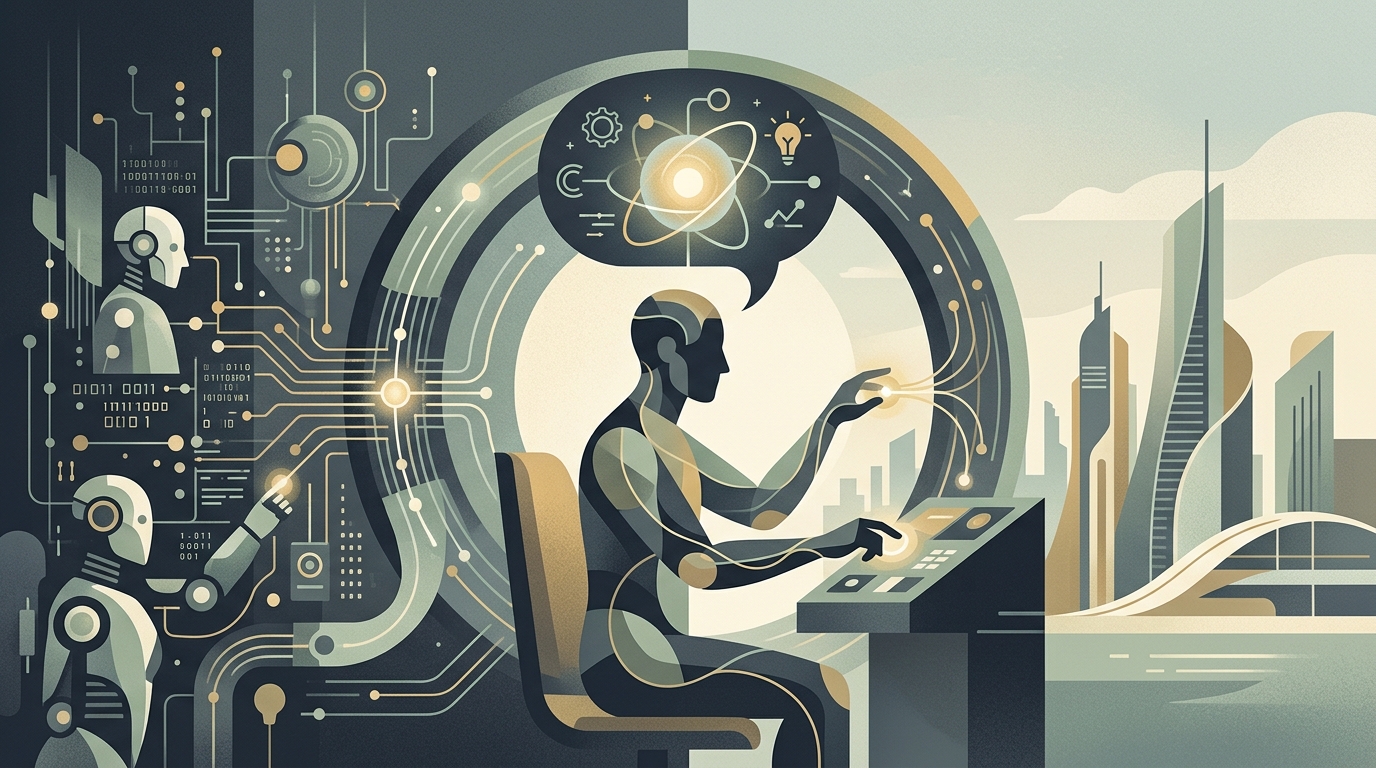
The departure of Mira Murati from OpenAI in the fall of 2024 sent shockwaves through Silicon Valley. As the architect behind ChatGPT and DALL-E, Murati was not merely an executive but the technical soul of the company that ignited the generative AI revolution. Today, through her new venture, Thinking Machines Lab, Murati seeks to redefine our relationship with the machine, prioritizing a model many thought lost in the race for Artificial General Intelligence (AGI): the non-negotiable presence of the human-in-the-loop.
The Philosophy of Collaborative Intelligence
In an extensive interview with WIRED, Murati made it clear that Thinking Machines Lab was not built to compete with OpenAI in the realm of raw compute power, but in the realm of utility and ethical integration. While Sam Altman and other industry leaders often speak of a world where AI performs the bulk of human labor, Murati envisions "reasoning machines" that function as extensions of the human intellect.
"I’m not interested in building something that simply replaces people," she stated. This approach is rooted in the belief that the true value of technology lies not in its autonomy, but in its capacity to collaborate. This means creating interfaces and models that allow the user to understand the AI's thought process, to intervene, and to correct its course in real-time. It is a shift from the "black box" model to one of transparent partnership.
Technical Innovation: Beyond Word Prediction
Today's Large Language Models (LLMs) are exceptional at predicting the next token, but they often lack what we call "deep reasoning." Thinking Machines Lab aims to develop models that can "think" before they respond, utilizing techniques reminiscent of System 2 in human psychology—conscious, slow, and analytical thought. According to Murati, keeping humans in this loop is not just an ethical imperative but a technical necessity to avoid hallucinations and ensure accuracy in critical fields like medicine and engineering.
- Robustness: Systems that recognize the limits of their own knowledge.
- Transparency: Models that explain the "why" behind every suggestion.
- Adaptability: AI that learns from user corrections without requiring full retraining.
The Political and Social Stakes
Murati's move comes at a time when the European Union and the US are tightening frameworks around AI safety. Her insistence on "human-in-the-loop" aligns with concerns regarding mass job displacement. If AI is designed as a tool for augmentation rather than replacement, its social acceptance will be smoother, and the economic fallout less painful.
"Technology should be a mirror of our values, not a threat to our existence. If we lose the human from the equation, we lose the meaning of progress itself," Murati notes.
However, the path is not without obstacles. Funding such ventures requires billions of dollars, forcing founders to balance their ideals with investor demands for rapid profitability. Thinking Machines Lab appears to have secured support from top-tier VCs like Thrive Capital, suggesting there is a market hungry for a more "responsible" version of AI.
Conclusion: A New Direction for Silicon Valley?
Mira Murati is attempting more than just founding a new company; she is attempting to change the industry's narrative. In a world that seems to be racing at light speed toward total automation, the reminder that humans must remain at the helm is vital. Whether Thinking Machines Lab can compete with the giants while staying true to its principles remains to be seen, but its very existence is a powerful rebuttal to the technological determinism of our time.