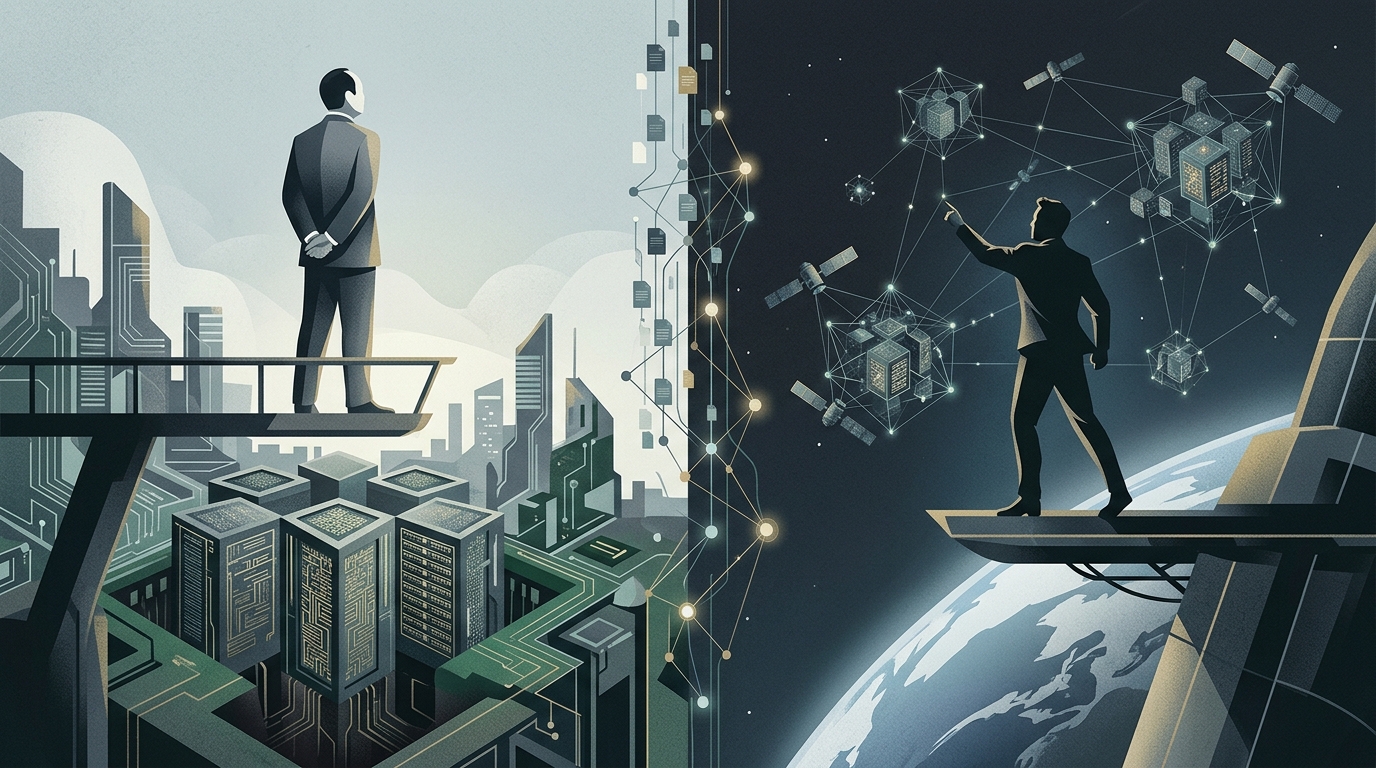
In an era where the race for Artificial Super Intelligence (ASI) increasingly resembles the Cold War, two of technology’s most prominent titans are clashing over the physical location of the future's "brain." Masayoshi Son, the enigmatic leader of SoftBank Group Corp., took a definitive stand during a recent address, dismissing Elon Musk’s vision for deploying data centers in outer space. For Son, the solution does not lie among the stars but is firmly rooted in terrestrial soil, where computational power can be controlled, cooled, and scaled at speeds that the vacuum of space simply cannot support.
The Terrestrial Reality of Super Intelligence
Masayoshi Son is no stranger to grand bets. Having funneled billions into ARM and the Vision Fund, his strategy is now laser-focused on ASI. According to Son, the energy requirements and thermal management challenges make space an "impractical" environment for the data centers that will train next-generation models. "Computing power requires massive amounts of stable energy and immediate access to maintenance infrastructure," Son remarked. The physics of space, while offering abundant solar radiation, presents a monumental problem: heat dissipation. In a vacuum, heat can only be transferred via radiation, making the cooling of millions of high-performance GPUs an engineering nightmare.
Furthermore, Son highlighted the issue of latency. Even with low-earth orbit (LEO) satellites, the distance from Earth adds milliseconds of delay that are critical for the real-time, bidirectional communication required by ASI. For SoftBank, victory in the AI sector will stem from massive server farms on Earth, interconnected by subsea fiber-optic cables and powered by large-scale nuclear or renewable energy sources.
Elon Musk’s Celestial Ambition
On the opposing side, Elon Musk, through xAI and SpaceX, advocates that space is the next logical frontier. Musk’s argument rests on the infinite availability of space and 24/7 solar power without atmospheric interference or weather disruptions. With Starship dramatically lowering launch costs, Musk envisions constellations of "compute-sats" operating outside the jurisdiction of terrestrial regulators and the constraints of local power grids.
However, critics, including Son, view this as more of a science-fiction scenario than a viable business strategy for the current decade. The complexity of launching sensitive semiconductors—which are prone to bit-flips and damage from cosmic radiation—adds layers of cost and risk that SoftBank is unwilling to entertain. Son believes that the terrestrial approach allows for faster iteration and immediate hardware upgrades, which are currently impossible in orbit.
The Geopolitics of Compute
The disagreement between Son and Musk is not merely technical; it is deeply political. Terrestrial data centers are subject to the laws of the nations where they reside. Japan, the US, and the EU are all racing to establish AI safety frameworks. A space-based data center could, theoretically, operate in a "gray zone" of international law. Son, however, appears to be betting on collaboration with governments and integrating AI into existing social structures.
SoftBank’s strategy involves building a global network based on ARM’s energy-efficient architecture. If AI is to become the "new electricity," it must be distributed through a network that is accessible and stable. Son warns that focusing on space distracts from the urgent need to restructure Earth’s power grids to handle the AI load. "We cannot wait for space to save us," seems to be his message; "we must build the future here, now."
Conclusion: The Market’s Verdict
While Musk continues to push the boundaries of the possible, Masayoshi Son remains tethered to the pragmatism of scale. The market, for now, seems to align with Son, as investment in terrestrial data centers reaches record highs. The battle for AI supremacy will be decided by who can produce the most tokens at the lowest cost with the highest reliability. In this game, Earth’s gravity—both literal and metaphorical—remains the strongest advantage.