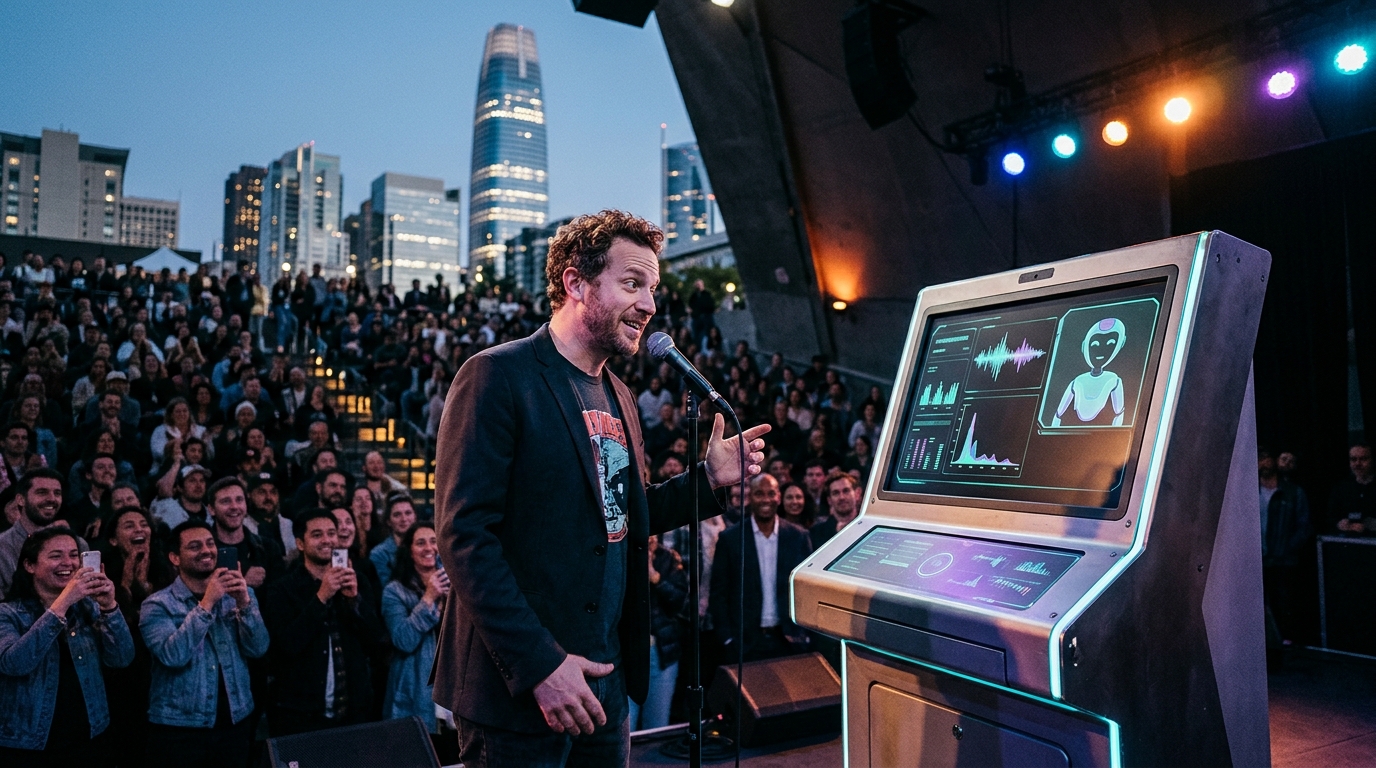
In the heart of San Francisco, where the technological hubris of Silicon Valley meets the raw honesty of street culture, an unusual experiment took place that promises to redefine the boundaries of generative Artificial Intelligence. This wasn't a demonstration of coding prowess or data analysis, but something far more personal, sharp, and deeply human: a Roast Battle. The event, titled "A.I. VS HUMAN ROAST BATTLE" and reported by BroadwayWorld, pitted a live rapper against a machine learning model in a quest to see if algorithms can master the art of the insult, humor, and social nuance.
This event is more than mere entertainment; it is a landmark in the evolution of Natural Language Processing (NLP). For decades, humor was considered the "final frontier" of human intelligence, requiring not just linguistic mastery but a profound understanding of cultural references, irony, and, crucially, timing. For a machine to "read" an opponent and deliver a biting retort that resonates with a live audience is a challenge that far exceeds simple text generation.
The Mechanics of the Burn: Training the Machine
To prepare an AI for such a confrontation, developers do more than just feed the model dictionaries. Training involves analyzing thousands of hours of stand-up comedy, rap battles, and historical roasts. The challenge lies in synthesis: the AI must identify the physical traits, style, or background of its opponent and convert them into comedic ammunition in real-time. This requires a multimodal AI approach, where the machine "sees" and "hears" the opponent before formulating a response.
However, AI faces a significant hurdle: the ethical guardrails and political correctness embedded in most large language models. An effective roast often flirts with the boundaries of the offensive. Researchers had to find a middle ground, creating an algorithm that is sharp without violating safety protocols—a balance human comedians find through empathy and "reading the room," skills AI is still struggling to simulate.
- The critical role of context in generating successful humor.
- Utilizing voice synthesis to convey emotional weight and sarcasm.
- Navigating the unpredictable nature of a live, reacting audience.
The Human Element: The Resilience of Spontaneity
Facing the processing power of billions of parameters, the human rapper counters with something the machine lacks: lived experience. Rap battles and roasts are traditions born from the need for survival and social validation in harsh environments. A human artist can utilize self-deprecation, play off the AI's glitches, and exploit the inherent "uncanniness" that robotic voices often produce.
"Technology can replicate the structure of a joke, but it cannot feel the satisfaction of winning over a crowd that was initially against you," remarked one of the event organizers.
On the San Francisco stage, the battle wasn't just about who had the best lines, but whether authenticity could be defeated by perfection. Spectators found themselves in a peculiar position, torn between admiration for the code's wit and an instinctive loyalty to their own species. This dynamic reveals much about our future relationship with AI: will we treat it as a tool, a partner, or a competitor to be humbled?
Beyond the Laughter: Implications for Entertainment
If an AI can hold its own in a roast battle, the applications for the broader entertainment industry are limitless. We could see interactive theater where scripts evolve based on audience reactions, or digital comedians offering personalized sets to every viewer. However, there is a darker side. The automation of creativity and wit raises questions about the value of human labor in the arts.
Furthermore, the ability of a machine to verbally "attack" a human, even in a controlled setting like a roast, opens a dialogue about the psychological impact of AI. How will we feel when an algorithm—which knows everything about us through our data—decides to criticize us? The San Francisco experiment is perhaps the first playful taste of a reality where machines won't just serve us, but will challenge us, mock us, and perhaps force us to think more deeply about what makes us unique.
In conclusion, the battle between the rapper and the AI did not produce a clear winner, but it highlighted a fundamental truth: technology has reached a level where it can mimic the complexity of human interaction. Whether it will ever acquire the "spirit" necessary to truly understand why we laugh remains the great question of our time. Until then, rappers and comedians can sleep soundly—though perhaps with one eye open.