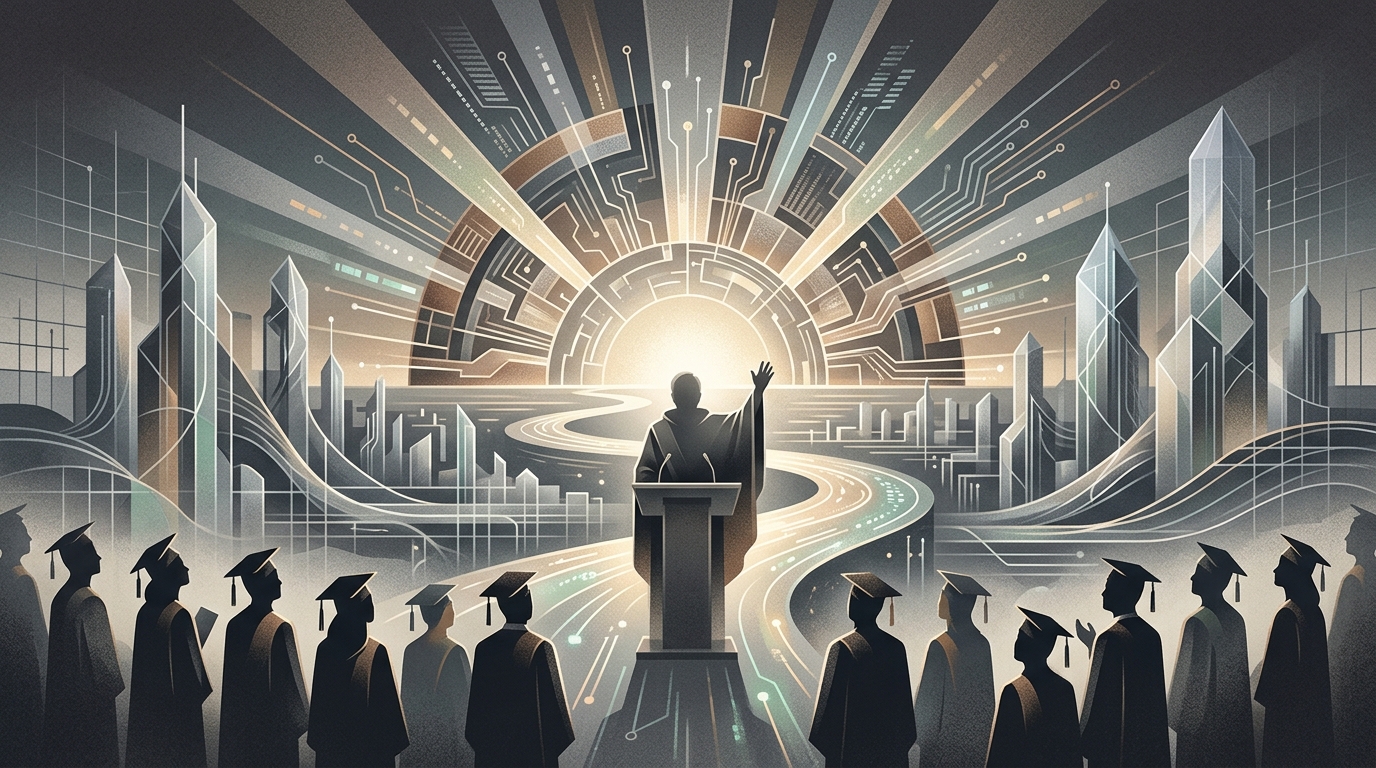
In an era where the global economy is being restructured under the weight of algorithmic advancements, Jensen Huang, the visionary leader of NVIDIA, issued a clarion call to new graduates. His message was clear and non-negotiable: your career is not just starting at a difficult juncture, but at the dawn of the most significant technological revolution in human history. For the class of 2026, artificial intelligence is not a future tool, but the bedrock upon which every facet of their professional lives will be built.
The Paradigm Shift
Huang, speaking with the confidence of a man who saw his company transform from a graphics card manufacturer into the central processor of the global digital brain, emphasized that AI represents a paradigm shift equivalent to the advent of the personal computer and the internet. However, the speed at which AI is penetrating every sector—from biotechnology to heavy industry—is unprecedented. His advice to graduates was to "run, don't walk," an exhortation that highlights the need for immediate adaptation.
According to Huang, the fear that AI will replace humans is partly misplaced. The real threat does not come from the machine, but from the human who knows how to use the machine better than you. In essence, AI acts as a "force multiplier." A programmer, artist, or data analyst leveraging LLMs and generative models can produce work that previously required entire teams. This democratization of productivity is the great opportunity, but also the great challenge, for the new generation.
The Strategy of the 'Agile Professional'
Huang’s speech was not limited to technical skills. He focused on the psychology of success in a high-volatility environment. NVIDIA itself went through periods near collapse before dominating the market, and this lesson of resilience is central to the CEO’s vision. Graduates must be prepared to fail fast, learn, and reinvent themselves.
- Adaptability: The ability to learn new AI tools every semester.
- Interdisciplinarity: Connecting AI with traditional fields like medicine or law.
- Ethical Judgment: The ability to discern truth in a world full of synthetic content.
Huang argued that AI will create new jobs that we cannot even imagine today, such as system-level prompt engineers or algorithmic ethics auditors. The new generation has the advantage of not having to "unlearn" old methods; they start from scratch with AI as a natural extension of their thinking.
Geopolitical and Economic Dimensions
We cannot ignore the fact that this speech takes place within a context of intense global competition. Access to computing power (compute) has become the new "oil." Huang knows that the graduates who will staff Western enterprises are the soldiers in a technological race with China and other emerging powers. Their success is not just personal, but a national and economic necessity.
"Artificial intelligence is not just a new technology; it is a new way to solve problems we thought were unsolvable. You are the first generation to have this magic wand in your hands from day one."
In closing, Jensen Huang reminded graduates that technology is the means, not the end. Human curiosity, the passion for creation, and empathy remain the only constants in a world changing at the speed of light. The challenge for the youth of 2026 is to use this vast power to address the great crises of our time, from climate change to social inequality, proving that humans remain the architects of the future, even when their tools are smarter than themselves.