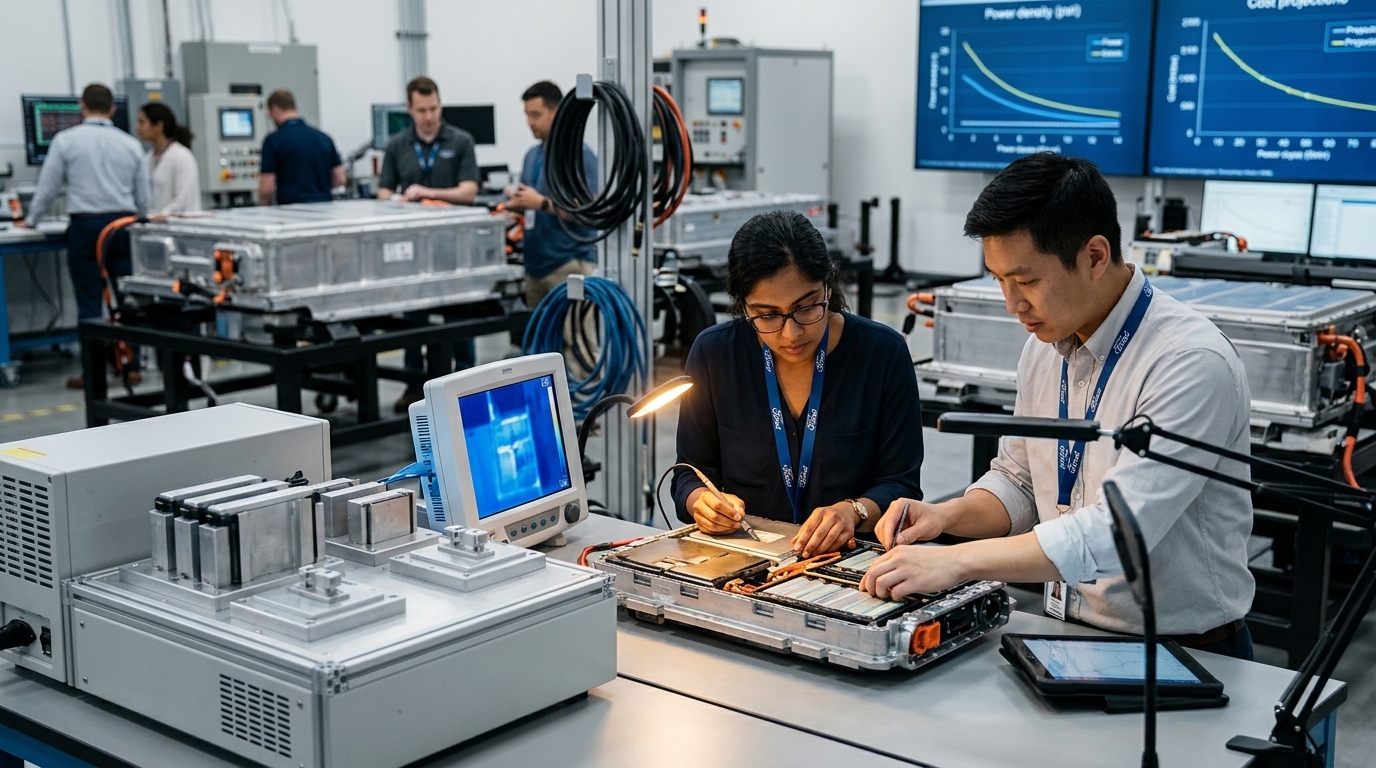
In the heart of Long Beach, California, far from the traditional halls of power in Dearborn, Michigan, a group of engineers is waging a quiet war. Ford, a giant that once laid the foundations of global motoring with the Model T, finds itself in an existential quest today. The stakes are not just about building another electric car, but creating a platform that will allow the Western auto industry to survive the surging Chinese threat. Ford’s “skunkworks” lab, led by Alan Clarke—a former Tesla executive—is the company’s last line of defense.
The Startup Strategy within a Titan
Jim Farley’s decision to create an independent unit for developing the next generation of electric vehicles (EVs) was no accident. Ford’s traditional structure, while effective for massive F-150 trucks, proved cumbersome and costly for the electric transition. The Long Beach lab operates with a startup mindset, stripped of the bureaucracy of 120 years of history. Here, the emphasis is not on luxury, but on “extreme cost efficiency.” Clarke’s team is working on the UEV (Universal EV) Project, a flexible platform capable of supporting everything from small crossovers to light commercial vehicles, aiming for a retail price near $25,000.
The need for this pivot became urgent following the ambiguous trajectory of the F-150 Lightning. While the electric pickup launched with enthusiasm, Ford was forced to scale back production, realizing that the market for early adopters willing to pay $70,000 has become saturated. The future belongs to the mass market, where price is the ultimate deciding factor.
The Ghost of China and the Technological Challenge
Ford’s real rival is no longer General Motors or Stellantis, but companies like BYD and Xiaomi. Chinese automakers have managed to vertically integrate their production to such an extent that they offer quality EVs at prices the West once deemed impossible. Ford knows that tariffs imposed by the US and the EU are merely a temporary protective measure. Without a radical overhaul of the manufacturing process, American manufacturers risk becoming marginal players.
In the Long Beach lab, the team focuses on two main pillars: the battery and the software. The use of LFP (Lithium Iron Phosphate) chemistry is central. Although LFP batteries have lower energy density than traditional NCM cells, they are significantly cheaper, safer, and have a longer lifespan. Furthermore, Ford is investing in a “software-defined” architecture, where the vehicle is designed around a central computer, drastically reducing wiring and the number of individual electronic control units (ECUs), which translates to lower weight and cost.
The Great Retreat and the New Bet
The recent cancellation of Ford’s large three-row electric SUV was a shocking move for analysts but perfectly logical for Farley’s new strategy. The company prefers to take a multi-billion dollar short-term accounting hit rather than continue investing in products that will not be profitable. The focus is now shifting entirely to the UEV platform.
The question remains whether Ford can change its DNA fast enough. Building a cheap electric car requires a discipline that the Detroit auto industry has forgotten for decades, having become addicted to the high profit margins of large SUVs and pickups. The Long Beach experiment is an attempt to recapture that lost art of efficiency. If it succeeds, Ford could lead the new era. If it fails, the California lab will go down in history as a brave but belated attempt to stem the inevitable.
- The UEV platform targets a starting price under $30,000.
- Using LFP batteries reduces costs by 30-40% compared to NCM.
- The skunkworks team operates autonomously to bypass corporate red tape.
- Ford is reallocating capital from large EVs to small, profitable models.