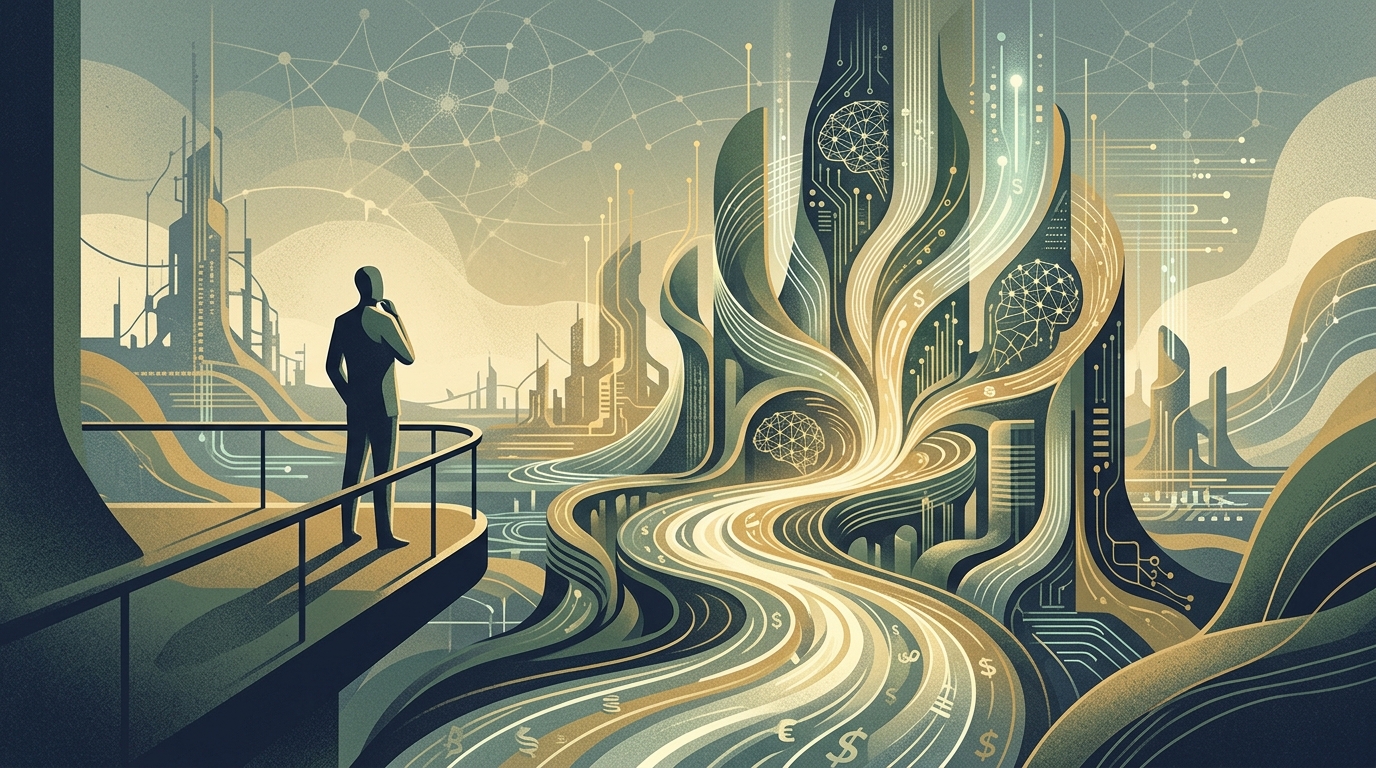
The history of digital business evolution can be divided into two major eras: the era of automation and the era of intelligence. For decades, automation was about executing predefined commands—the classic "if this, then that" model. However, as we move through 2026, we stand at the threshold of a fundamental shift. Businesses are no longer merely seeking faster workflows; they are pursuing autonomous AI Agents capable of thinking, adapting, and acting independently.
The Sunset of Rigid Workflows
Until recently, Robotic Process Automation (RPA) was the king of efficiency. It was excellent for repetitive tasks like data entry or invoicing but crumbled the moment it encountered an unusual case or a change in environment. Workflows were like railway tracks: fixed, reliable, but completely unable to turn if an obstacle appeared.
Today, the advent of Large Action Models (LAMs) and the maturation of Generative AI ecosystems have created a new reality. AI Agents do not just follow a list of instructions; they understand the end goal. If a customer requests a refund that falls outside standard policy, traditional automation would simply reject it. An AI Agent will analyze the customer's history, their lifetime value to the company, and propose a personalized solution, acting like an experienced employee.
The Architecture of the Autonomous Enterprise
Transitioning to the "intelligent enterprise" requires a new architecture. It is no longer about isolated tools, but about a network of agents (Agentic Ecosystems) that communicate with each other. In a marketing department, one agent might analyze market trends in real-time, while another generates content, and a third optimizes ad spend—all without the need for constant human intervention.
- Reasoning: The system's ability to analyze complex problems and plan steps of action.
- Tool Use: Agents can now use ERPs, CRMs, and email just like a human would.
- Memory: The capability to learn from past interactions and improve performance over time.
In Greece, we are already seeing pioneering companies in the energy and shipping sectors adopting these technologies. As noted by industry leaders like Team Candi, the challenge is no longer technical but organizational. Integrating AI Agents requires clean data and, crucially, a culture of trust toward the machine.
The Human Dimension and the Future of Work
The greatest concern remains the impact on employment. However, market analysis suggests that AI Agents are not replacing humans, but rather the "mechanical" aspects of their work. In the intelligent enterprise, the worker's role shifts from execution to oversight and strategic decision-making. Humans become the "orchestrators" of digital agents.
"AI will not replace managers, but managers who use AI will replace those who do not," is a common refrain in Silicon Valley circles, and in 2026, this has become an axiom.
In conclusion, the transition from automation to intelligence is a point of no return. Businesses that manage to integrate AI Agents into the core of their operations will not only gain speed but will acquire an unprecedented ability to adapt in a world changing at a geometric pace. The "intelligent" enterprise of tomorrow is already here, and it speaks the language of autonomy.