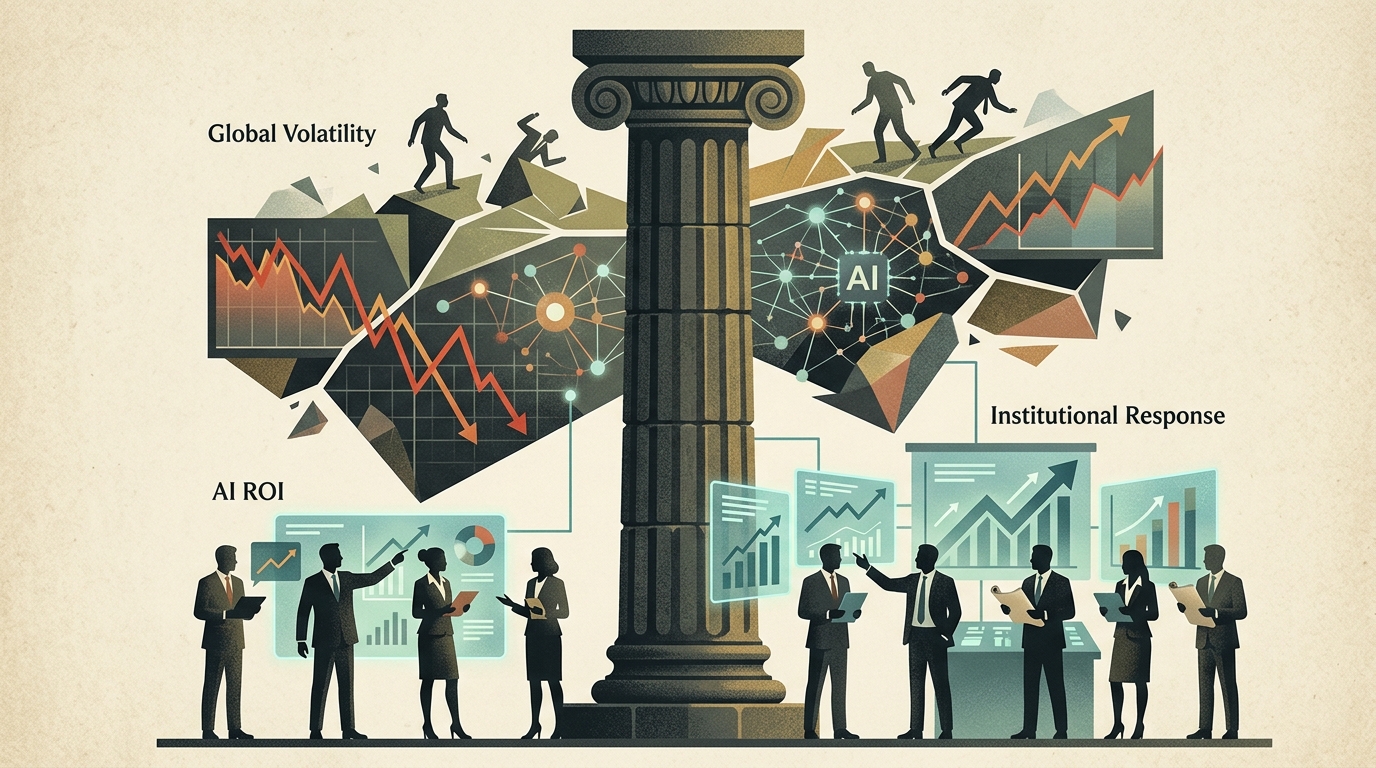
In an era where the global economy is desperately seeking new engines of growth, Ludovic Subran, Chief Economist and CIO of Allianz, has articulated the current market state in a striking manner: we are in the midst of a "Darwinian effect" of Artificial Intelligence (AI). Speaking on Bloomberg Television on June 23, 2026, Subran analyzed how the technological revolution is no longer just a Silicon Valley narrative, but an existential factor determining the valuation of every company on the stock market.
Survival of the Digitally Fittest
The term "Darwinian effect" was not chosen lightly. According to Subran, markets have shifted from viewing AI as a generic promise of the future to pricing in the actual ability of companies to integrate the technology into their daily operations. This is creating a two-tier divide. On one side, we have the "adaptive" organizations using AI to bolster profit margins, slash operational costs, and accelerate innovation. On the other, "digital dinosaurs" risk extinction as the cost of capital remains high and competition becomes increasingly predatory.
Allianz's analysis suggests that the concentration of capital in tech giants is not merely a speculative bubble, but a reflection of this selection process. Investors are "voting" with their capital in favor of those who possess the data, the computing power, and, crucially, the strategic leadership to leverage Generative AI. This process of natural selection is expected to intensify in the second half of 2026, as the first tangible results of AI implementation at scale begin to manifest in corporate balance sheets.
Inflation and Monetary Policy: The New Puzzle
One of the most compelling aspects of Subran’s thesis concerns the relationship between AI and inflation. While technological progress is traditionally viewed as deflationary due to productivity gains, the current transition is more nuanced. The massive energy demand from data centers and the urgent need for specialized labor are creating upward price pressures in specific sectors. Central banks, such as the Federal Reserve and the ECB, face a dilemma: how to calibrate interest rates when the economy is receiving a simultaneous supply shock (due to AI) and a structural shift in the labor market?
Subran argues that AI could ultimately assist in a "soft landing" for the economy by increasing efficiency without necessarily triggering mass unemployment—at least in the short term. However, uncertainty prevails. Markets are attempting to predict whether productivity gains will arrive fast enough to offset demographic pressures and the costs of the green transition. If AI fails to deliver the expected productivity dividends soon, current valuations will face a violent correction.
The European Challenge and Global Strategy
For Europe, the "Darwinian effect" is particularly concerning. The Allianz CIO pointed out that the gap between the US and Europe in AI adoption is widening. While American firms invest billions in infrastructure, Europe grapples with complex regulatory frameworks and a lack of large-scale venture capital. The risk for the European economy is becoming a mere consumer of technology produced elsewhere, missing the opportunity to lead in industrial AI, where it traditionally holds a competitive edge.
- Infrastructure vs. Application: Markets are moving from rewarding chip makers to rewarding those who use the chips to transform services.
- Capital Expenditure (CapEx): The massive spending on AI must eventually show a return on investment (ROI) to sustain market confidence.
- The R-Star Debate: AI's impact on long-term neutral interest rates is becoming a central theme for institutional investors.
"It is no longer about whether AI is real, but about who can afford it and who can implement it fastest. The market no longer forgives delay," Subran noted.
In conclusion, Allianz envisions a future where the divergence of returns between sectors will be immense. Investors must be extremely selective, focusing not just on the hype but on the substantive integration of technology. The era of easy money is over, and the era of intelligent survival has begun. The 2026 landscape is defined by this ruthless efficiency, where only those who evolve their business models through AI will thrive in the long run.