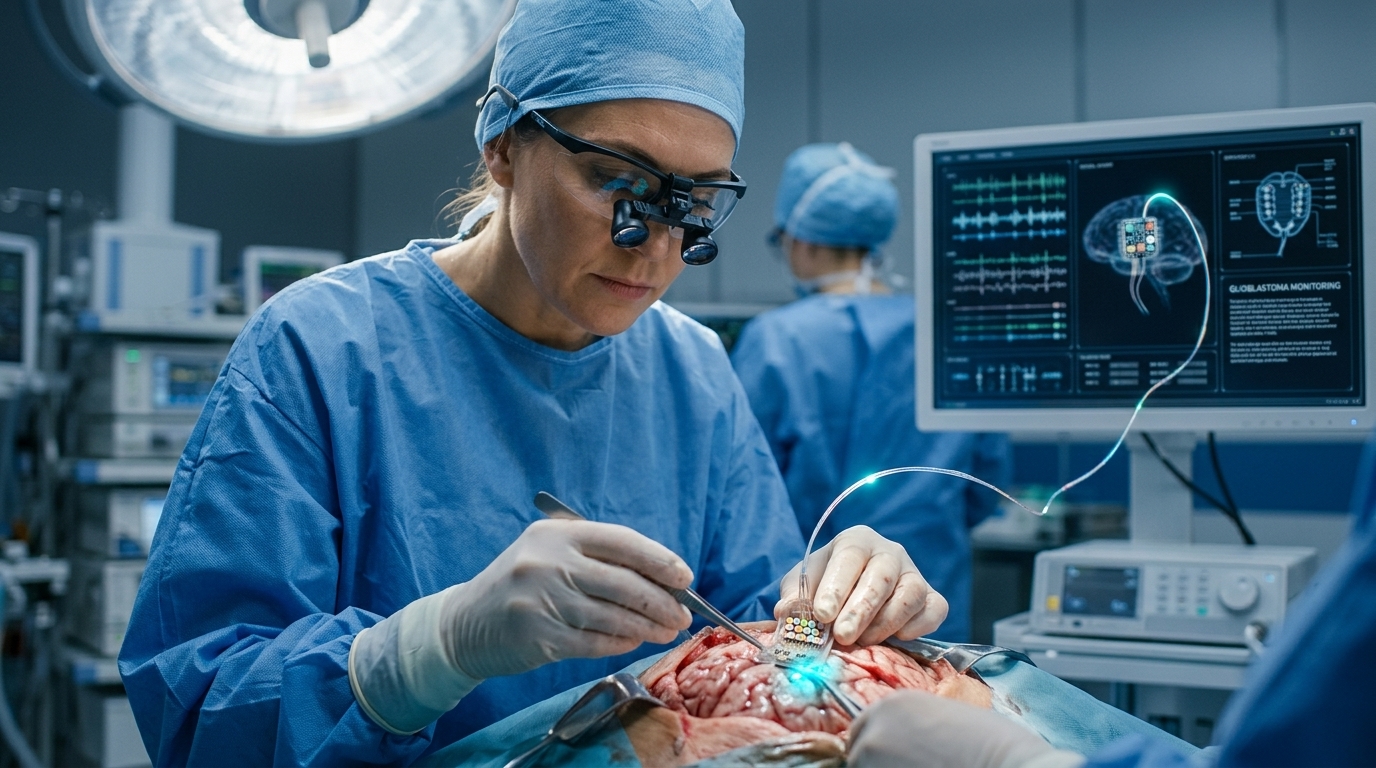
The battle against glioblastoma, one of the most aggressive and lethal forms of brain cancer, is entering a radical new phase. While traditional oncology relies on surgery, chemotherapy, and radiation, a US-based startup, Coherence Neuro, is proposing an approach that sounds like science fiction: using brain-computer interfaces (BCIs) to monitor and eventually electrically "short-circuit" tumors. To date, three patients have already received these implants, marking the beginning of a clinical trial that could redefine our understanding of cancer biology.
The Electrical Nature of Cancer
For decades, we viewed cancer as a purely genetic and chemical disease. However, recent research in neuro-oncology has revealed something startling: brain tumors are not just passive masses of cells. Instead, they actively "talk" to the nervous system. Glioblastoma cells form functional synapses with healthy neurons, hijacking electrical signals to fuel their growth and spread. This electrical integration makes the tumor part of the brain's network, explaining why it is so difficult to eradicate without harming the patient's cognitive functions.
Coherence Neuro leverages this exact property. Its implants, placed during the surgical resection of the tumor, feature electrodes that monitor activity in the surrounding tissue. The goal is twofold: first, to detect tumor recurrence much earlier than an MRI could, and second, to use electrical stimulation to disrupt the communication between neurons and cancer cells.
From Detection to Intervention
The current stage of the trial focuses on safety and detection capability. The first three patients carry a device that records data 24/7, transmitting it to an external processing unit. If the device identifies abnormal electrical patterns suggestive of tumor return, doctors can intervene immediately. In the future, Coherence Neuro hopes the implant itself will be able to emit targeted electrical pulses that "stun" the tumor, preventing it from growing further.
"We are no longer treating cancer as an external invader, but as a dysfunctional part of the brain's circuitry that needs to be reprogrammed," sources close to the research suggest.
This approach, known as "bioelectronic medicine," promises a more personalized and less toxic alternative to traditional therapies. While chemotherapy affects the entire body, the implant acts locally, targeting only the high-risk area. It represents a shift from systemic toxicity to localized precision.
Ethical Dilemmas and Biological Hurdles
Despite the excitement, the challenges remain immense. Placing an implant in the brain carries risks of infection, hemorrhage, or rejection by the body. Furthermore, there is the ethical question of constant monitoring of a patient's brainwaves. Although the purpose is medical, this technology opens the door to an era where mental privacy could be compromised.
Moreover, the effectiveness of electrical stimulation in halting cancer has yet to be proven on a large scale. Biological mechanisms are incredibly complex, and cancer is notorious for developing resistance. However, for glioblastoma patients, whose life expectancy is often measured in months, Coherence Neuro's technology offers a glimmer of hope where traditional medicine has reached its limits.
The Future of Neuro-Oncology
Coherence Neuro's move is part of a broader trend seeing BCIs move beyond rehabilitation (e.g., helping paralyzed individuals move) and into therapeutic medicine. If the trial proves successful, we could see similar devices for other forms of cancer or even neurodegenerative diseases like Alzheimer's. The convergence of artificial intelligence, neuroscience, and oncology is creating a new paradigm where the human body is treated as a data system that can be corrected with algorithmic precision. We are moving from the era of the pill to the era of the pulse.