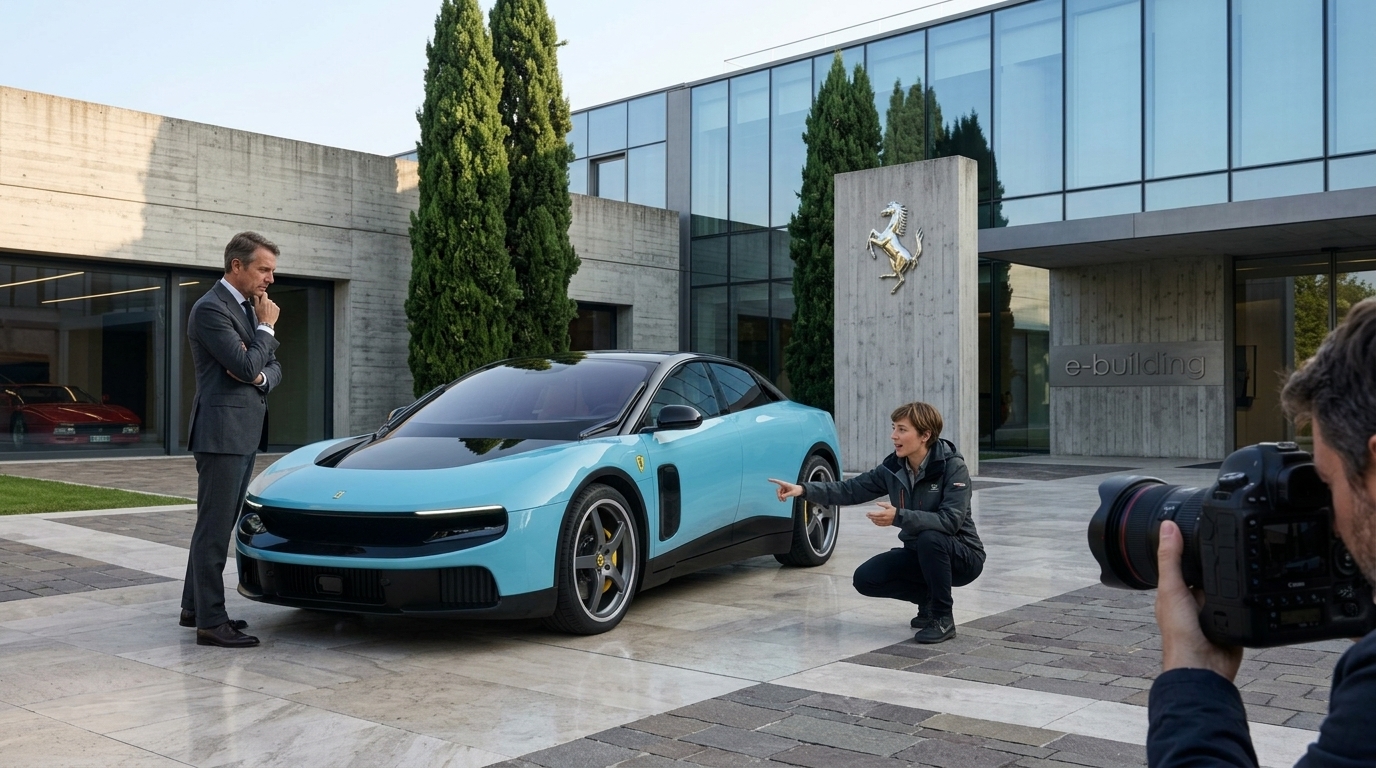
In the heart of Maranello, where the sound of internal combustion engines has for decades been the sacred chant of an entire region, an uneasy silence now prevails. The unveiling of the Ferrari Luce, the historic automaker's first all-electric model, was not merely a product reveal; it was a cultural collision. The Luce (Light) promises to lead the brand into a new era, but the initial reaction from markets and the brand's faithful followers, the famous Tifosi, has been anything but bright. The stock price drop following the announcement reflects a deep-seated fear: that Ferrari, in its quest to satisfy environmental regulations, might sacrifice its very soul.
The Sound of Silence and Investor Shock
For the average investor, Ferrari is not a car company but a luxury goods powerhouse with profit margins envied by Parisian fashion houses. However, the transition to electrification requires massive investments in R&D, which are putting pressure on profitability. The Luce, with a rumored price tag exceeding €500,000, targets an audience that doesn't just buy transportation but emotion. When CEO Benedetto Vigna took the stage, the absence of the characteristic engine roar was palpable. Markets reacted immediately, with the stock sliding 4% as analysts questioned whether the "electric driving experience" can maintain the same pricing power as traditional combustion models.
The challenge for Maranello is twofold. On one hand, it must convince traditional collectors that the Luce is a "real Ferrari." On the other, it must attract a new generation of wealthy buyers—the tech-nomads of Silicon Valley and Shanghai—who view internal combustion engines as anachronistic. Ferrari claims to have developed a unique "acoustic signature" for the Luce, which is not artificial but derived from the frequencies of the electric motors; yet for many, this feels like a low-quality substitute.
The 'e-building' Strategy and Autonomy
Ferrari is not walking blindly. The recent inauguration of the "e-building," a state-of-the-art factory dedicated to producing electric components, shows that the decision is final. The company wants full control over its battery and motor technology, refusing to become a mere "assembler" of third-party parts. This vertical integration is Vigna's big bet. If Ferrari can offer a battery with higher energy density and lower weight than the competition, then the Luce could redefine the hypercar segment.
- The Luce features four electric motors, one at each wheel, offering unprecedented traction control.
- Acceleration from 0-100 km/h is achieved in less than 2 seconds, surpassing almost every gasoline model.
- The use of synthetic fuels (e-fuels) remains on the table for future hybrid models as an attempt to save the V12.
However, technology alone is not enough. The Ferrari Luce must solve the problem of obsolescence. While a 1962 Ferrari 250 GTO increases in value over time, what will happen to an electric Ferrari when its battery technology is considered outdated in ten years? This is the question keeping collectors at a distance and investors on edge.
Politics and Environment: The EU Pressure
Ferrari's transition does not happen in a vacuum. The European Union, despite recent debates about easing measures, remains committed to the 2035 zero-emission target. Ferrari, as a low-volume manufacturer, had some concessions, but the pressure for ESG (Environmental, Social, and Governance) compliance from institutional investors is stifling. The Luce is the company's "green passport" to continue operating in the world's major metropolises, where restrictions on polluting vehicles are becoming increasingly strict.
"We don't sell cars; we sell dreams. And the dreams of the new generation are colored by electricity, not just the red of gasoline," said a company executive during the presentation.
In conclusion, the Ferrari Luce is the most dangerous chapter in the brand's history. If it succeeds, it will prove that luxury and speed can survive without fossil fuels. If it fails, it risks turning the Prancing Horse into an expensive gadget that loses its luster as soon as the next software update arrives. The stock drop is a warning: tradition is a heavy burden, and electricity might not be enough to lift it.