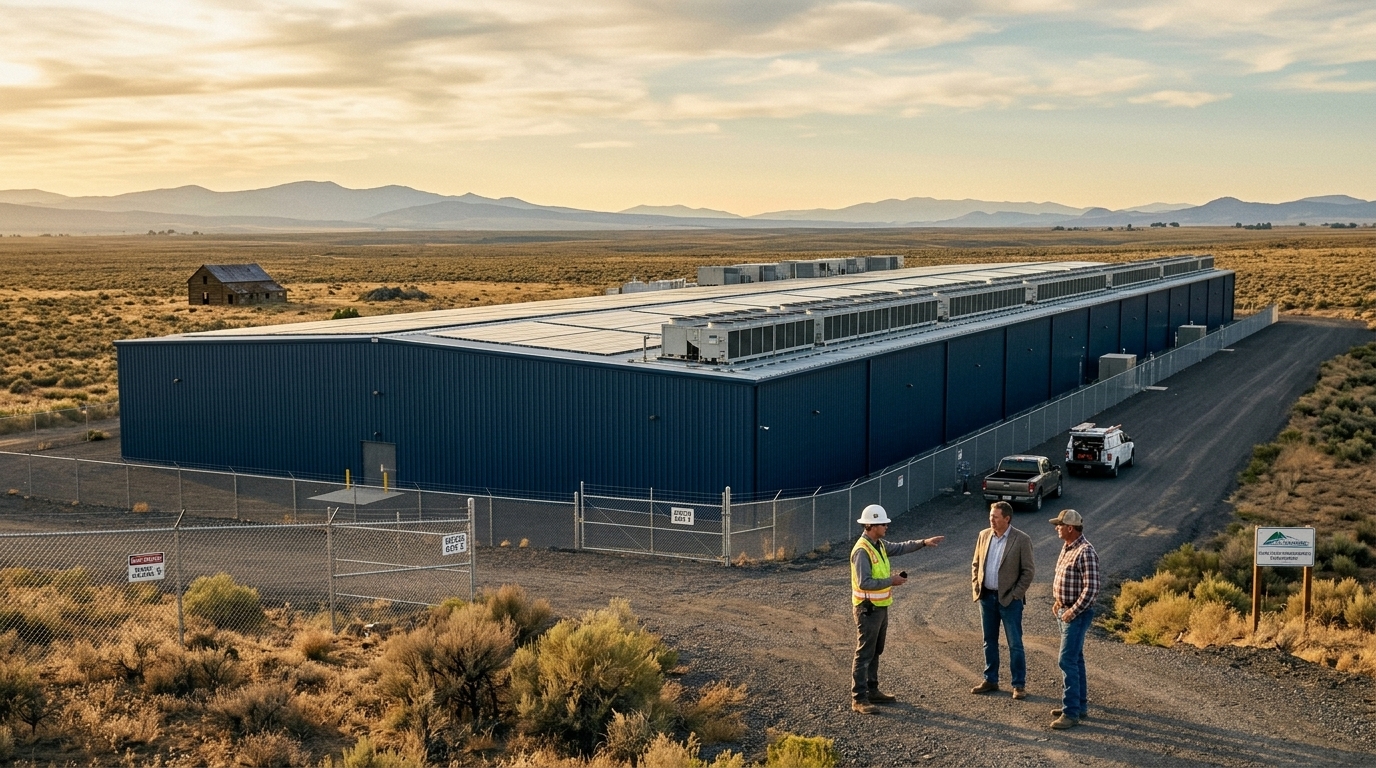
In the heart of Maine, where the hum of the Androscoggin paper mill once served as the pulse of the local economy, an eerie silence now prevails. The 2020 explosion of a pulp digester didn't just destroy a building; it tore the social fabric of Jay, a town of 4,000. Today, this 1.4 million-square-foot industrial carcass is being repurposed into something new—something that doesn't smell of pine and chemicals, but radiates the heat of thousands of servers. The rise of data centers in rural America is the new 'gold rush' for investors, but for residents, it is a stark reminder that their world is changing fundamentally without necessarily including them.
From Paper to Bits: Anatomy of a Transition
The case of Jay is not an isolated incident. Across the U.S. heartland, legacy industrial sites—from steel mills to textile factories—are being snapped up by tech consortiums. The reason is simple: infrastructure. These brownfield sites already possess high-voltage connections to the power grid and access to vast quantities of water for cooling, two essential ingredients for training next-generation artificial intelligence. DG Americas, involved in the Jay facility's acquisition, sees the future of the digital economy within these ruins.
However, the shift from manufacturing to information technology carries a bitter irony. At its peak, the Androscoggin mill employed 1,500 people. These were jobs requiring physical stamina and technical expertise, offering wages that sustained families for generations. A data center of the same magnitude, despite its massive footprint, requires only a few dozen technicians and security personnel. Industry is returning, but the jobs are not.
The Energy and Environmental Footprint
AI’s hunger for power is insatiable. As Microsoft, Google, and Amazon race to expand the capabilities of Large Language Models (LLMs), the strain on local power grids is intensifying. In Jay, residents worry that the massive demand from servers could lead to spiked electricity rates for households or grid instability during Maine's harsh winters. Furthermore, the water consumption required for cooling systems remains a contentious issue, especially in regions beginning to feel the erratic effects of climate change.
- Data center energy consumption is projected to double by 2030.
- Local property tax revenues increase, but direct employment plummet.
- Noise pollution from massive cooling fans is becoming a new source of community friction.
Social Identity and the Future of the Heartland
For towns like Jay, the mill was more than an employer; it was their identity. People called themselves 'papermakers.' Now, they are being asked to host 'digital ghosts.' Data centers are often windowless, inaccessible fortresses surrounded by barbed wire and cameras, offering zero interaction with the local community. The fear is that rural America is being transformed into a 'battery' for Silicon Valley—providing land and resources without receiving the social vitality that traditional industry once provided.
'We don’t build things anymore; we just store information about how to build things,' says a former mill worker, capturing the disillusionment of an entire class of laborers.
In conclusion, the arrival of data centers in Maine and other rural states is an inevitable evolution of technological progress. It represents the efficient reuse of legacy infrastructure, but it also highlights the profound gap between digital prosperity and the physical survival of local communities. The challenge for policymakers will be to ensure that these technological behemoths offer more than just tax revenue: they must offer a new sense of purpose to regions that feel increasingly abandoned by the march of progress.