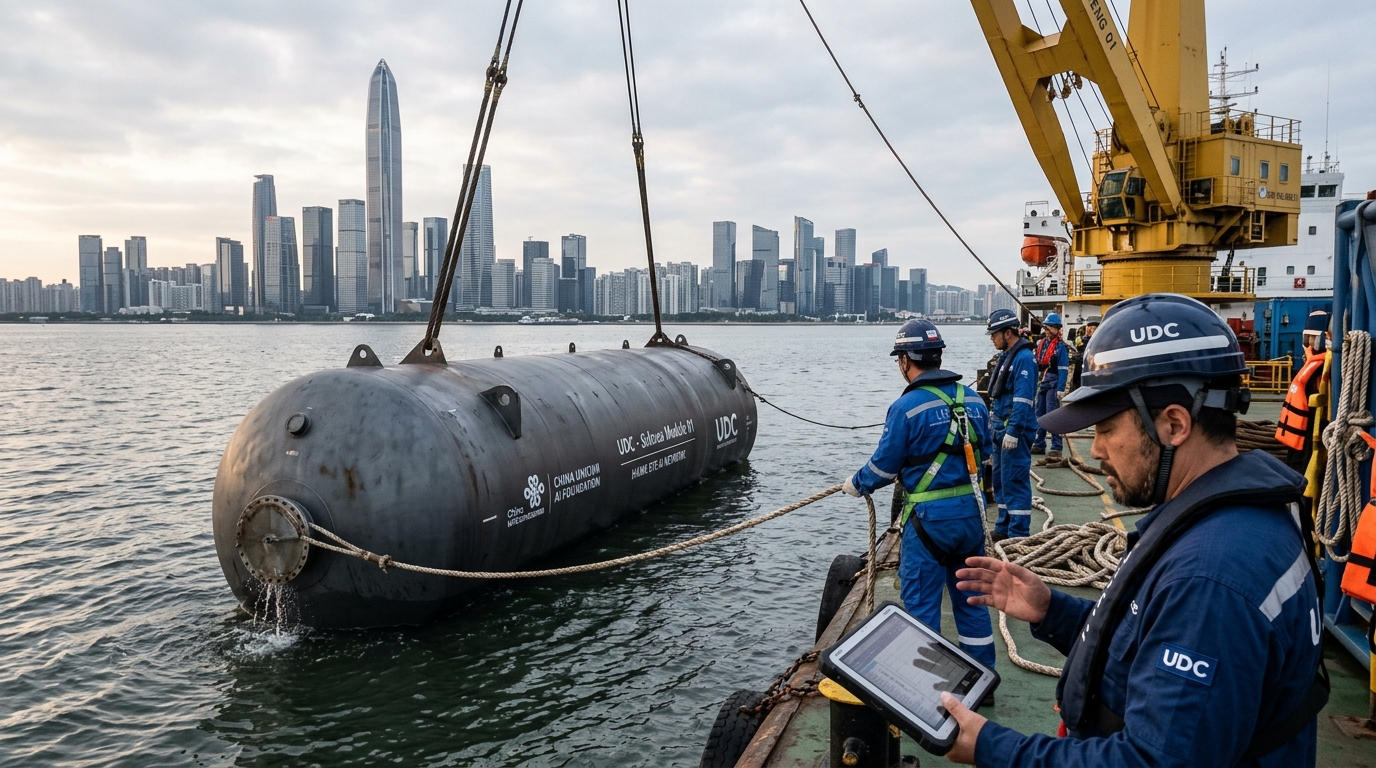
The global race for Artificial Intelligence supremacy is not only being fought in the software labs of Silicon Valley or Beijing but also in the depths of the world's oceans. As the demand for raw computing power skyrockets, the primary bottleneck is no longer just code architecture, but heat and energy. In a move that blends environmental engineering with a masterclass in infrastructure strategy, China has launched the world’s first commercial underwater data center (UDC), powered entirely by offshore wind energy.
Located off the coast of Hainan Province, this project represents a bold answer to the digital age’s energy paradox: the smarter our technology becomes, the more the planet suffers from its thermal footprint. By submerging servers on the seafloor, China is harnessing the ocean's natural cooling capacity, effectively eliminating the need for the vast amounts of freshwater and electricity required by traditional terrestrial air-conditioning systems.
The Engineering of the Abyss: How the Underwater Cloud Operates
An underwater data center is far more than a waterproof box; it is a marvel of maritime and information engineering. Each unit weighs approximately 1,300 tons—roughly the weight of 1,000 cars—and is designed to operate at depths of 35 meters. The servers are housed in pressure vessels filled with inert gas to prevent corrosion and oxidation, while seawater circulates around the exterior shell, absorbing heat at a rate that land-based facilities can only envy.
According to Highlander (Shenzhen Hi-Cloud), the company leading the venture, the energy efficiency is staggering. The PUE (Power Usage Effectiveness) ratio—a metric where 1.0 is the theoretical perfect score—is estimated to be near 1.05. In comparison, the global average for traditional data centers hovers around 1.58. This efficiency gap translates into millions of kilowatt-hours saved annually, a critical factor as global energy prices remain volatile.
Synergy with Offshore Wind
What makes the Hainan project truly revolutionary is its direct integration with offshore wind farms. Rather than drawing power from a national grid that remains heavily reliant on coal, the underwater data center is tethered to nearby wind turbines. This creates a localized, green ecosystem of data production and consumption.
- Land Conservation: In densely populated coastal hubs, land is a premium asset. The seafloor offers virtually unlimited real estate.
- Water Preservation: Traditional data centers consume billions of gallons of freshwater for cooling, a resource becoming increasingly scarce due to climate change.
- Edge Computing Benefits: With 80% of the world's population living near coasts, placing data centers in the ocean reduces latency, providing faster services for end-users.
Geopolitical and Environmental Implications
China’s move is as much political as it is technical. Within the framework of the "East Data, West Computing" national strategy, Beijing is attempting to balance digital development between its affluent eastern coast and the interior. Underwater centers allow coastal megacities like Shanghai and Shenzhen to expand their digital infrastructure without straining urban land use or local power grids.
"The sea is not just the future of the supply chain; it is the new lung of the digital economy," industry analysts suggest.
However, the project is not without its critics and challenges. The long-term impact of thermal discharge on marine ecosystems is still being studied. While engineers argue that the localized temperature rise is negligible, the planned scale of the facility—aiming for 100 modules by 2027—demands rigorous environmental oversight. Furthermore, maintenance at such depths requires specialized robotics, as human intervention is both difficult and prohibitively expensive.
The Future of AI Infrastructure
As AI models become increasingly energy-intensive, China’s solution may set the global standard. While Microsoft experimented with the concept via Project Natick years ago, China is the first to bring it to a full-scale commercial reality. The stakes are high: if successful, the ocean could become the new home of the global cloud, offering a sustainable path forward for humanity's insatiable hunger for data and computation.