

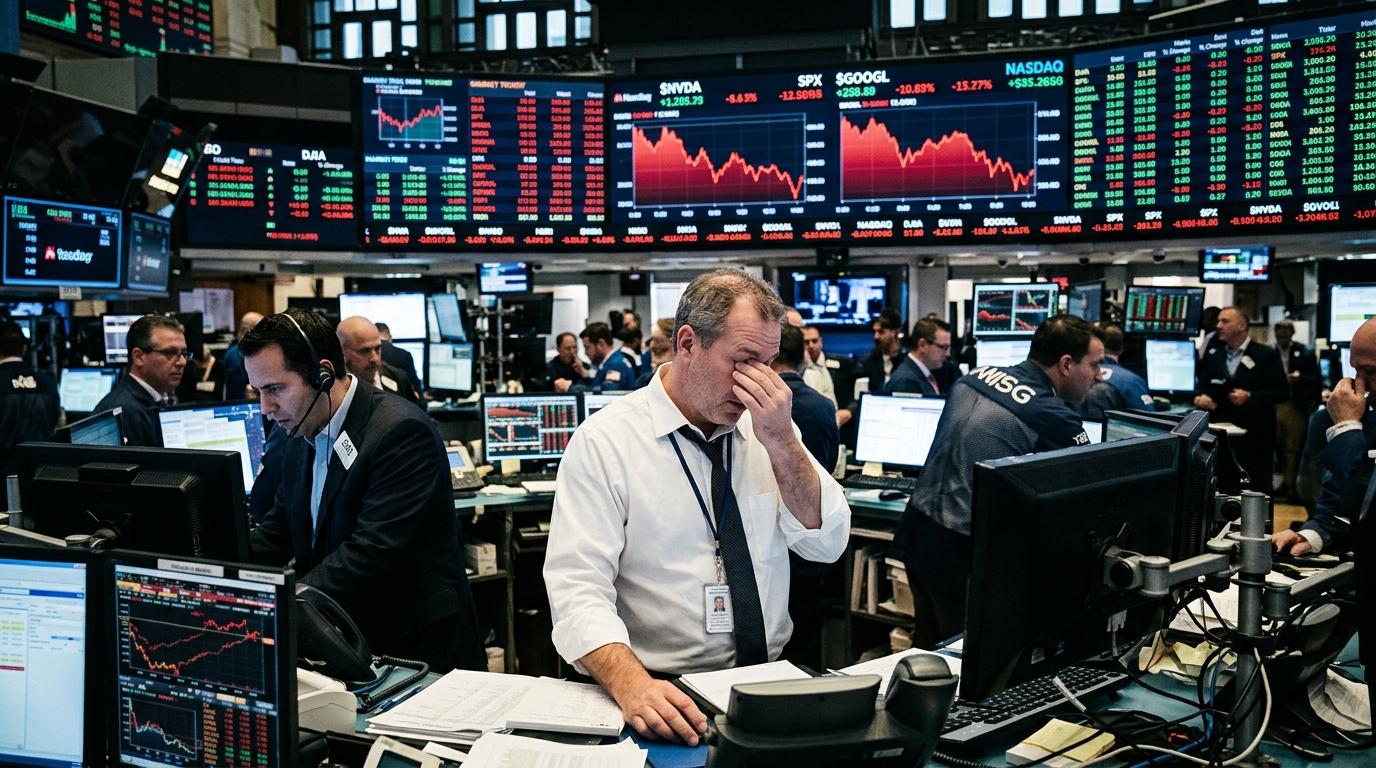
Wall Street faced another volatile session as investors began to recalibrate their expectations for the tech sector’s dominance in the current economic landscape. Despite initial hopes for a steady climb, major indices retreated, dragged down by significant losses in technology shares—a sector that has functioned as the primary engine for market growth for months. This volatility is not merely a random fluctuation but reflects a structural shift in market psychology as we move into the second half of 2026.
The Great AI Reality Check
For nearly two years, the promise of Artificial Intelligence (AI) fueled one of the most impressive bull runs in Wall Street history. However, today’s downturn suggests that investors are transitioning from a phase of pure excitement to a phase of demanding tangible results. Companies that have poured billions into AI infrastructure are now being asked to prove that these investments translate into bottom-line profits and operational efficiency. When industry giants in semiconductors and software see their valuations under pressure, the message is clear: the market is no longer satisfied with long-term narratives alone.
Analysts point out that this "tech fatigue" is partly due to historically high valuations. With price-to-earnings ratios at record levels, the margin for error is razor-thin. Any hint of a slowdown in chip orders or a cooling in cloud service adoption triggers waves of liquidation as institutional investors move to lock in gains. The focus has shifted from the potential of the technology to the sustainability of the business models supporting it.
Macroeconomic Pressures and the Inflation Ghost
Beyond the internal dynamics of the tech sector, Wall Street is being heavily influenced by the broader macroeconomic environment. Recent statements from Federal Reserve officials suggest that the battle against inflation is not yet fully won. While interest rates have stabilized, the prospect of an early rate cut seems to be receding, which directly impacts growth stocks that rely on affordable borrowing for future expansion.
- Rising Treasury yields are providing a competitive alternative to equities.
- Geopolitical tensions continue to threaten the supply chain for critical raw materials.
- Household consumption is showing signs of fatigue due to the cumulative cost of living.
This combined pressure is forcing portfolios to rotate into more defensive sectors, such as energy and consumer staples. This "rotation" is evident in daily fluctuations where the Dow Jones often outperforms the Nasdaq, highlighting a preference for companies with steady cash flows and reliable dividends over high-growth, high-risk tech ventures.
Investor Strategy for the Remainder of 2026
As we head toward the autumn months, focus is shifting to the second-quarter corporate earnings reports. These will serve as the ultimate "crash test" for the tech industry. Investors will be looking for granular details on how AI is being integrated into business processes and what the actual cost of maintaining these systems entails. The era of the "blank check" for tech companies appears to be coming to a close.
"The market is at a crossroads where technological supremacy must be accompanied by fiscal discipline," noted a senior New York market strategist.
In conclusion, today's drop on Wall Street should not be viewed as a collapse, but rather as a necessary correction that brings the market closer to reality. While technology will remain the central pillar of the global economy, the excesses of the past are giving way to a more mature and cautious investment approach. The coming months will determine whether the AI revolution can deliver the productivity gains needed to justify its current price tag.





