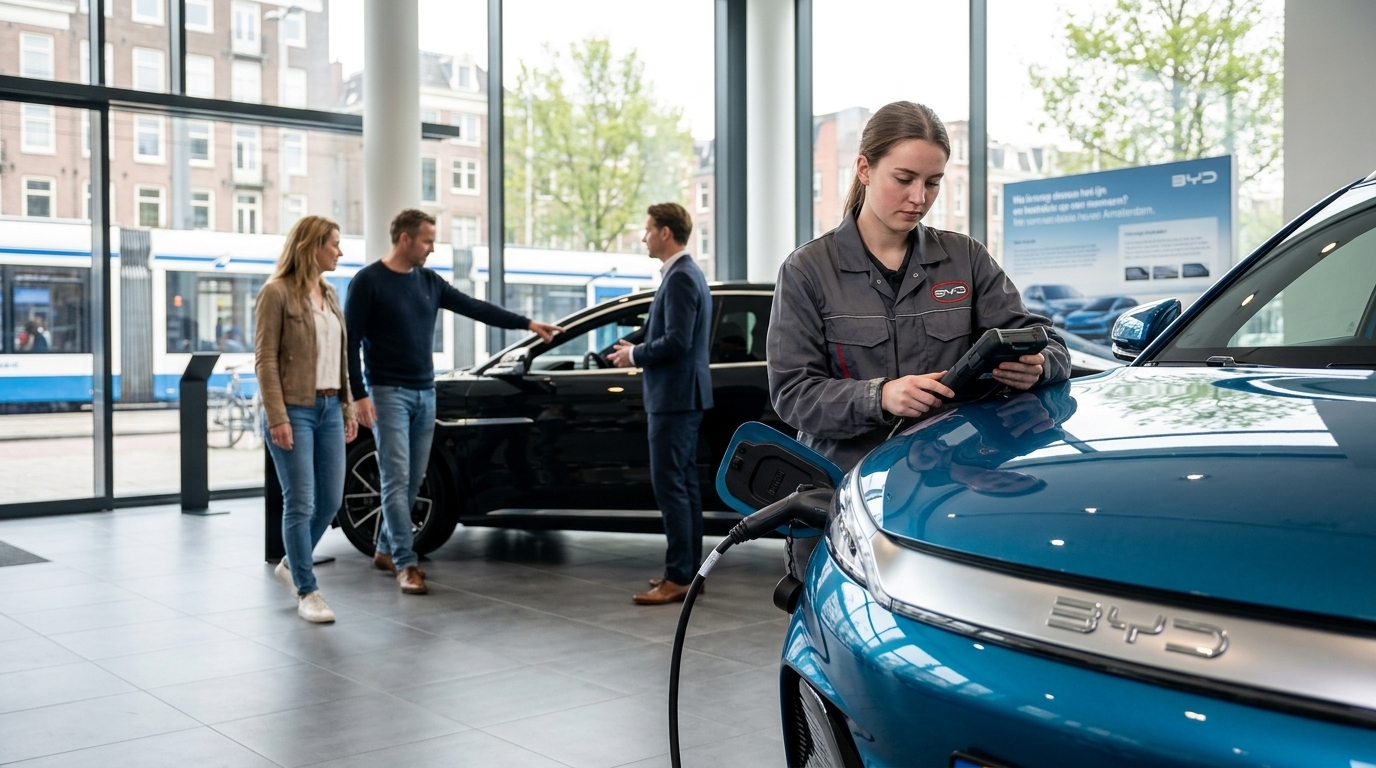
In the heart of the European automotive landscape, where names like Volkswagen, BMW, and Stellantis once reigned supreme, a new contender from the East is not just changing the rules—it is redesigning the entire pitch. BYD (Build Your Dreams), the Chinese titan that has already challenged Tesla for the crown of global EV sales, has announced a strategic masterstroke: the deployment of 3,000 'Flash Chargers' across Europe and the UK by the end of 2027.
The Technology of Instant Gratification
The secret to achieving a five-minute charge lies not only in the charging station itself but in BYD’s proprietary battery technology. Their acclaimed 'Blade Battery,' which utilizes Lithium Iron Phosphate (LFP) chemistry, has long been praised for its safety and longevity. However, the next generation of these batteries, paired with the 800V architecture of BYD’s latest models, allows for energy absorption at rates previously thought impossible for mass-market vehicles.
BYD’s Flash Chargers are expected to deliver power outputs reaching up to 500kW. To put this in perspective, most fast chargers in Europe currently range between 50kW and 150kW, while Tesla’s Superchargers max out at 250kW. The ability to add 400-500 kilometers of range in the time it takes to order and drink an espresso effectively dismantles the final psychological barrier for consumers: charging anxiety.
Geopolitical Chess and Trade Barriers
This move comes at a highly sensitive geopolitical moment. The European Union has recently imposed significant tariffs on Chinese-made EVs, accusing Beijing of distorting the market with state subsidies. BYD’s response is ingenious: instead of merely exporting hardware, it is investing in the continent’s core infrastructure. By building a proprietary network that offers seamless integration and likely preferential pricing for BYD owners, the company makes its vehicles far more attractive than domestic rivals who must rely on fragmented and often unreliable public charging networks.
- Deployment of 3,000 high-power hubs at strategic highway locations.
- Partnerships with local energy providers to ensure 100% renewable sourcing.
- Integration of Energy Storage Systems (ESS) to mitigate grid strain.
BYD is not just building chargers; it is building an ecosystem. Much like Apple created the App Store to lock users into the iPhone, BYD is creating the 'Flash Network' to make owning a European EV feel like a slow, outdated compromise.
The Challenge for the European Grid
However, realizing this vision is fraught with technical hurdles. Delivering 500kW to a single charging bay requires immense electrical capacity. When ten such chargers operate simultaneously, the demand is equivalent to the consumption of a small town. European grid operators are already voicing concerns about stability. BYD plans to circumvent this by installing massive battery buffer systems at each station. These buffers will charge slowly during off-peak hours or from on-site solar arrays, then 'discharge' their energy rapidly when a vehicle plugs in.
"The era of waiting is over. If Europe wants to lead the green transition, it must accept that speed is the new currency of mobility," a BYD executive stated during the Munich unveiling.
In conclusion, BYD is attacking where Europe is most vulnerable: the lack of a cohesive, high-speed infrastructure. While European legacy automakers focus on protecting their market share through political lobbying and tariffs, China is investing in the utility of the technology itself. They are transforming the electric car from an 'ecological sacrifice' into a superior technological experience. The road to 2030 now appears to be paved with Flash Chargers from Shenzhen.