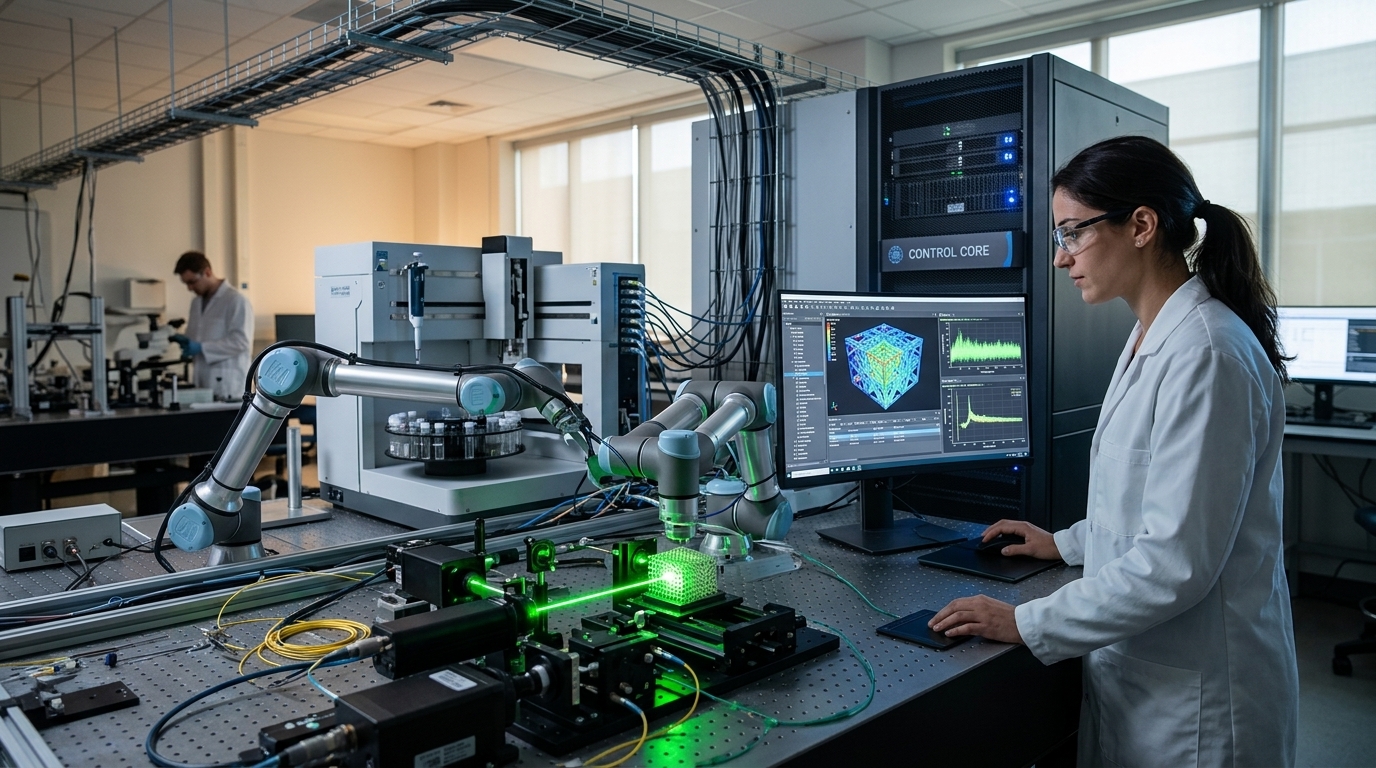
May 1, 2026, will likely be recorded in the annals of the history of science as the moment humanity handed over the keys of empirical discovery to machines. A new study published on ArXiv (2604.27092) describes the successful operation of an artificial intelligence system that performs end-to-end autonomous scientific discovery on a real optical platform. We are no longer talking about simulations or theoretical models, but a physical setup where AI makes decisions, moves mirrors, adjusts lasers, and analyzes data to arrive at new conclusions.
The Shift from Assistance to Autonomy
Until today, Artificial Intelligence in science functioned primarily as an incredibly fast assistant. Scientists used algorithms to analyze vast amounts of data or to predict protein folding. However, the core of the scientific method—formulating a hypothesis, designing the experiment, and revising the theory based on the results—remained an exclusively human prerogative. This new research overturns that status quo.
Using agents based on Large Language Models (LLMs), researchers created a closed-loop system. The AI agent begins with a general research question. It then "thinks" about which physical arrangement could provide an answer, writes the code to control the optical instruments, executes the experiment, and, most importantly, learns from its failures. If the results do not align with predictions, the AI modifies its hypothesis and repeats the process, just as a postdoctoral researcher would, but with speed and precision that surpasses human capabilities.
The Optical Platform as a Proving Ground
The choice of an optical platform for this achievement was not accidental. Optics offers an environment where variables are highly controlled, and data can be collected at immense speeds via light sensors and cameras. The system's ability to manipulate physical objects through software—moving optical elements with nanometer precision—demonstrates that AI now has "hands" in the physical world.
- Autonomous experimental setup design.
- Dynamic error correction during execution.
- Automated statistical analysis and inference.
- Continuous learning through iterative discovery cycles.
What makes this approach revolutionary is the use of LLMs not just for drafting text, but as reasoning engines that can understand the physical significance of experimental data. The model doesn't just see numbers; it understands that a change in the angle of a prism affects light refraction and uses this knowledge to optimize its next step.
Implications for the Scientific Community
The emergence of autonomous science evokes both awe and concern. On one hand, the pace of innovation could accelerate exponentially. Discoveries that would have required decades of experimentation could now be completed in a matter of weeks. This has immense potential in fields such as materials science, quantum computing, and pharmacology.
"We are not just automating the lab; we are automating curiosity and critical thinking itself," says one of the study's lead authors.
On the other hand, questions arise regarding the interpretability of results. If an AI discovers a new law of physics or a new material, will we be able to understand the "why" behind the discovery? The risk of a "black box" science, where machines produce knowledge that humans simply consume without understanding, is now palpable. Furthermore, access to such autonomous platforms may create a new divide between wealthy research institutions and the rest, reshaping the geopolitical map of knowledge.
Conclusion: The New Role of the Scientist
In this new landscape, the role of the human scientist is shifting. From being the executor of the experiment, the human becomes the architect of questions and the judge of the ethics and significance of the results. Creativity will remain our last bastion, as we will be called upon to direct these powerful machines toward problems that have real value for humanity. The autonomous optical laboratory is just the beginning; the future of science is already here, and it is written in code and light.