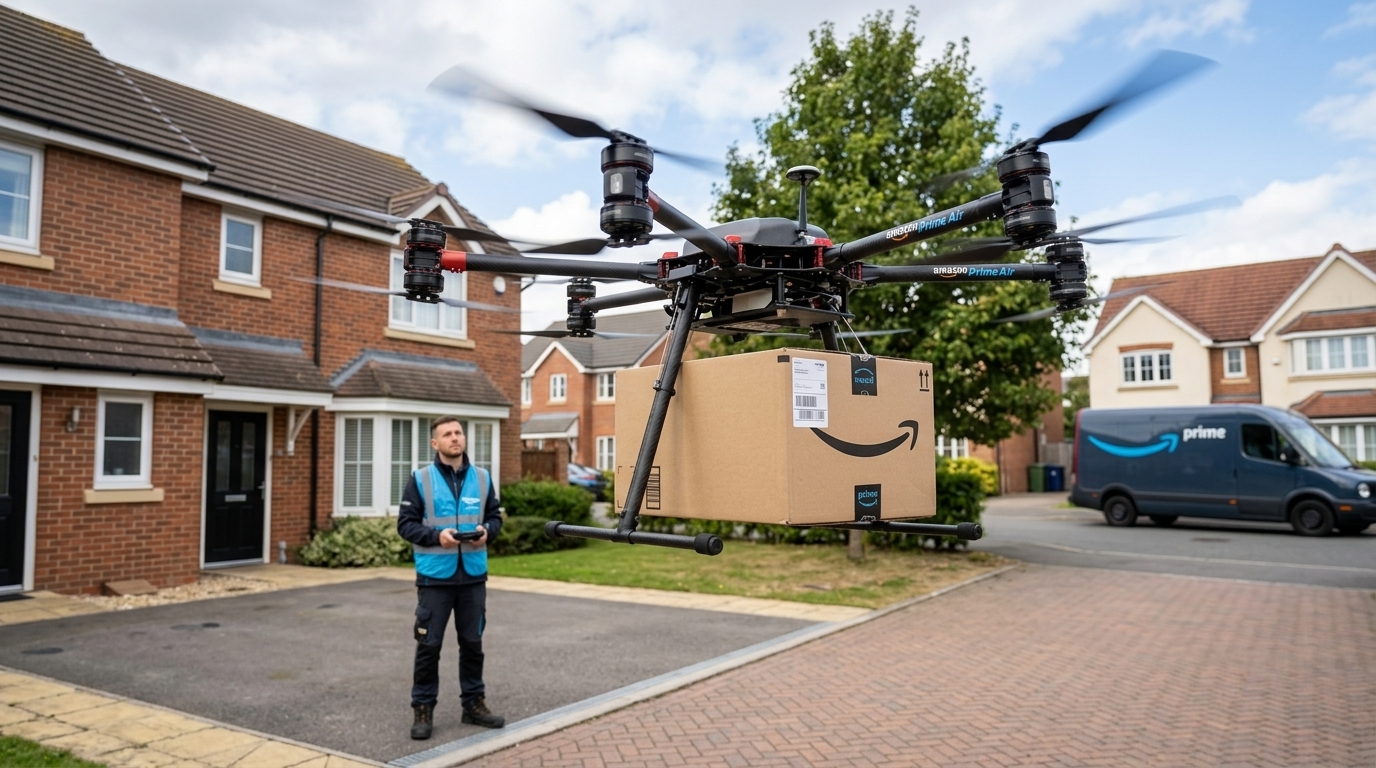
May 7, 2026, will be recorded in the annals of global commerce as the day Britain's skies officially opened for commercial drone deliveries. After years of testing, regulatory hurdles, and technological iterations, Amazon has formally launched its Prime Air service in Darlington, Northeast England. This is not merely a marketing stunt; it represents the full integration of autonomous aerial vehicles into the supply chain of one of the company's largest fulfillment centers in Europe.
The MK30 Technology: Silent and Efficient
At the heart of this new era lies the MK30 drone. Unlike its predecessors, the MK30 is engineered to operate in populated areas with minimal disruption. Amazon claims this new model is 50% quieter than previous iterations, a crucial detail for gaining social acceptance in local neighborhoods. The drone features Vertical Take-Off and Landing (VTOL) capabilities, transitioning to horizontal wing-borne flight for greater speed and efficiency.
One of the most significant technological breakthroughs is the 'Sense and Avoid' system. Utilizing artificial intelligence and advanced sensors, the drone can detect and bypass obstacles such as aircraft, pets, trees, and power lines in real-time. This sophisticated autonomy allowed the UK Civil Aviation Authority (CAA) to grant permission for 'Beyond Visual Line of Sight' (BVLOS) flights—operations where the controller does not need a direct line of sight to the aircraft.
The UK as a Global Laboratory
The choice of Darlington was strategic. The British government, through its 'Future Flight' program, has demonstrated greater regulatory flexibility than the US FAA, aiming to position the country as a leader in autonomous transport. Amazon's collaboration with the CAA serves as a blueprint for how regulators and innovators can coexist without compromising public safety.
Residents participating in the pilot can now order thousands of items—ranging from pharmaceuticals to household essentials—weighing up to 2.2kg (5lbs). The promise? Delivery to their backyard in under 60 minutes, with a goal to reduce that to 30 minutes shortly. This speed radically redefines 'instant gratification' and sets a new benchmark for competition with traditional brick-and-mortar retail.
Economic and Environmental Implications
From an economic perspective, drone delivery is the 'Holy Grail' of last-mile logistics. Van deliveries are costly due to fuel, urban congestion, and driver wages. Drones, being fully electric, drastically reduce the carbon footprint per package while simultaneously de-congesting road networks. Amazon aims to conduct 500 million drone deliveries annually by the end of the decade, which would represent a massive optimization of operational resources.
"We are not just building a delivery system; we are building infrastructure for the future of our cities," an Amazon executive stated during the launch ceremony in Darlington.
Challenges: Privacy and Noise
Despite the excitement, critics remain cautious. Privacy is a paramount concern, as these drones are equipped with high-resolution cameras. While Amazon assures that the cameras are strictly for navigation and obstacle avoidance, data privacy advocates are calling for more stringent oversight. Furthermore, concerns regarding 'noise pollution' persist; should thousands of drones fill the skies, the cumulative auditory impact remains a point of contention, despite improvements in propeller design.
The future of delivery has arrived, and the UK is its proving ground. If the Darlington experiment succeeds, the hum of drones may soon become as familiar as the sound of a delivery truck, permanently altering our perception of consumption and urban mobility.