In an era where the global labor market is in a state of constant flux, Brian Chesky, the visionary co-founder and CEO of Airbnb, has put forward a provocative prediction: Artificial Intelligence (AI) will not simply replace workers, but will fundamentally "rewrite" job descriptions. According to Chesky, we are entering an age where the narrow, specialized roles that defined the industrial and early digital eras will give way to more fluid, multidimensional tasks.
The Transition from Specialist to 'Polymath' via AI
Chesky argues that AI acts as a powerful catalyst, allowing individuals to transcend the boundaries of their technical knowledge. For instance, a designer who previously needed a developer to implement an idea can now use generative AI tools to write code. This means the job description of a "designer" is shifting: it's no longer just about aesthetics, but also about technical execution. At Airbnb, this approach is already being implemented, with the company encouraging employees to become "full-stack" professionals capable of managing a product's entire lifecycle.
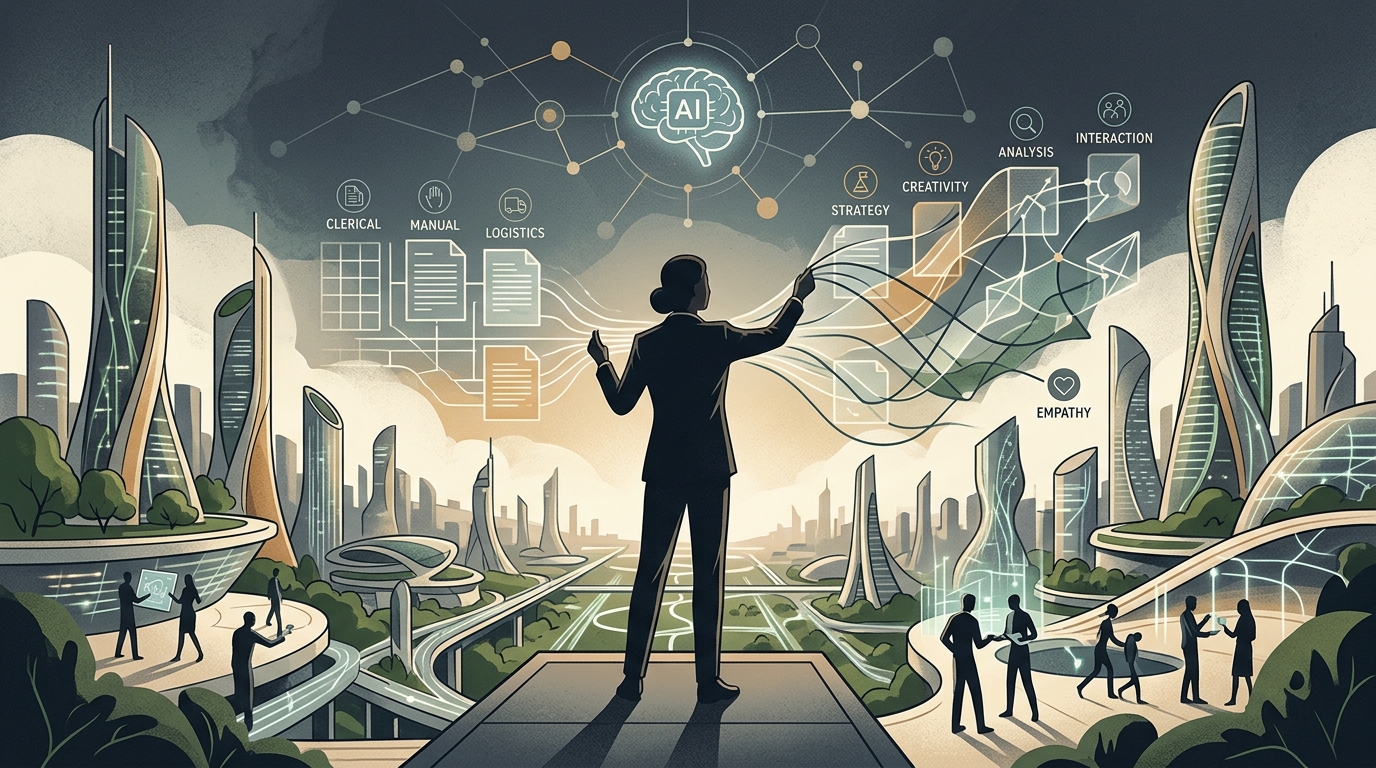
This evolution extends far beyond the tech sector. Chesky views AI as a tool that strips away the "administrative burden" from every profession. From lawyers analyzing thousands of documents in seconds to doctors utilizing AI for diagnostics, the common denominator is the liberation of time. This time, Chesky asserts, must be reinvested in human connection, creativity, and strategic thinking—areas where machines still fall short.
Airbnb’s Strategy: Fewer People, More Power
Airbnb has adopted an unusual stance compared to other Silicon Valley giants. While companies like Google and Meta have hired and fired thousands in cycles, Airbnb has maintained a relatively lean workforce since the pandemic. Chesky believes that AI will enable companies to remain "small and nimble," achieving results that previously required armies of employees.
- Process Streamlining: AI handles repetitive tasks, allowing teams to focus on core innovation.
- Role Consolidation: The distinction between marketing, product, and design is becoming increasingly blurred.
- Customer Experience Focus: By automating basic support, Airbnb staff can focus on solving complex issues requiring empathy.
Risks and the Ethics of Transition
However, Chesky’s prediction is not without its risks. If job descriptions become more generalized and require AI proficiency, what happens to workers who cannot adapt? The "digital divide" risks widening, creating an elite class of "super-workers" while leaving a large mass of people with obsolete skills. Furthermore, there is a fear that "role consolidation" is merely a polite way to describe labor intensification, where one employee is expected to do the work of three.
"AI will allow us to return to the age of the craftsman, where one person could build something from start to finish," says Chesky.
This romanticized view of the digital-age "craftsman" contrasts with the harsh realities of the market. For this model to succeed, a radical overhaul of the educational system and corporate training structures is required. Airbnb is investing in internal up-skilling programs, but the question remains: can this approach scale across the entire economy?
Conclusion: The Future is Human (via the Machine)
Chesky’s analysis leads to an optimistic, albeit challenging, conclusion. AI is not the enemy of work, but its liberator from monotony. If his predictions hold true, 2026 and the years beyond will witness the birth of a new work ethic, where an individual's value is not measured by how well they execute a specific command, but by how creatively they can synthesize different tools and ideas to solve problems. The "job description" of the future may simply be a blank page waiting for the right person to fill it.