In the heart of the American Midwest, the University of North Dakota (UND) is emerging as an unexpected epicenter for one of the most intense debates of the 21st century: the intersection of Artificial Intelligence (AI) with human creativity. As 2026 sees this technology permeating every aspect of daily life, UND’s departments of Fine Arts and Music are not merely passive observers but active shapers of a new aesthetic reality.
The Sonic Revolution: From Algorithms to Symphony
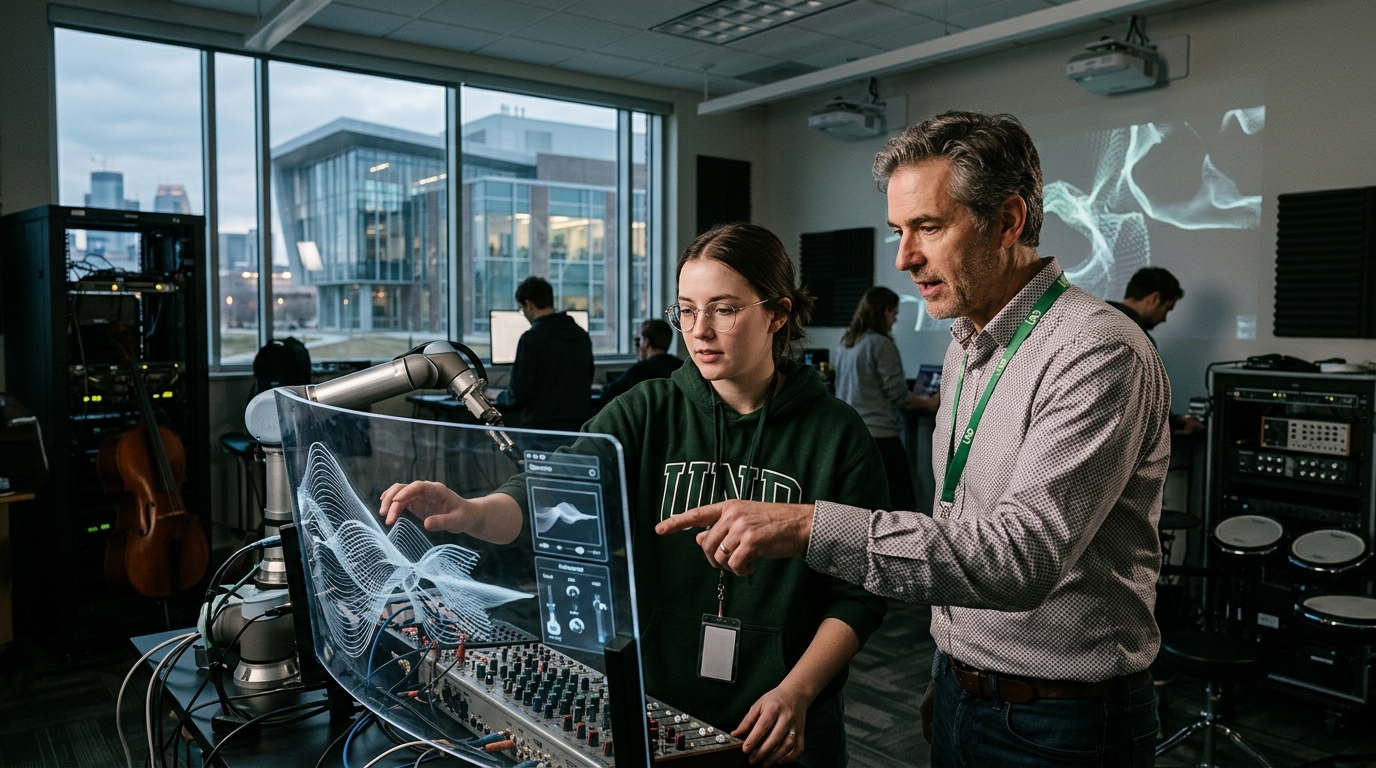
In UND’s Music Department, the conversation regarding AI has moved past the stage of fearing the replacement of composers. Instead, faculty and students are exploring how large language models and neural codes can function as "co-creators." The use of AI tools to analyze vast amounts of musical data allows students to gain a deeper understanding of classical composition structures while simultaneously offering them the ability to experiment with timbres that were previously impossible to produce.
However, the academic community at UND remains cautious. The emphasis is placed on "AI-assisted composition," where the human retains full control over artistic intent. As academics point out, AI can produce a perfectly structured melody, but it lacks the lived experience and emotional weight that a human artist provides. At UND, teaching focuses on how technology can liberate the creator from technical repetition, allowing them to dedicate themselves to pure inspiration.
Visual Arts: The Redefined Image
In the realm of visual arts, the challenge is even more visible. With the rise of generative image models, the concept of "skill" is shifting. At UND, students are encouraged to use AI not to replace the brush or the chisel, but to broaden the boundaries of their visual language. AI is often used for the "rapid prototyping" of ideas, allowing artists to see hundreds of variations of a concept before commencing manual labor.
This approach raises critical questions about authenticity. If an algorithm suggests the color palette, who is the creator? UND addresses this issue through ethics and intellectual property seminars. Students learn to disclose the use of AI in their work, fostering a culture of transparency that is essential for the survival of art in the digital age. Art is no longer considered just the final product, but the process and the curation of choices made by the artist.
Ethical Challenges and the Future of Education
One of the most significant points of UND’s strategy is the recognition of risks. Intellectual property remains the "thorny" issue. As AI models are trained on the works of thousands of artists without their consent, the university promotes a critical stance toward big tech companies. Education at UND is not just about using the tools but also about understanding the political and economic structures that govern them.
The future of artistic education, as outlined in North Dakota, is hybrid. Graduates from 2026 onwards will need to be as proficient in handling an algorithm as they are with a traditional medium. The job market now demands creators who can bridge the gap between technology and the humanities. UND is investing in this interdisciplinarity, linking the Computer Science department with the Arts department, creating an environment where code is considered a new form of poetry.
Conclusion: The Human Supremacy
Despite the impressive progress of technology, the central message from the University of North Dakota is reassuring: AI is a mirror, not a replacement. Art remains a deeply human activity stemming from the need for communication and connection. AI can provide the means, but the human remains the only one who can provide the meaning. At UND, technology is not killing art; rather, it is forcing it to evolve, to redefine itself, and ultimately, to remember its essence.