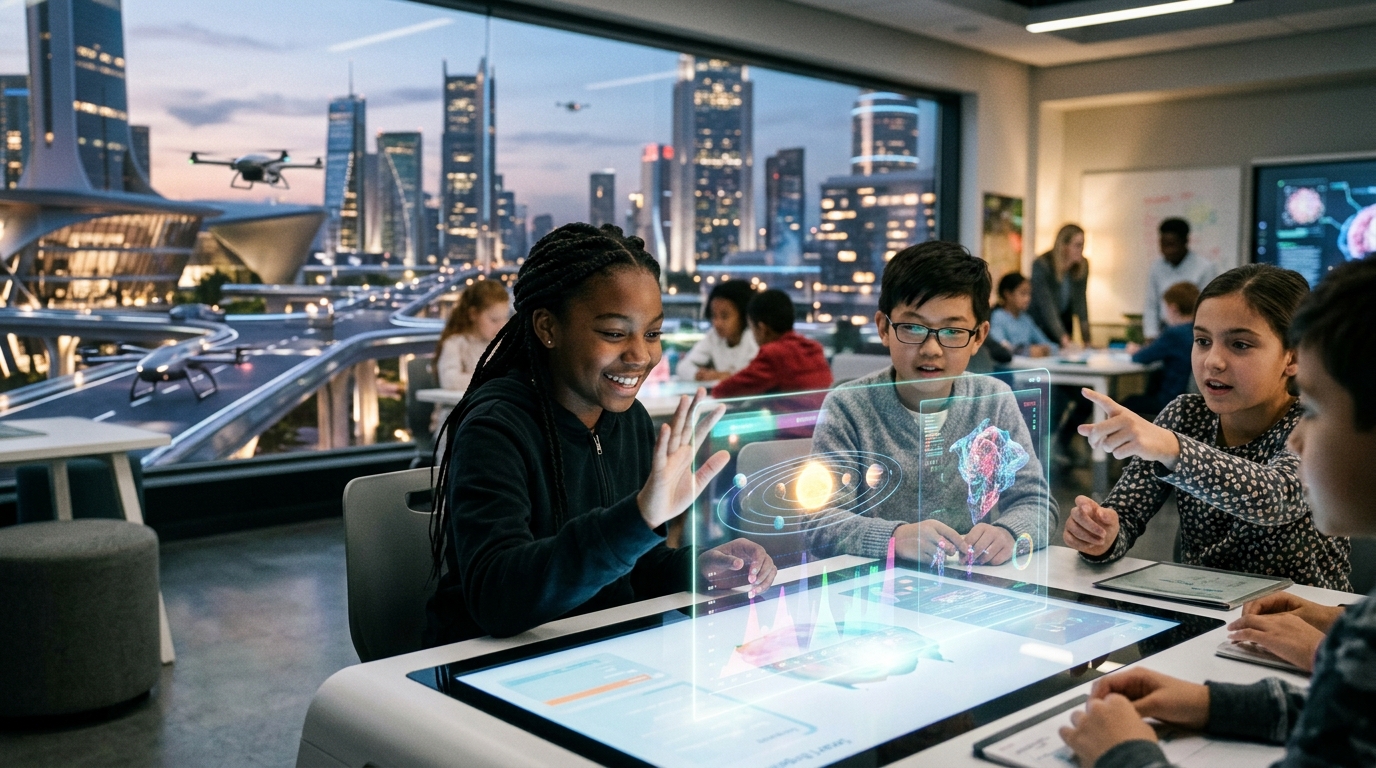
As we navigate the first half of 2026, the conversation surrounding Artificial Intelligence (AI) in schools has shifted from initial panic over plagiarism to a profound exploration of what "learning" truly means in the digital age. A recent report from the New Hampshire Bulletin hits the mark: education must adapt not merely to survive, but to protect and empower young generations against a technological force that is reshaping reality itself.
The Shift from Rote Memorization to Critical Evaluation
For decades, the educational system relied on students' ability to retrieve and reproduce information. Today, with generative AI tools having access to the sum of human knowledge, rote memorization has become obsolete. The challenge for educators is to teach students how to become "curators" of information rather than mere consumers. "Prompt literacy" and the ability to distinguish algorithmic hallucinations from factual reality are the new foundational skills.
According to analysts, if schools continue to assess students through traditional essays that can be written in seconds by a chatbot, they are merely training youth in the art of deception. Instead, the educational process must focus on the thinking process. Students should be asked to explain their reasoning, challenge AI-generated answers, and use technology as a "co-pilot" for complex problems that require empathy and moral judgment—areas where AI still falls short.
The Human Connection as a Counterweight to Algorithms
Despite the technological explosion, the role of the teacher is becoming more critical than ever. AI can offer personalized learning at scale, adjusting the pace of instruction to each child's needs, but it cannot inspire, comfort, or provide moral guidance. Education must invest in socio-emotional learning. In a world dominated by screens, the school must remain a space for human interaction, dialogue, and collaboration.
- Developing ethical frameworks for AI use created by the students themselves.
- Focusing on "soft skills" such as negotiation and teamwork.
- Bringing oral examinations and experiential learning back to the forefront.
The New Hampshire Bulletin highlights that the delay in adopting AI policies creates a "readiness gap." Students from privileged backgrounds are already using AI to accelerate their learning, while those in underserved areas risk falling behind, using technology only for entertainment or as a shortcut for schoolwork.
Policy and Equity: The State's Responsibility
Integrating AI into education is not just a pedagogical issue; it is a deeply political one. Governments must ensure that access to advanced AI tools does not become a new factor in class division. Furthermore, the protection of minors' personal data is imperative. Large language models are trained on data; our students' data must not become the "fuel" for the profit-making machines of tech giants without strict oversight.
"Artificial Intelligence will not replace teachers, but teachers who use AI will replace those who do not."
In conclusion, education must take a leap of faith. We must accept that the world we are preparing our children for no longer exists. The new mission of schools is to cultivate a resilient, critical, and ethically grounded generation that can hold the reins of technology rather than being swept away by it. The stakes are high, and time is of the essence.