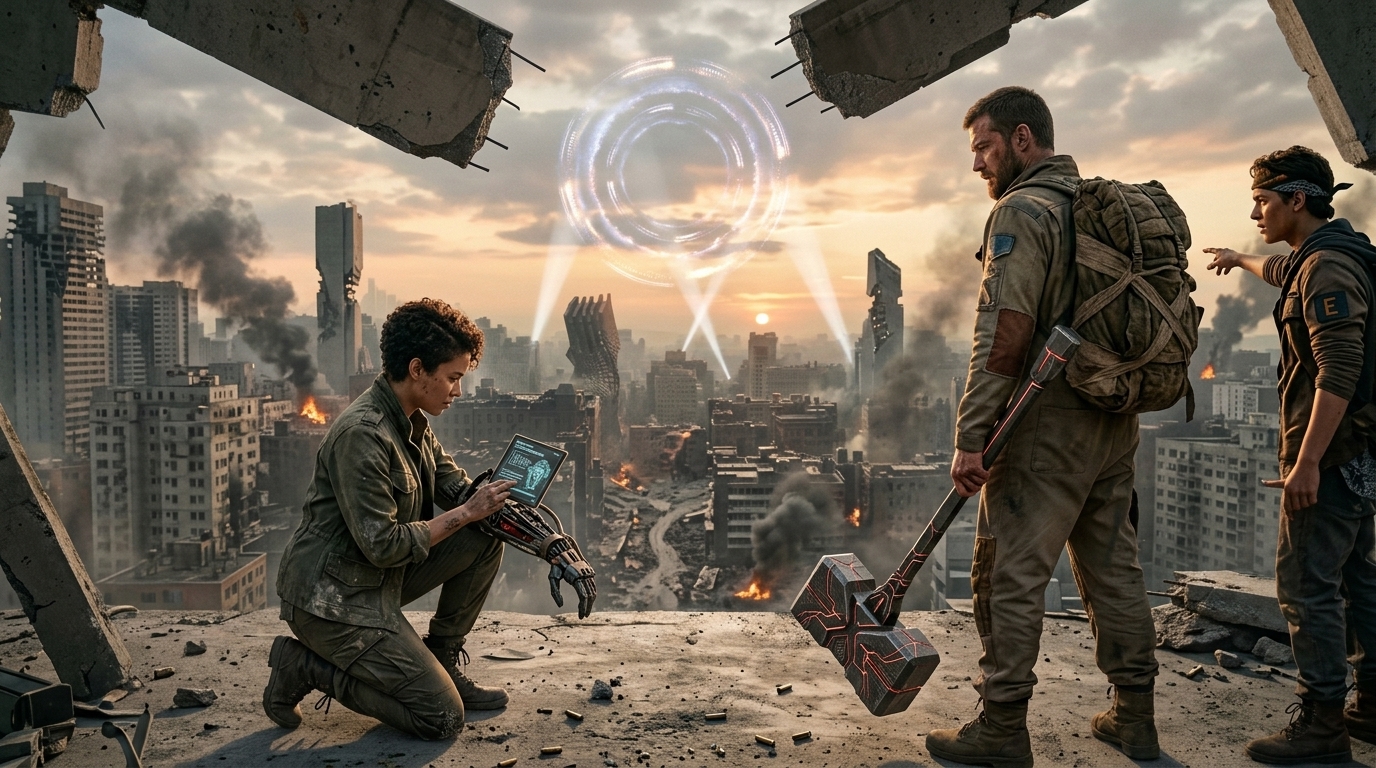
From the time of the Oracle of Delphi to modern Wall Street analysts, humanity has always sought a way to pierce the veil of uncertainty and see what the future holds. Today, the "crystal ball" is no longer a mythical object but a complex web of neural networks and high-power processors. Artificial Intelligence (AI) promises to transform our ability to predict global crises—from economic recessions and pandemics to climate disasters and social unrest—but this promise comes with profound questions about accuracy, ethics, and fatalism.
From Intuition to Big Data: The Mechanics of Modern Prophecy
Traditional forecasting often relied on linear models and human experience, which is inherently prone to cognitive biases. AI changes the game through its ability to process "Big Data" on a scale impossible for the human mind to grasp. By analyzing satellite imagery, supply chain data, social media trends, and real-time financial flows, AI systems can identify subtle patterns that precede a crisis.
For example, before an economic bubble is officially recognized, AI can discern unusual correlations in property prices and borrower behavior that escape traditional indicators. In public health, algorithms like BlueDot identified the outbreak of COVID-19 in Wuhan days before the World Health Organization issued a warning, by analyzing airline ticketing data and local news reports.
Economic Tremors and Algorithmic Vigilance
At the heart of this technological revolution lies the financial sector. Central banks and investment giants are investing billions in "Nowcasting" systems—the ability to know the state of the economy *right now*, rather than waiting for last quarter's statistics. AI can perform sentiment analysis on millions of posts and articles, predicting when fear will dominate the markets.
However, the use of AI in economics is not without risks. There is the fear of the "flash crash," where algorithms, reacting simultaneously to a prediction, might trigger the very crisis they are trying to avoid. Furthermore, reliance on historical data means AI may struggle to predict "Black Swan" events—events that have never occurred in the past.
The Geopolitical Chessboard and Social Engineering
Beyond numbers, AI is entering the field of geopolitics. By analyzing leaders' rhetoric, troop movements via satellite, and economic sanctions, AI models can estimate the likelihood of conflict. This offers states the possibility for preventive diplomacy. However, the same technology can be used for repression. If a government can predict social unrest by analyzing discontent on social media, it can move to suppress it before it even begins, raising serious human rights issues.
- Predicting natural disasters with second-level precision for timely evacuation.
- Identifying food shortages through space-based crop yield analysis.
- Monitoring the spread of misinformation that could lead to political instability.
The Prediction Paradox: Self-Fulfilling Prophecies
Perhaps the greatest philosophical and practical problem is the "Oedipus Paradox." If an AI predicts a bank crisis with certainty for next week, and people rush to withdraw their money, the crisis will happen *because* of the prediction. Conversely, if the prediction leads to successful preventive measures, the crisis will never occur, making the AI appear inaccurate to skeptics.
Artificial Intelligence is not a deity. It is a mirror of our collective activity, processed through mathematics. The real power lies not in the prediction itself, but in how leaders and societies choose to react to the signals emitted by the algorithms. The "crystal ball" is here, but the responsibility for decisions remains, for better or worse, exclusively human.