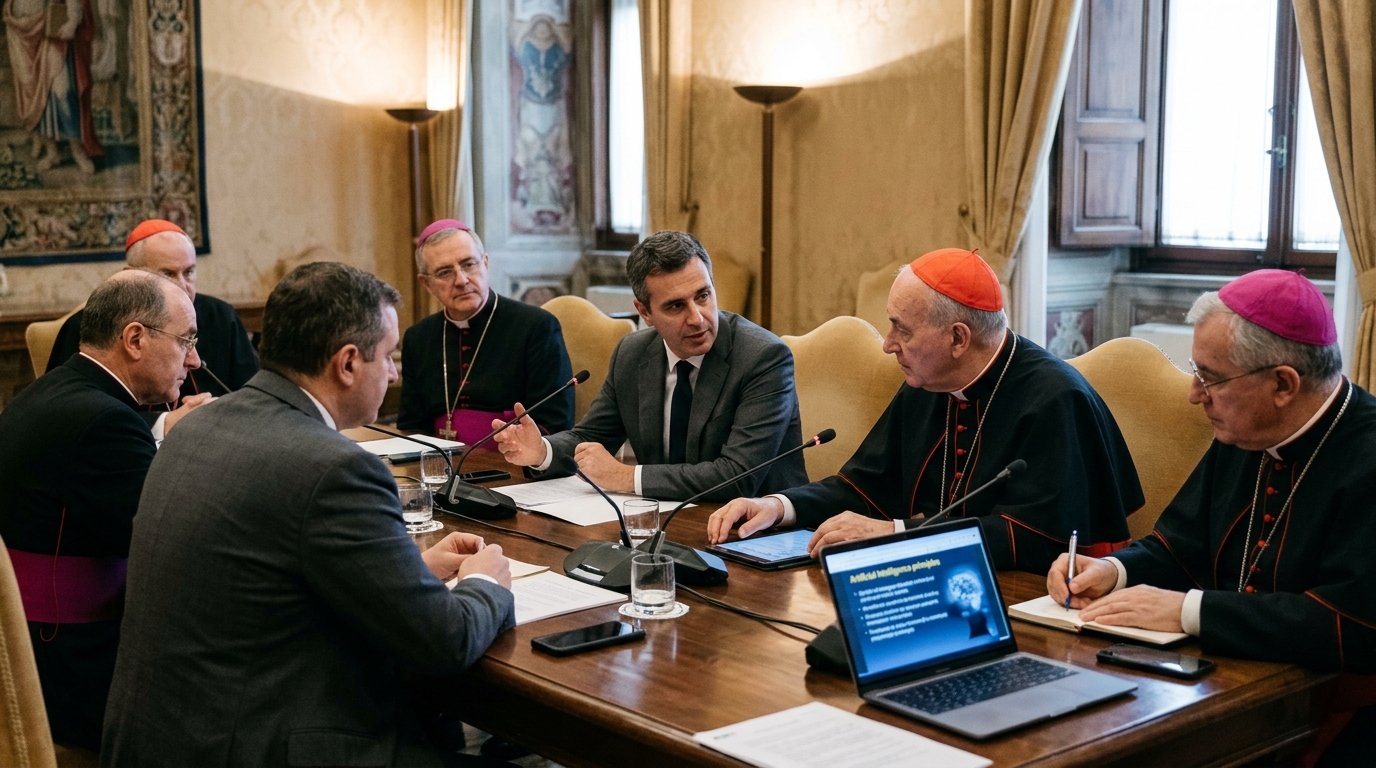
In an era where technological advancement often outpaces ethical restraint, the Vatican has decided to intervene decisively in the debate over Artificial Intelligence (AI). The first meeting of the Interdicasterial Commission on Artificial Intelligence marks a new epoch for the Catholic Church, which seeks to play the role of a moral guardian in a world increasingly governed by algorithms. This commission, established at the initiative of Pope Francis, brings together leading minds from various departments of the Roman Curia to study the social, spiritual, and ethical implications of AI.
The Emergence of 'Algor-ethics'
Central to the commission's mission is the promotion of the concept of 'algor-ethics.' This is a term introduced by the Vatican to describe the need to integrate ethical values directly into the design and development of AI systems. During the first meeting, it was emphasized that technology is never neutral; it carries the biases and priorities of its creators. The Church argues that without a solid ethical foundation, AI risks widening social inequalities and undermining human dignity.
The Vatican's approach is not merely theoretical. The commission is examining specific issues, such as the use of AI in surveillance, the automation of labor that threatens the jobs of the most vulnerable, and the creation of deepfakes that erode trust in the truth. For the Holy See, the stakes involve the very essence of human existence: if the machine begins to replace human judgment in critical areas, what remains of free will?
Bridging Silicon Valley and the International Community
The creation of this commission is not an isolated move. In recent years, the Vatican has built bridges with tech giants like Microsoft and IBM through the 'Rome Call for AI Ethics.' The new Interdicasterial Commission is expected to function as the central hub coordinating these international collaborations. Participants in the meeting included representatives from the Dicastery for Culture and Education, the Dicastery for Communication, and the Dicastery for Promoting Integral Human Development.
The strategy is clear: the Vatican wants to influence the regulatory framework of AI on a global level, acting as a diplomatic mediator between governments and tech companies. At a time when the European Union and the United States are struggling to establish rules for AI, the Church's voice offers a perspective centered on the 'common good'—a concept often omitted in discussions about profitability and efficiency.
Challenges and the Future of Digital Pastoral Care
One of the greatest challenges facing the commission is the speed of developments. Technology moves at a pace that traditional ecclesiastical bureaucracy often finds difficult to match. However, the first meeting showed a willingness for flexibility. The need for continuous education of the clergy and the faithful regarding digital tools was discussed, as well as the use of AI in the Church's own missionary activities.
"Artificial intelligence must serve the human person and not the other way around," a commission member stated during the press briefing. "We do not fear progress, but progress without a soul."
In conclusion, the first meeting of the Interdicasterial Commission on AI is not just an administrative formality. It is a statement of intent. The Vatican recognizes that the digital revolution is a spiritual challenge as significant as the industrial revolution of the 19th century. With this commission, the Holy See positions itself at the forefront of the battle for the future of humanity in the age of machines, insisting that code must be subordinate to conscience.