The image of Greece as a nation solely dependent on tourism and shipping is beginning to give way to a new, technologically advanced narrative. The recent announcement by ICEYE, the Finnish giant in Synthetic Aperture Radar (SAR) satellites, regarding the establishment of a major production facility in Greece, is not just a business headline. It is the culmination of a decade-long effort by the Greek space ecosystem to prove that the country possesses the human capital and strategic position to play a leading role in the "NewSpace" economy.
The ICEYE Investment and the Co-production Model
ICEYE currently operates the world's largest fleet of SAR satellites, a technology that enables Earth observation day and night, even through thick cloud cover. Its decision to install a production line in Greece is directly linked to the National Microsatellite Program, valued at over €200 million and funded by the Recovery and Resilience Facility (RRF). The strategy here is clear: Greece is not just buying "off-the-shelf" products but is demanding domestic added value, knowledge transfer, and the participation of Greek industry in the manufacturing process.
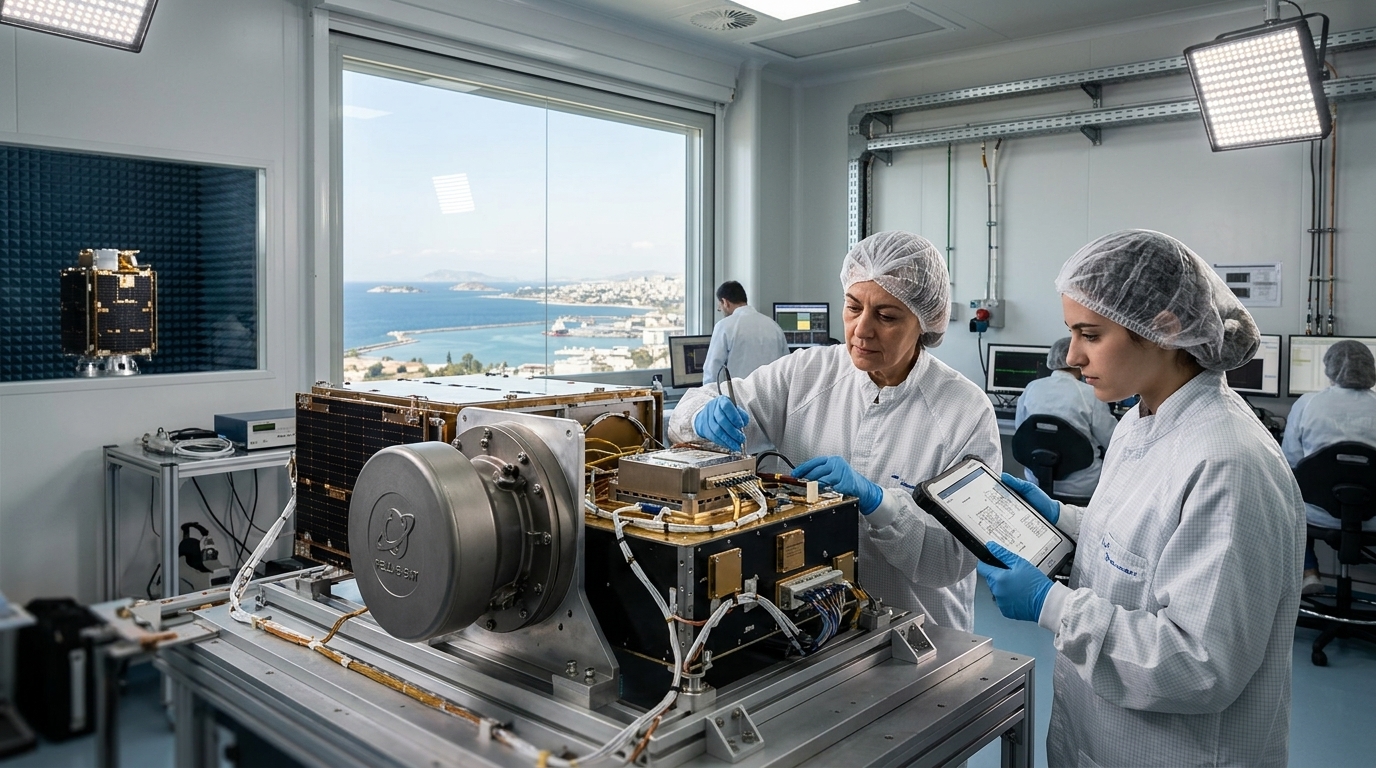
The new facility is expected to employ hundreds of highly specialized engineers, acting as a magnet for the repatriation of Greek scientists (brain gain). This is not a simple assembly line; it involves the design, testing, and certification of satellite systems that will be exported from Greece globally. This shifts the country from being a consumer of space services to a producer of cutting-edge technology.
The National Microsatellite Program: A Strategic Choice
The Ministry of Digital Governance, under the guidance of the General Secretariat of Telecommunications and Posts, has laid the foundations for a holistic space strategy. The microsatellite program aims to meet critical national needs, such as:
- Civil Protection: Early fire detection, flood monitoring, and real-time disaster assessment.
- National Security: Surveillance of borders and maritime zones with weather-independent technologies.
- Urban Planning and Environment: Monitoring illegal construction and coastline changes due to climate change.
The use of microsatellites offers flexibility and lower costs compared to traditional, bulky satellites, allowing Greece to have an autonomous "eye" in space without depending exclusively on international providers or ESA (European Space Agency) systems, although it remains an active member of the latter.
A Maturing Ecosystem
ICEYE is not alone. Greece already boasts the Hellenic Association of Space Industries (HASI), which includes dozens of companies such as OHB Hellas, Theon Sensors, Prisma Electronics, and Terra Spatium. These companies have already participated in flagship NASA and ESA programs, manufacturing everything from components for the James Webb telescope to navigation systems for interplanetary missions.
"Greece is no longer the poor relative of Europe in space. We have the expertise to manufacture subsystems that compete with the best in the world," market executives state.
The creation of a "Space Hub" in Greece is also favored by its geographical location. As the southeastern tip of the EU, the country can serve as a gateway for space collaborations with the Middle East and Africa—sectors where the demand for satellite data is rapidly increasing for monitoring agriculture and water resources.
Challenges and the Future
Despite the optimism, the road is not without obstacles. Bureaucracy remains a thorn for high-tech investments, while global competition is relentless. Countries like Luxembourg and Portugal have already implemented aggressive policies to attract space companies. Greece must ensure that RRF funding is absorbed efficiently and that there is policy continuity, regardless of government changes.
In conclusion, transforming Greece into a satellite manufacturing hub is a bet that seems to be paying off. This is not "science fiction" but a realistic industrial shift that leverages the country's brightest capital: the minds of its people. If Greece dominated the seas with its ships in the 20th century, the 21st century might find it dominating orbits with its satellites.