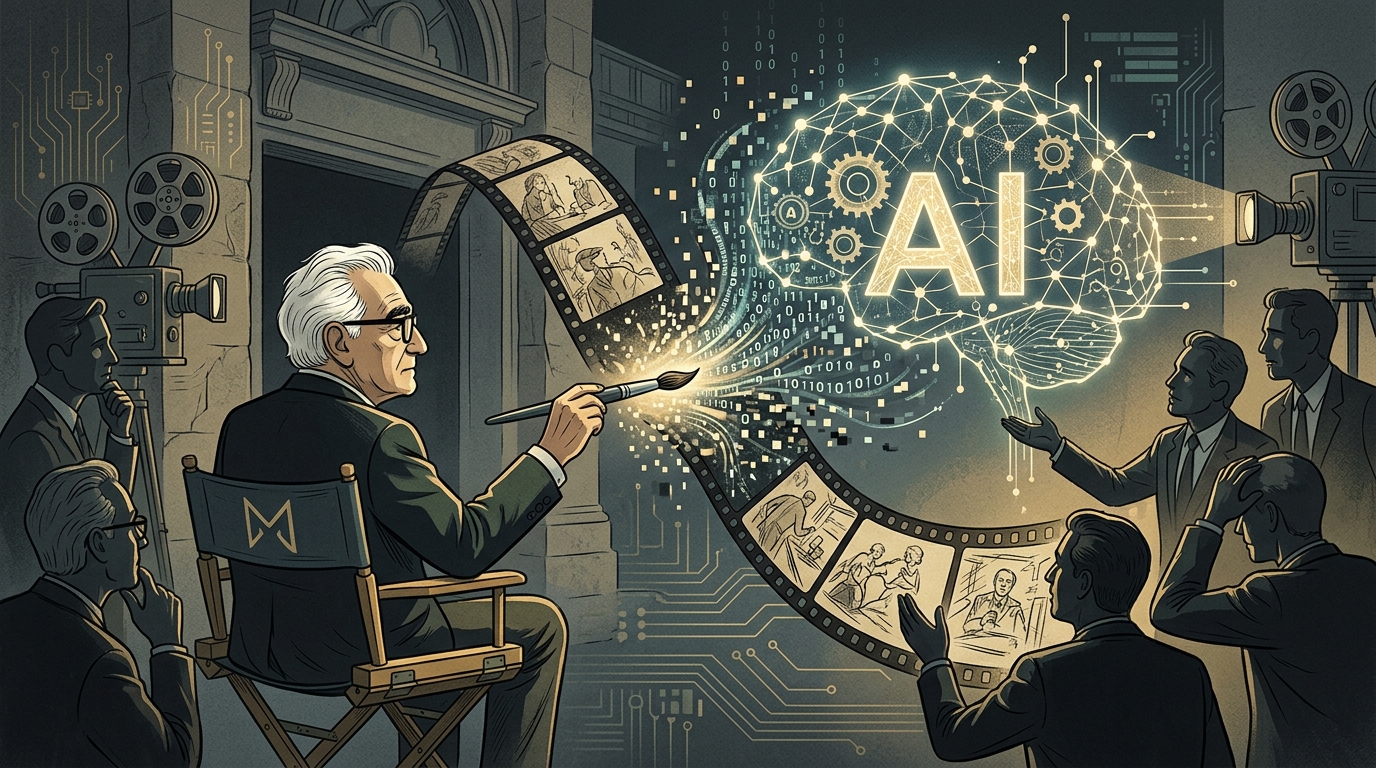
When Martin Scorsese, the high priest of traditional cinema and the man who once famously dismissed Marvel movies as "theme parks" rather than "cinema," decides to embrace Artificial Intelligence, the art world catches its breath. The news that the 83-year-old director is partnering with the startup Black Forest Labs to utilize their Flux.1 model for creating storyboards is not merely a tech headline; it is a cultural seismic shift. For cinephiles, Scorsese was the last bastion of analog authenticity. His pivot toward generative tools is seen by many as the definitive capitulation of art to the algorithm.
The Partnership with Black Forest Labs
This collaboration is no accident. Black Forest Labs, the company behind the powerful Flux image generation model, is comprised of former Stability AI executives and is currently regarded as the cutting edge of visual AI. Scorsese joined the company’s advisory board not as a passive figurehead, but as a creator seeking new tools to visualize his complex narratives. According to statements, AI allows him to experiment with shot composition, lighting, and movement long before stepping onto a physical set.
The use of AI in storyboarding—the sketches that guide the filming of every scene—is a process that has traditionally required armies of talented illustrators. With Flux.1, Scorsese can transform a verbal description into a detailed visual frame in seconds. For him, it is the evolution of the "stylus." For his critics, however, it represents the beginning of the end for an entire class of industry professionals.
The Purist’s Dilemma and the Ethics of "Betrayal"
On social media and in cinematography forums, the reaction has been swift and often vitriolic. Many accuse Scorsese of hypocrisy. "How can you speak about the sanctity of the image while using a tool trained by scraping the work of thousands of artists without consent?" one user asked on Reddit. The argument is potent: models like those from Black Forest Labs are built on massive datasets of images harvested from the internet without the permission of the original creators.
Furthermore, there is the fear of "homogenization." If every major director begins using the same AI models to design their films, will the visual language of global cinema begin to look desperately uniform? Scorsese has always been celebrated for his unique "eye." The concern is that AI, regardless of its sophistication, tends toward the statistical mean—toward the "safe" and the "expected"—qualities that are diametrically opposed to the essence of auteur theory.
The Labor Question: A Threat to Visual Artists
Beyond the philosophical debate lies a harsh economic reality. Storyboard artists are among the first to be impacted by the AI surge. A director’s ability to generate high-quality drafts independently reduces the need for human labor, depresses wages, and makes the profession of Hollywood illustrator increasingly precarious. Following the massive SAG-AFTRA and WGA strikes of recent years, Scorsese's move is viewed by some as a "stab in the back" to the very craftspeople who helped build his legacy.
However, proponents of the move argue that technology does not replace creativity; it liberates it from the constraints of budget and time. If a creator of Scorsese's caliber can iterate 100 different versions of a sequence in an hour, the final artistic product may be superior. The question remains: who pays the price for this efficiency?
A New Era or the End of History?
Scorsese’s stance signals a paradigm shift. If the man who personifies film history accepts AI, then the debate over "banning" the technology is effectively over. The conversation now shifts to how its use will be regulated and ethically bounded. Scorsese is not a Silicon Valley technocrat; he is an artist who understands the power of the frame. Perhaps his gamble is that human intent will always remain the dominant element, whether the "brush" is made of camel hair or Python code.
What is certain is that the Hollywood of 2026 bears little resemblance to that of previous decades. The collision between nostalgia for the past and the inevitability of digital progress has reached its peak, and Martin Scorsese, once again, finds himself at the center of the frame.