The era of Artificial Intelligence is often marketed as an ethereal revolution—a world of algorithms and data residing in a nebulous "cloud." However, the reality is far more industrial, noisy, and resource-intensive. According to a recent Gallup poll reported by The Hill, nearly half of Americans strongly oppose the construction of AI data centers in their local communities. This finding is not merely an expression of NIMBYism (Not In My Backyard); it reflects deep-seated concerns about the future of local resources and quality of life.
The Hunger for Power and Grid Instability
AI data centers supporting generative models are fundamentally different from traditional data storage facilities. Training and running models like GPT-4 require exponentially more computing power, which translates into massive electricity consumption. Residents in regions like Northern Virginia—the world's data center capital—are witnessing local power grids being pushed to their breaking points. The concern is straightforward: if the demand from tech giants continues to surge, who will bear the cost of grid upgrades, and more importantly, what will happen to residential electricity rates?
Furthermore, there is the issue of energy sourcing. While companies like Google and Microsoft pledge to use "clean" energy, the 24/7 nature of data center operations often necessitates backup from fossil fuel plants when renewable sources fluctuate. This creates an ethical contradiction where AI progress may be undermining local climate goals and carbon reduction targets.
Water Scarcity and the Hum of Industry
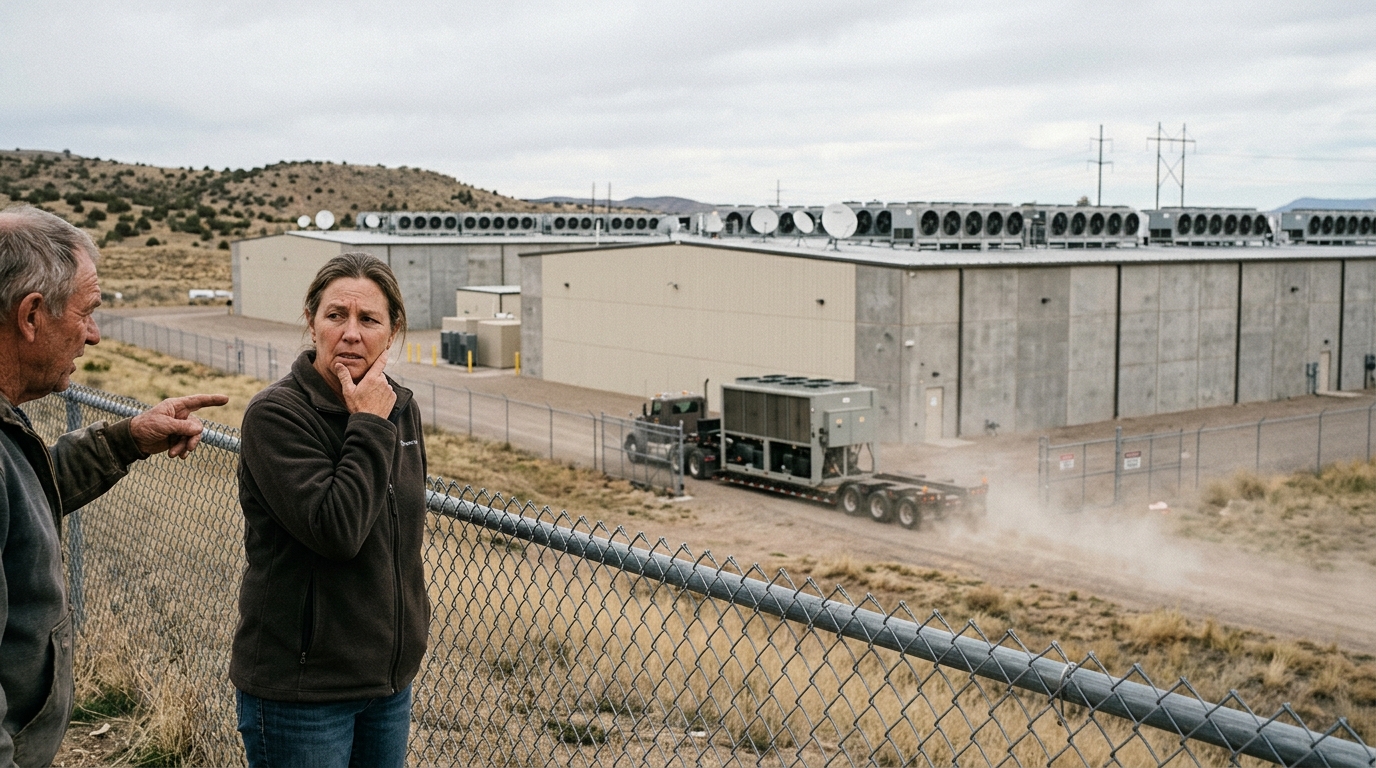
Beyond electricity, cooling these gargantuan facilities requires millions of gallons of water daily. In drought-prone areas, the use of potable water to cool servers is increasingly viewed as an unacceptable trade-off. The Gallup poll indicates that environmental impact is the primary driver of public opposition. Residents no longer see these buildings as symbols of high-tech prestige, but as "industrial invaders" that deplete natural resources without offering proportional benefits.
Noise pollution is another frequently overlooked factor. The massive cooling fans that run incessantly produce a low-frequency hum that can carry for miles, disrupting the tranquility of residential neighborhoods. For many, this is the moment AI stops being an app on their phone and becomes a physical nuisance in their daily lives.
Economic Boon or False Promise?
Proponents of data centers often tout economic growth and job creation as the primary benefits. However, a closer look at the data reveals a more nuanced picture. While the construction phase creates temporary jobs, the long-term operation of a data center requires surprisingly few employees—often fewer than 50 people for a facility worth billions of dollars. Local communities feel they are trading vast swaths of land and resources for an industry that offers minimal local employment, all while tech giants benefit from significant tax breaks that drain potential public revenue.
"We cannot build the future of the digital economy at the expense of local community sustainability. Consent is no longer a given; it must be earned," says a local government official in Virginia dealing with the expansion.
The Need for a New Social Contract
The resistance captured by Gallup serves as a wake-up call for Silicon Valley. The "move fast and break things" strategy cannot be applied when the "things" being broken are the environment and social cohesion. Tech companies must invest in innovative cooling technologies (such as closed-loop liquid cooling), directly fund the generation of new clean energy, and demonstrate far greater transparency in their operations.
In conclusion, the battle over data centers is a battle over how we define progress in the 21st century. If artificial intelligence is to truly benefit humanity, it must begin by respecting the communities that host its physical infrastructure. The Gallup poll is not just a statistic; it is a demand for a more responsible, human-centric approach to technological expansion.