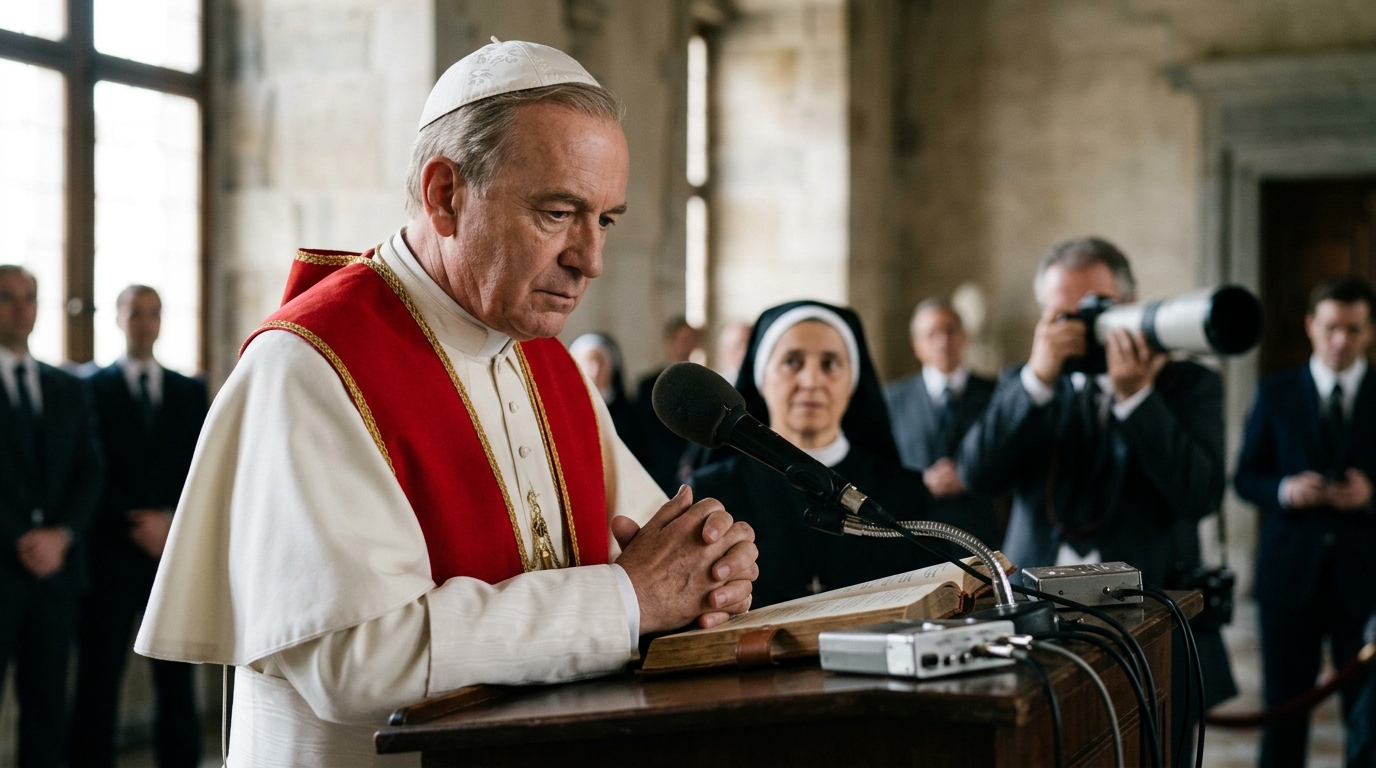
From the heart of the Vatican, in a move poised to reshape the global discourse on technology, Pope Leo XIV issued a profound manifesto on Monday. This document, arguably the most comprehensive theological and political statement by the Catholic Church to date, calls for an urgent "disarming" of Artificial Intelligence (AI). This is not merely an appeal to restrict autonomous weapons, but a foundational critique of how this technology is restructuring human society, leading, in the Pontiff's words, to "new forms of slavery."
'Disarmament' as an Ethical Imperative
Pope Leo XIV’s choice of the word "disarmament" is deliberate and provocative. In his manifesto, he attempts a conceptual expansion of the term. While traditional disarmament concerns the decommissioning of nuclear or conventional arsenals, here it refers to stripping away the algorithmic power used for mass surveillance, public opinion manipulation, and the enforcement of digital authoritarianism. The Pontiff argues that when AI becomes a tool for profit maximization at the expense of human dignity, it transforms into a weapon of mass social destruction.
The Vatican focuses specifically on Lethal Autonomous Weapon Systems (LAWS), emphasizing that the decision over life and death should never be delegated to an algorithm. However, the analysis goes deeper, examining the "disarming" of the very logic of efficiency that discards mercy. The call is directed at both governments and Silicon Valley tech giants, demanding transparency and, crucially, the preservation of "human-in-the-loop" mechanisms for every critical decision.
New Forms of Slavery in the Digital Age
Perhaps the most arresting segment of the manifesto is the warning regarding the resurgence of slavery in a new guise. Pope Leo XIV describes a reality where millions are being turned into "digital serfs." He references gig economy workers controlled by relentless algorithms, the "invisible" data laborers in the developing world who train AI models under deplorable conditions, and the average user who "sells" their privacy for a modicum of digital convenience.
"The freedom of the spirit is at risk of being sacrificed on the altar of predictive certainty. When the machine knows what you will choose before you do, free will ceases to exist," the Pontiff writes.
This "new slavery" is not characterized by chains, but by code. Leo XIV points out that reliance on AI for moral decision-making leads to a spiritual atrophy. His critique also targets "algorithmic feudalism," where a small elite owns the means of knowledge production, while the rest of humanity merely consumes pre-packaged truths.
The Necessity of 'Algor-ethics'
Building on the work of his predecessors, the Pope promotes the concept of "Algor-ethics"—a term blending algorithms with ethics. The manifesto proposes the establishment of an international body, under the auspices of the UN, to oversee AI development through the lens of human rights. This is not a voice against progress, but a voice for progress that remains "truly human."
This intervention comes at a time when the global community stands at a crossroads. With elections in numerous countries threatened by deepfakes and inequality widening due to automation, the Vatican’s manifesto serves as a moral compass. The Pope concludes with a plea to scientists and developers: "You are your brother’s keeper. Do not allow code to become humanity’s jailer."
Conclusions and Implications
The impact of this document is expected to be long-lasting. Already, Catholic organizations and human rights activists are preparing campaigns based on the manifesto's principles. The challenge now shifts to the corridors of power: Will political authorities be able to impose limits on technological supremacy, or will the "Digital Leviathan" continue its unchecked advance? Leo XIV has taken the first step, reminding us that technology is a good servant, but a dangerous master.