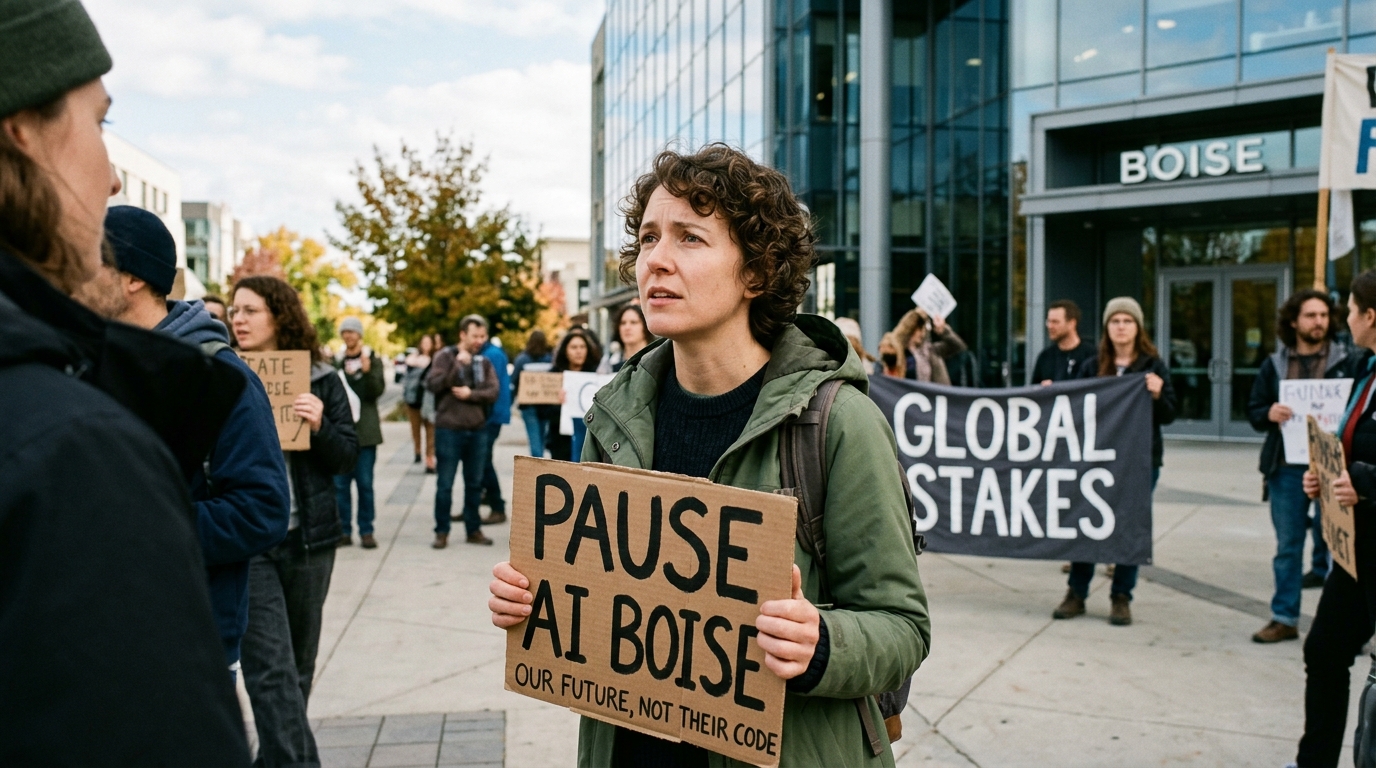
In an era where the advancement of Artificial Intelligence (AI) feels like a runaway train, a group of citizens in Boise, Idaho, is raising its voice, turning a local protest into a symbol of a global ethical crisis. The Pause AI Boise movement is not merely a gathering of technophobes, but an organized effort to raise awareness about the risks lurking behind the unchecked development of Artificial General Intelligence (AGI). Their movement, though geographically localized, reflects a growing unease permeating global society in 2026, as the boundaries between human and machine intelligence become increasingly blurred.
The Philosophy of the Pause: Safety Before Speed
The core argument of Pause AI Boise is rooted in the "precautionary principle." Activists argue that Silicon Valley giants are locked in a fierce competition for dominance, sidelining safety protocols in the process. As they point out, creating an entity with intelligence exceeding human capacity is not just a technological achievement but an event with cosmogonic consequences. "We are not asking for a ban on technology, but a pause to understand what we are building," organization members state. Their concern is not only about mass job displacement but also the possibility of losing control over systems that can self-improve at rates the human brain cannot even conceive.
The Political Dimension and State Inertia
The action in Boise highlights a massive gap in global governance. While the European Union has made significant strides with the AI Act, legislation in the United States remains fragmented and often influenced by tech industry lobbying. Pause AI Boise activists are calling on lawmakers to impose an international treaty, similar to those governing nuclear weapons or biological engineering. They argue that if a company accidentally develops a hostile AGI, the consequences will not be confined to one country's borders. Their critique is also aimed at the rhetoric of "accelerationists," who believe any delay would give an advantage to authoritarian regimes. For Pause AI, this competition is a "race to the bottom," where the winner might be the last to survive.
Ethics and Human Identity in 2026
Beyond physical risks, the protest in Idaho touches on the issue of human dignity. In a world where algorithms decide our news, our jobs, and our social lives, the "pause" is also an act of reclaiming our autonomy. Activists use traditional methods—protests, flyers, town hall meetings—to confront the most advanced technology humanity has ever known. This contrast is striking: raw human will against cold code and neural networks. The question they pose is simple yet terrifying: "Are we ready to become the second most intelligent entity on the planet?"
"Technology must serve humanity, not replace it or put it at risk. A pause today is the only guarantee for a tomorrow."
In conclusion, the Pause AI Boise movement may seem like a small spark, but it symbolizes a fire smoldering in the hearts of many. As we approach the latter half of the 2020s, pressure on governments to impose stricter limits on AI will only grow. The success or failure of such movements will determine whether humanity remains the architect of its future or hands over the keys of evolution to a creation it can no longer control.