In a move that straddles the fine line between digital safety and total biometric surveillance, Meta—the parent company of Facebook and Instagram—has announced the deployment of a new Artificial Intelligence system designed to analyze users' bone structures. The company's objective is to identify and remove users under the age of 13, who frequently bypass traditional age verification by providing false birth dates. However, this news has sparked a firestorm of criticism from privacy advocates and child psychology experts alike.
The Technology Behind the Gaze
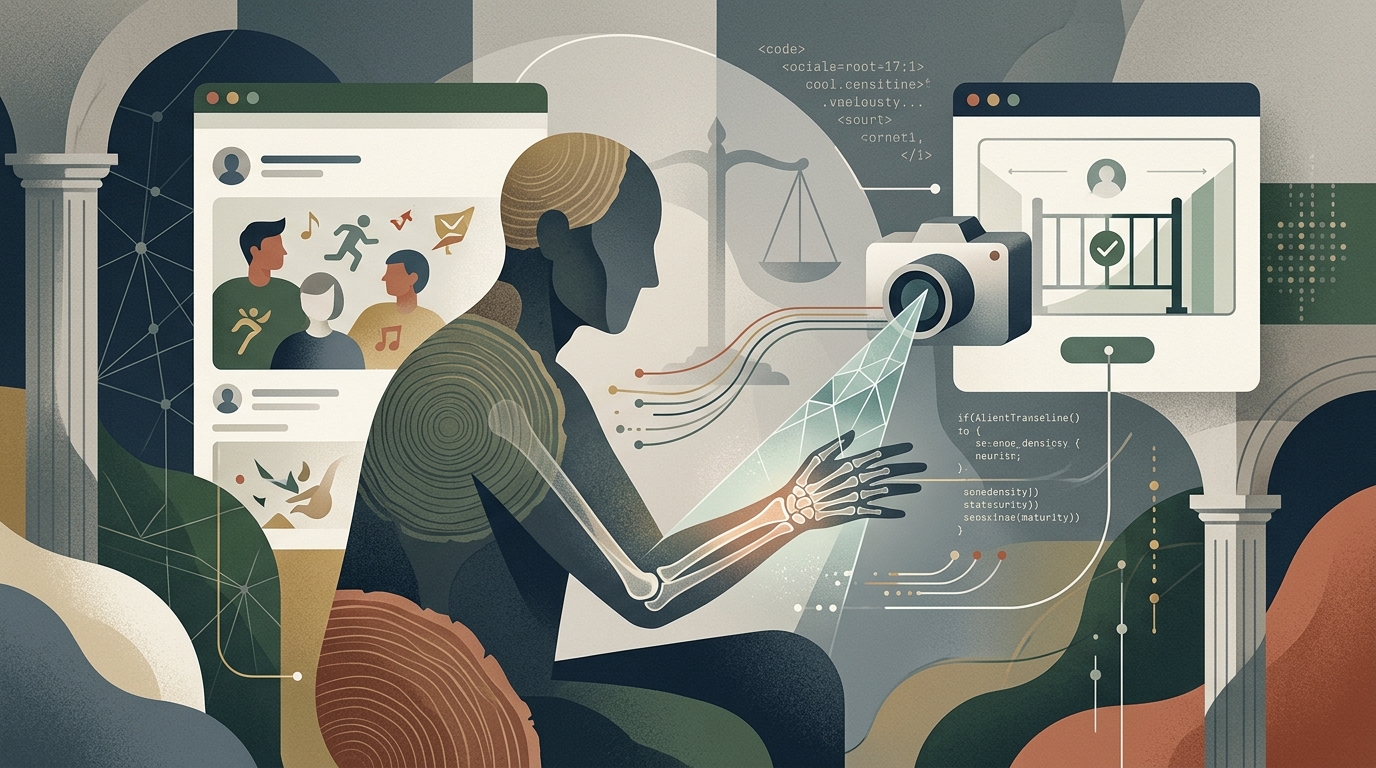
The system goes far beyond simple facial recognition. According to technical details, Meta's AI utilizes sophisticated computer vision algorithms to scan photos and videos for "general themes and visual cues." The key lies in analyzing limb proportions, facial feature density, and skeletal development markers indicative of pre-pubescence. Meta contends that this method is significantly more accurate than facial-based age estimation, as skeletal growth follows specific biological patterns that are difficult to mask with filters, lighting, or makeup.
The impetus for such a drastic solution stems from mounting global regulatory pressure. Under the Digital Services Act (DSA) in the European Union and stricter COPPA requirements in the United States, social media platforms face astronomical fines if they are found to be hosting minors under 13 without explicit parental consent. Meta argues that this automated process is the only feasible way to ensure compliance across a user base of billions.
The Ethical Minefield of Biometric Surveillance
Despite the company's assurances that the process is "protective," critics argue it represents an unprecedented intrusion into children's privacy. Using biometric data—such as bone structure—to determine age transforms every photo a teenager uploads into a tool for forensic analysis. There is also the significant risk of "false positives." Human development is notoriously non-linear. Children with hormonal imbalances, diverse ethnic backgrounds, or specific medical conditions could be miscategorized, leading to arbitrary exclusion from digital social life.
"We cannot protect children by destroying their right to anonymity and privacy. Turning Instagram into a biometric scanning lab is a dangerous overreach," says Dr. Elena Papadakis, an expert in digital rights.
Furthermore, the issue of data storage looms large. While Meta claims that analyses are performed in real-time and that data is not stored in a personally identifiable manner, the company's history with data breaches does little to inspire confidence. The notion that a private corporation holds a map of the skeletal development of millions of young people is, at the very least, unsettling.
Algorithmic Bias and the Social Dimension
Another critical aspect is racial and cultural bias. AI algorithms are often trained on datasets that fail to represent global diversity. If the training data is skewed toward Western developmental norms, there is a serious risk that the AI will fail when analyzing children from Asia, Africa, or Latin America. This could result in a new form of digital exclusion, where access to technology depends on whether one's body fits the statistical models of Silicon Valley.
In conclusion, Meta's move signals a new era where our online identity is defined not by what we say, but by our biological reality as interpreted by a machine. While the goal of protecting minors is noble, the methods employed raise a fundamental question: How much liberty are we willing to sacrifice at the altar of security? The debate over bone analysis is merely the tip of the iceberg in a society that is gradually accepting universal surveillance as the necessary price for digital convenience.