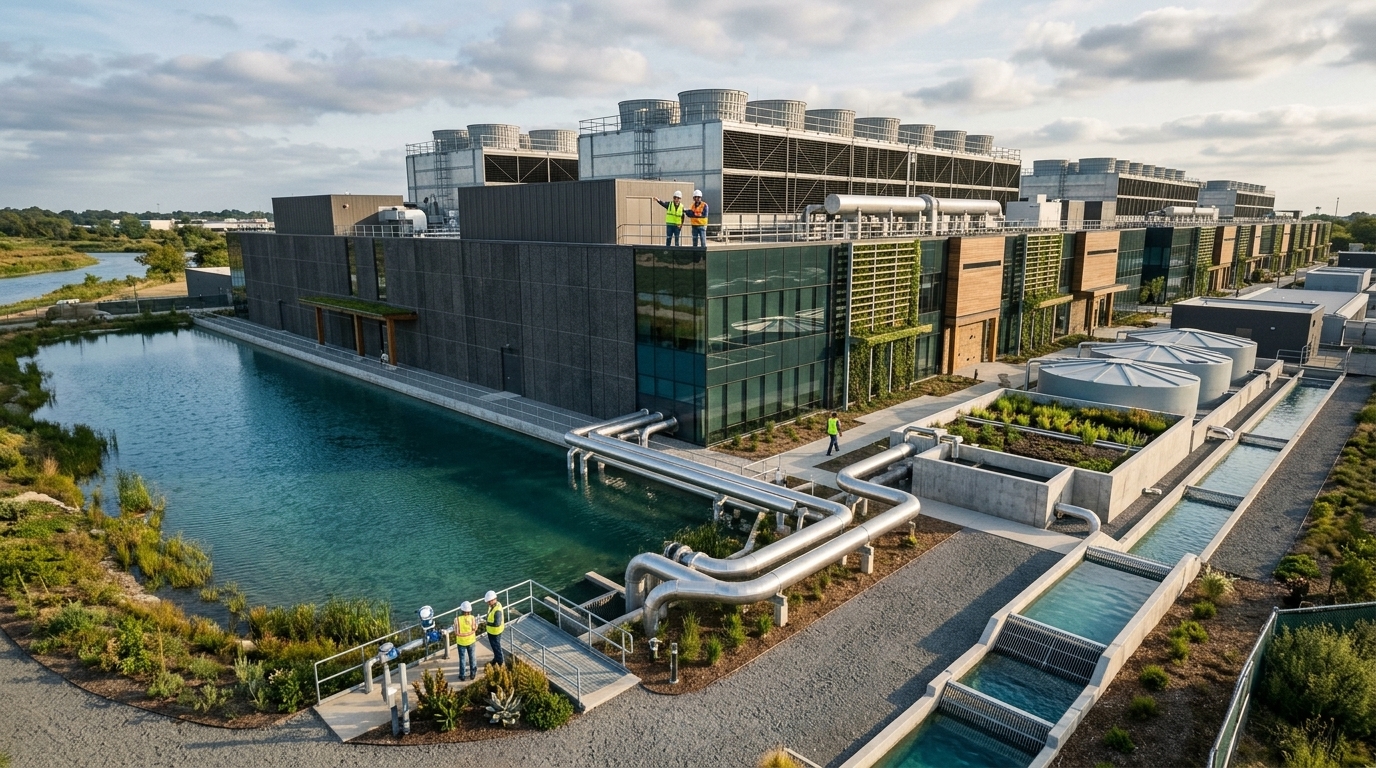
The meteoric rise of generative artificial intelligence (AI) has brought with it an insatiable hunger for resources. While much of the public discourse focuses on electricity and carbon footprints, a more visceral crisis is brewing: AI’s massive water consumption. As Google’s TPUs and NVIDIA’s GPUs crunch numbers to power models like Gemini, they generate immense heat. To dissipate this heat, data centers rely on cooling systems that swallow millions of gallons of water daily. In an era of increasing droughts, Google is now attempting to pivot from being part of the problem to presenting itself as the solution.
The Invisible Thirst of the Cloud
Data centers are the physical backbone of the internet, but their environmental cost is often hidden from the end-user. Most facilities use evaporative cooling—a process where water is evaporated to cool the air surrounding the servers. While this is more energy-efficient than traditional air conditioning, it is incredibly water-intensive. Research suggests that a single conversation with an AI model can consume the equivalent of a 500ml bottle of water. For a company at Google’s scale, this adds up to billions of gallons annually.
In 2022 alone, Google’s total water consumption rose by 20%, a figure that has likely trended upward as the AI arms race intensified. This has led to friction in states like Arizona and Oregon, where local residents are increasingly wary of tech giants tapping into shared, and often dwindling, water supplies.
Google’s Five Pillars of Water Stewardship
In a new policy push, Google has outlined five commitments designed to mitigate its impact and improve its standing with local communities:
- Climate-Conscious Cooling: Google aims to shift its cooling strategy based on local water stress. In areas where water is scarce, it will prioritize air cooling, even if it requires more electricity, to preserve local aquifers.
- Utilizing Non-Potable Sources: The company is committing to using recycled water, industrial water, or seawater where possible, ensuring that high-quality drinking water is reserved for people, not servers.
- Water Positive Goal: Google has reaffirmed its target to replenish 120% of the water it consumes by 2030. This involves funding projects that restore watersheds and improve water quality in the basins where it operates.
- Transparency and Reporting: Moving forward, Google promises more granular, site-specific data on water usage, moving away from aggregated global figures that can obscure local impacts.
- Technological Innovation: The company is investing in next-generation cooling technologies, such as direct-to-chip liquid cooling, which can drastically reduce the volume of water needed for thermal management.
"Our goal is to ensure that our presence supports, rather than strains, the ecosystems and communities we call home," the company stated in its latest environmental update.
Critical Analysis: Progress or 'Water-Washing'?
While these commitments sound promising, environmental advocates remain cautious. The concept of being "Water Positive" is frequently criticized for its lack of geographical precision. If a company consumes water in a high-stress basin but replenishes it in a different, healthier watershed, the local ecosystem still suffers a net loss. Critics argue that "offsets" for water are not as fungible as carbon credits.
Furthermore, the infrastructure required to use non-potable water—such as purple pipe systems for recycled water—is often non-existent in many municipalities. This places a burden on local governments to build the very infrastructure that allows tech companies to claim they are being sustainable. There is also the trade-off between water and energy: air cooling is less water-intensive but more energy-hungry, potentially increasing the carbon footprint if the grid isn't fully green.
The Road Ahead: Regulation and Responsibility
Google’s move is likely a strategic response to impending regulations. In Europe, the Energy Efficiency Directive is already beginning to demand more transparency regarding data center resource use. In the US, local zoning boards are becoming battlegrounds for new data center permits. By setting these standards now, Google hopes to define the narrative before regulators do it for them.
Ultimately, the sustainability of AI will depend on whether these commitments translate into measurable local improvements. As AI becomes more integrated into every facet of human life, the physical resources it requires must be managed with a level of precision that matches the complexity of the algorithms themselves. The era of unlimited, invisible resource consumption is coming to an end; the era of accountability has begun.