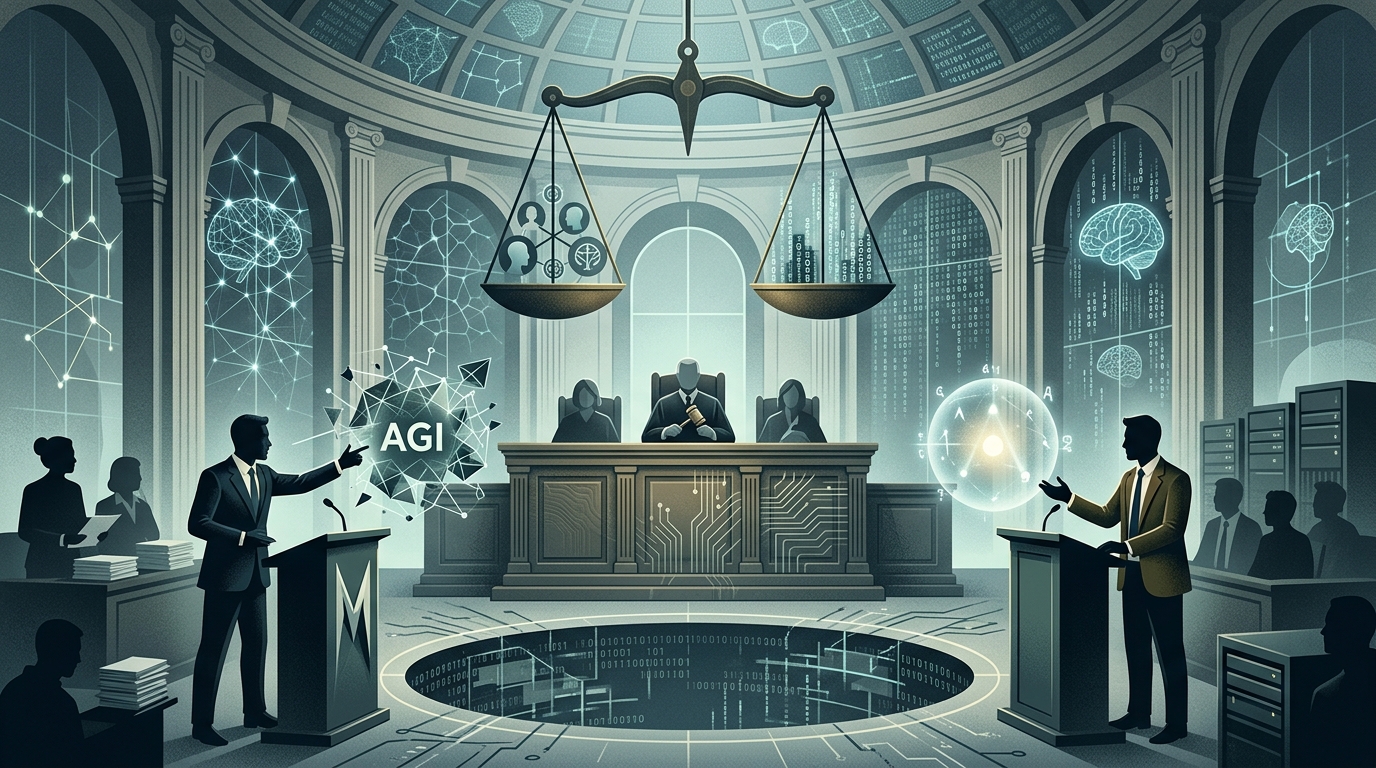
The courtroom in San Francisco has become the stage for a historic confrontation that transcends the boundaries of a simple corporate dispute. On one side, Elon Musk, the billionaire who helped found OpenAI with the promise of a non-profit future. On the other, Sam Altman, the man who transformed OpenAI into a global titan with the backing of Microsoft. At the heart of the trial are not just contracts and signatures, but the very fate of Artificial General Intelligence (AGI) and whether it will belong to humanity or to shareholders.
The 'Betrayal' of the Founding Vision
Musk contends that OpenAI has mutated into a "de facto subsidiary" of Microsoft, abandoning its original mission to develop AI for the benefit of humanity, free from the constraints of profit. In his lawsuit, Musk cites a "Founding Agreement" which, although not a single signed document, emerges from the correspondence and public commitments of the founders in 2015. The allegation is clear: OpenAI "closed" its code, not for safety reasons, but to maximize Microsoft's profits.
OpenAI's defense, however, is striking back with sharp rhetoric. Altman's lawyers argue that Musk is attempting to leverage the judicial system due to his own failure to dominate the AI space through xAI. Furthermore, they emphasize that developing AGI requires billions in capital that only a for-profit structure could secure. This conflict highlights the fundamental paradox of modern technology: can a revolution of this magnitude remain "open" when the cost of compute power is prohibitive for anyone outside Big Tech?
Can Justice Be Impartial?
The question looming over the courtroom is whether a traditional court can adjudicate matters touching the bleeding edge of science. The concept of "Artificial General Intelligence" (AGI) is legally nebulous. Microsoft holds rights to OpenAI's technology up to the point it is deemed AGI. But who defines that point? A judge, a jury, or the company itself? The complexity of the issue makes impartiality a difficult exercise, as technical nuances are often overshadowed by rhetoric regarding "existential risk" or "national security."
- The difficulty of interpreting informal agreements in the Silicon Valley ecosystem.
- Pressure from public opinion and global economic interests.
- The risk of creating a legal precedent that could stifle innovation.
Moreover, the political dimension cannot be ignored. Musk, with his vast influence on social media and close ties to political circles, has the power to shape the narrative long before the hearing begins. OpenAI, on the other hand, possesses an army of lobbyists in Washington and Brussels. In such an environment, judicial independence is tested by the twin pressures of power and capital.
Implications for the AI Ecosystem
Regardless of the outcome, this trial has already shifted the landscape. The era of "romantic" AI, where researchers freely shared their findings, seems to be ending for good. If Musk prevails, OpenAI might be forced to open-source its models, which could cause a market earthquake and jeopardize its partnership with Microsoft. If Altman wins, it will solidify the model of "closed" and commercially controlled AI as the only viable path forward.
"This isn't a fight about money; it's about who holds the keys to the intelligence of the future," industry analysts note.
Ultimately, the Musk vs. Altman trial is a mirror of our own anxieties regarding technology. Do we want an AI controlled by a select few, or an AI that is accessible to everyone? The answer may never be fully delivered in a courtroom, but the consequences of the decision will resonate for decades to come.