The history of Disney is a narrative of constant oscillation between unparalleled creativity and corporate stagnation. From the golden ages of Walt Disney to the 1990s Renaissance, the entertainment giant has always found ways to redefine the fantastic. However, a recent report from Digital Camera World sounds a clarion call: the integration of Generative AI into Marvel and Disney productions is not merely a technological tool, but the harbinger of a new ‘Dark Age.’
The Illusion of Progress and the Displacement of Artists
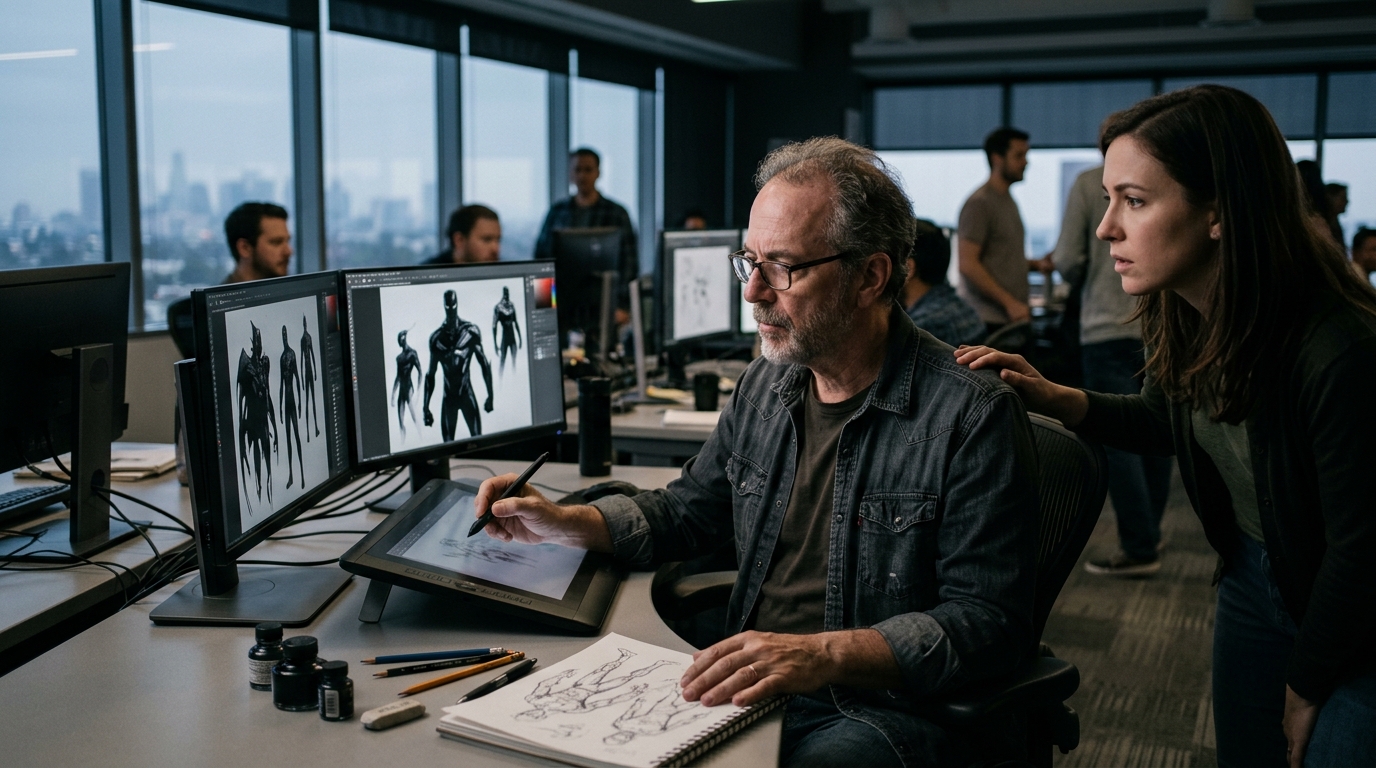
For decades, Marvel has been the breeding ground for the world's most talented illustrators and storyboard artists. Today, these professionals face an existential threat. The use of AI to generate the opening credits for the series 'Secret Invasion' was just the tip of the iceberg. While the company maintained that the use of AI was a "creative choice" to reflect the shape-shifting nature of the Skrulls, the artistic community perceived it as a direct assault on their livelihoods.
The problem lies not just in the final image, but in the process itself. When a corporation of Disney’s magnitude chooses to automate creative stages, it sends a message to the entire industry: the human touch is expendable if costs can be trimmed. Marvel artists, once considered the "untouchables" of the industry due to their specialized skills, are now seeing algorithms trained on their own portfolios, essentially harvesting their personal style to produce content at the click of a button.
The Economic Logic Behind Artistic Compromise
Why is Disney risking its brand integrity? The answer lies in the balance sheets. With Disney+ expenditures squeezing profit margins and 'superhero fatigue' impacting box office revenues, management is desperately seeking ways to lower production costs. A Marvel film costs an average of $200-300 million, with a massive portion of that budget allocated to visual effects (VFX) and post-production.
AI promises to slash these timelines and costs. However, this approach ignores a fundamental truth: Disney’s value is built on emotional resonance with the audience. As many analysts point out, Disney’s previous 'Dark Age' (the post-Walt period from the late '60s to the mid-'80s) was characterized by a lack of vision and repetitive output. Today’s reliance on AI risks a similar period where films feel like laboratory "products," devoid of the soul and the imperfection that makes art humanly relatable.
"Artificial Intelligence does not create; it reassembles. And in reassembly, originality dies."
The Uncanny Valley and Audience Backlash
One of the greatest risks Disney is taking is the alienation of its own fanbase. AI aesthetics often fall into the 'Uncanny Valley,' where images look almost human but evoke revulsion due to subtle, eerie errors. In the case of Marvel, where fans scrutinize every frame for Easter eggs and detail, the use of AI is immediately noticeable and often ridiculed on social media platforms.
Furthermore, there is the ethical quagmire of training these models. Using artworks without the creators' consent to train models like Midjourney or DALL-E has triggered a wave of lawsuits. Disney, as a holder of vast intellectual property, finds itself in a paradoxical position: on one hand, it ferociously protects its own copyrights, while on the other, it appears to embrace a technology built on the infringement of independent creators' rights.
The Resistance of Creators and the Road Ahead
The pushback is coming not just from the audience, but from within the studios. Recent strikes by writers and actors in Hollywood placed AI at the center of negotiations. Artists are demanding guarantees that technology will be used as an aid, not a replacement. However, the pressure from shareholders for maximum efficiency remains potent.
If Disney continues down this path, the 'Dark Age' predicted by Digital Camera World may not just concern aesthetics, but the very viability of the creative ecosystem. Without young artists apprenticing under masters, the chain of creative knowledge breaks. AI can produce thousands of images per second, but it cannot inspire the next generation to pick up a pencil. In a world saturated with perfect, algorithmically generated idols, the need for the authentic, the flawed, and the human will soon become the new luxury.