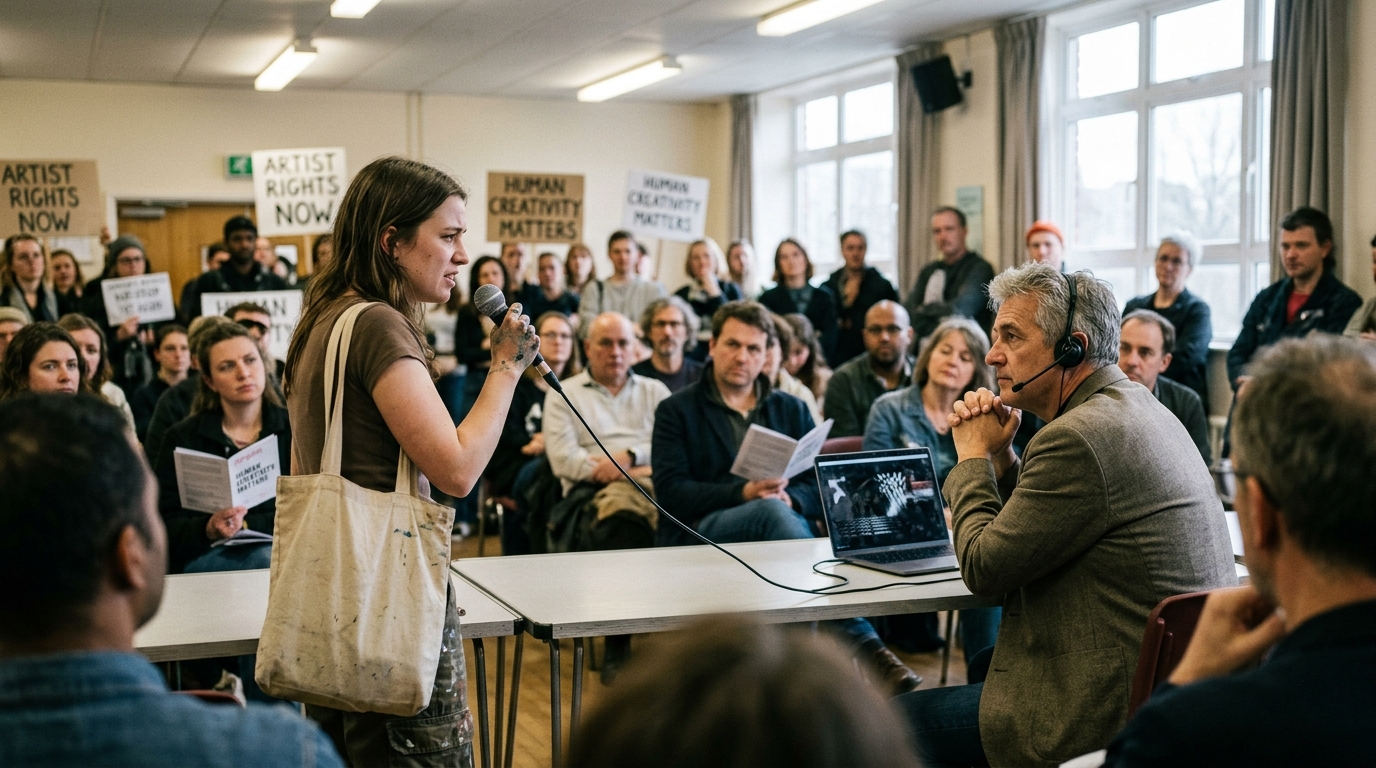
As of June 15, 2026, the global artistic community finds itself at a defining crossroads. What began three years ago as a fascinating technological novelty has transformed into an existential struggle for creators worldwide. Digital art, once considered the pinnacle of modern expression, now faces an algorithm capable of churning out thousands of images per second—often by 'borrowing' the style, technique, and soul of the very humans who unwittingly trained these models.
The Ethics of Data and the Enclosure of Inspiration
The primary friction point remains the source of training data. Large language models and image generators have been fed billions of artworks without the explicit consent of their creators. In markets ranging from Southeast Asia to Europe, artists speak of a 'digital enclosure of the commons,' where public access to art was surreptitiously converted into private profit for tech conglomerates. The ethical dimension extends beyond mere copyright; it touches the very definition of creativity: Can a machine truly 'create,' or is it simply rearranging pixels based on statistical probabilities?
"We don't fear the technology; we fear the dehumanization of the process and the total devaluation of our labor by markets that prefer 'free and good enough' over 'laborious and exceptional'," states a prominent digital illustrator.
The Resistance: From Glaze to Nightshade
Artists are not remaining passive observers. A new wave of 'technological resistance' has emerged. Tools such as Glaze and Nightshade, developed by researchers at the University of Chicago, allow creators to 'poison' their data. By adding invisible alterations to pixels, they make the work appear normal to the human eye while causing AI algorithms to hallucinate, destroying the model's ability to correctly identify objects. This form of digital guerrilla warfare is a direct response to the lack of a legal framework effectively protecting intellectual property in the age of AI.
- Identity Protection: Artists are increasingly using robust watermarking that is impossible to remove without degrading the image.
- Gated Communities: There is a noticeable migration from public platforms like Instagram to closed, subscription-based communities.
- Legal Challenges: Class-action lawsuits against AI giants are progressing, aiming to set precedents for 'fair use' in the generative era.
Re-evaluating the 'Human Error'
Paradoxically, the flood of perfect, smooth, and often repetitive AI art has birthed a new market for the imperfect. Collectors and art enthusiasts are beginning to seek the 'human trace'—the brushstroke that isn't quite perfect, the slightly trembling line, the choice made not by statistics but by raw emotion. In major art hubs, galleries report a surge in interest for works accompanied by 'proof of creation'—documentation that tracks every stage of the manual process. Digital art is returning to its roots, where the process holds as much value as the final output.
Global Perspectives and Aesthetic Sovereignty
Recent reports from emerging markets like Vietnam highlight a different facet: how developing economies use AI to bridge the gap with the West while simultaneously fighting to preserve local cultural heritage. There is a looming risk that AI will homogenize global aesthetics, imposing a Western-centric style that dominates training datasets. The resistance of artists is, therefore, also a fight for cultural diversity. If art becomes a global algorithmic average, we lose the ability to see the world through diverse lenses.
In conclusion, the relationship between digital art and artificial intelligence need not be a zero-sum game. It could lead to a new Renaissance where AI serves as the 'brush' rather than the 'painter.' However, for this to materialize, the power balance must be restored: the human must remain at the apex of the creative pyramid, with technology serving the vision rather than replacing it.