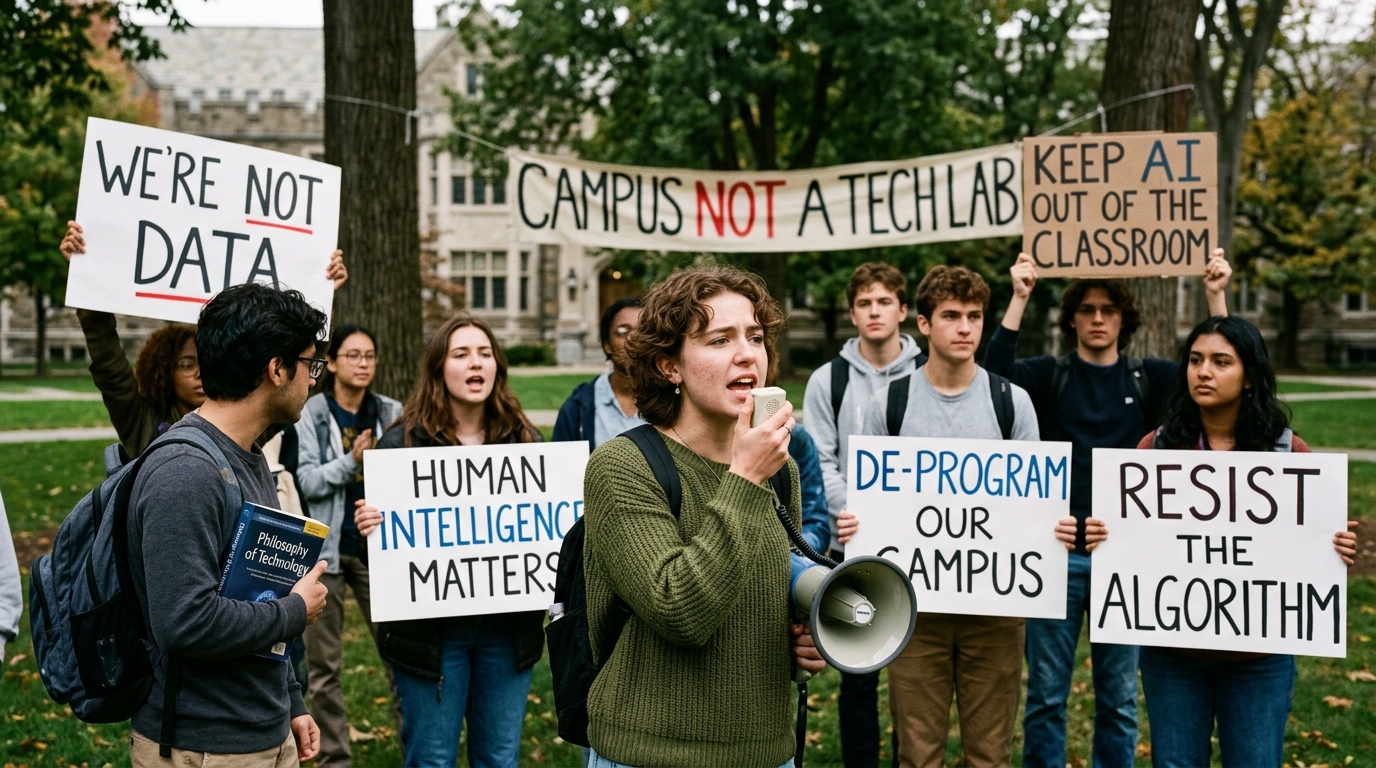
May 2026. In the lecture halls of the world’s leading universities, from Stanford to Oxford, the atmosphere has shifted radically. If 2023 was the year of excitement over ChatGPT and 2024 the year of awkward adjustment, 2026 is being recorded as the year of the Great Student Revolt. According to a recent Bloomberg Tech report, students are no longer the passive users of AI tools that tech giants hoped to cultivate. Instead, they are organizing protests, signing petitions, and using performance art to express a deep existential concern: that their education is being transformed into a soulless exchange of data between algorithms.
The Devaluation of the Degree and 'Automated' Learning
The primary source of student ire stems from the feeling that the value of their degree is being decimated. When professors use AI to grade assignments and students use AI to write them, the educational contract collapses. "I am paying tens of thousands of dollars a year to be taught by a human, not to feed my assignments into a model that spits out standardized answers," says a student in London. The resistance is not about the technology itself, but about the substitution of human judgment.
Students report that the excessive use of AI in curricula leads to a "homogenization of thought." Critical analysis is being replaced by prompt engineering, and the joy of discovery by the speed of production. This has led to an unexpected turn: the demand for "Analog Zones" within universities, where the use of any AI is strictly prohibited, allowing students to communicate and create without digital mediation.
The Specter of Unemployment and the Identity Crisis
Beyond the quality of education, the protest has deep economic roots. Today's students see AI not as an assistant, but as a competitor threatening to eliminate junior-level jobs before they even graduate. Fields like computer science, law, and creative writing are taking the hardest hits. There is a growing sense that universities are preparing them for a world that will no longer need them.
- Performance Art Protests: At Yale, students held a "funeral for creativity," symbolically burying keyboards and AI-generated printouts.
- 'Human-Only' Petitions: Over 50 student unions in the US have called for the certification of courses as "AI-Free," guaranteeing that content and assessment come exclusively from humans.
- EdTech Boycotts: Students are refusing to use platforms that integrate generative AI without their consent, citing intellectual property concerns.
The University's Dilemma
University administrations find themselves in a deadlock. On one hand, they face pressure from the labor market and tech companies to integrate AI to remain "relevant." On the other hand, their primary stakeholders—the students—are demanding the exact opposite. The trend of "Digital Luddism" observed is not a regressive movement but an attempt to redefine human value in an age of total automation.
"We are not against progress. We are against the replacement of human experience with a cheap simulation. If the university cannot protect human thought, then what is its reason for existing?"
Victor Swezey’s report for Bloomberg highlights that this movement is gaining ground primarily through social media, where the hashtag #HumanGrad has become a badge of honor. Students are now seeking the "difficulty" of learning, the friction with texts, and direct contact with professors—elements that AI promises to eliminate in the name of efficiency.
Conclusion: Toward a New Social Contract
The student revolt of 2026 is a loud message to Silicon Valley: technology cannot be imposed on spaces traditionally reserved for intellectual inquiry without serious dialogue. Education is a deeply social and human process. If universities want to survive, they must find the middle ground between technological evolution and the preservation of their humanistic essence. The battle for the "future of learning" has just begun, and this time, the protagonists refuse to follow the script written by algorithms.